
The core Lunar New Year card symbols are blossoms that open at the turn of the season (plum, peach and yellow apricot), golden fruit such as kumquats and mandarins, the fish, and a red-and-gold colour palette. Each one carries a wish for luck, renewal, abundance or long life, and customers who celebrate the festival read those wishes instantly. For a wholesale buyer, knowing which symbol means what is the difference between a seasonal card that sells through and one that feels slightly off.
When is Lunar New Year 2027?
Lunar New Year 2027 falls on Saturday 6 February and opens the Year of the Goat, according to Royal Museums Greenwich. The date moves every year because it follows a lunisolar calendar: the festival begins on the new Moon that starts the first lunar month, so it usually lands between late January and mid-February. The holiday is celebrated as Spring Festival in China, Tết in Vietnam and Seollal in Korea, and by diaspora communities across North America, Europe, Australia and Southeast Asia.
Which blossoms are the key Lunar New Year card symbols?
Flowers are the most flexible motif on a Lunar New Year card, and they suit quilling perfectly because petals can be shaped coil by coil. Three blossoms do most of the work.
Plum blossom: renewal and perseverance
The plum is among the first trees to flower as winter ends, which is why Sotheby’s describes it as a symbol of renewal and perseverance in Chinese art. Together with pine and bamboo it forms the “Three Friends of Winter”, a group that stands for endurance in hard times. A spray of pink or white plum blossom on a bare branch is an elegant, widely understood choice for Chinese-speaking customers.
Peach blossom: growth and long life in northern Vietnam
In northern Vietnam, pink peach blossom (hoa đào) is the flower of Tết. VietnamNet describes it as a symbol of renewal and strong growth, while the peach fruit stands for longevity. A peach branch in the home is meant to bring health, wealth and joy in the year ahead.
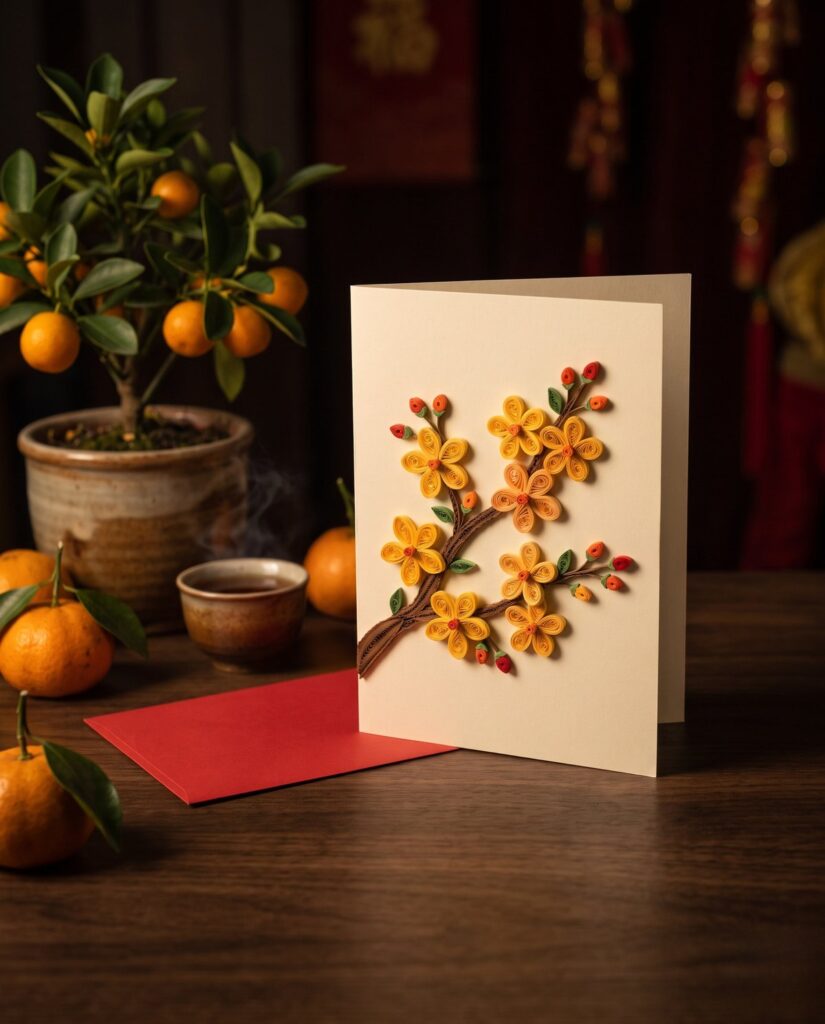
Yellow apricot blossom: wealth and hope in southern Vietnam
Southern Vietnamese families choose the yellow apricot blossom (hoa mai) instead, and its yellow colour stands for wealth and hope. Families hope the buds open on the first morning of the new year, and blossoms with extra petals are considered especially lucky. If your customers are Vietnamese diaspora shoppers, offering both a pink peach design and a yellow mai design lets northern and southern families each find “their” Tết card.
What do kumquats, mandarins and fish mean on Lunar New Year cards?
Fruit and animal motifs work through wordplay and appearance. A kumquat tree heavy with fruit symbolises prosperity and abundance, and VTV notes that each fruit is thought to bring the household luck, so a fuller tree is more auspicious. Mandarin oranges suggest great fortune, and the fish, whose name sounds like the word for “surplus” in Chinese, carries the blessing of abundance year after year (Sotheby’s).
Why are red and gold the Lunar New Year card colours?
Red is the colour of luck and celebration across the festival. Sotheby’s links it to fire, the sun, vitality and joy, and Vietnam’s national tourism site notes that red signifies good luck at Tết, from red sticky rice to the lucky-money envelopes children receive on the first day. Gold or yellow is the natural partner, adding a sense of richness. In quilling, a deep red card base with gold and orange coils gives strong shelf impact without any printed text.
Lunar New Year card symbols at a glance
| Symbol | Strongest with | Traditional meaning | How it works in quilling |
|---|---|---|---|
| Plum blossom | Chinese-speaking customers | Renewal, perseverance | Small five-petal coils on a fine dark branch |
| Peach blossom (hoa đào) | Northern Vietnamese families | Growth, longevity, health | Pink teardrop petals in layered clusters |
| Yellow apricot (hoa mai) | Southern Vietnamese families | Wealth, hope | Golden petals with tight orange centres |
| Kumquat tree | Vietnamese and Chinese customers | Prosperity, abundance | Tight round orange coils among green leaf shapes |
| Mandarin orange | Chinese-speaking customers | Great fortune | Larger domed coils, often in pairs |
| Fish | Chinese-speaking customers | Surplus year after year | Scale pattern built from loose coils |
| Red and gold palette | All Lunar New Year customers | Luck, joy, richness | Red card base, gold and orange accent strips |
How should buyers choose symbols for a Lunar New Year card range?
Start with who actually buys from you. A shop near a large Vietnamese community will sell more mai and peach designs, while a store serving Chinese, Singaporean or Malaysian customers will lean towards plum blossom, mandarins and fish. A mixed or general audience usually responds best to blossoms and red-and-gold colour, which read as festive even to shoppers who don’t celebrate.
Next, decide how much of the range should be dated. A Year of the Goat design is timely for 2027 only, so many buyers keep the zodiac animal to one or two designs and build the rest around evergreen blossoms and fruit that can be reordered next year. Leaving the inside blank, or printing a short greeting in the languages your customers use, keeps the card flexible across communities. Our partner workshops can quill custom designs to your brief, add your logo and pack the cards in private-label packaging; see our handmade greeting cards for the range. For the wider story behind floral motifs, read our guide to flower meanings on greeting cards, and for gifting customs in other markets see greeting card traditions around the world.
Finally, plan early. Seasonal quilled cards go through design approval, sampling and a four-step quality check before packing, so it pays to brief Lunar New Year artwork well before the autumn rush of Christmas orders.
Frequently Asked Questions
What is the most popular flower on Lunar New Year cards?
It depends on the community. Plum blossom is the classic choice in Chinese tradition, while Vietnamese customers expect pink peach blossom in the north and yellow apricot blossom in the south. A range that includes more than one blossom covers the widest audience.
Should a Lunar New Year card show the zodiac animal?
A zodiac design, such as the Goat for 2027, is timely and popular, but it only sells for one season. Many buyers keep one or two zodiac cards and build the rest of the range on evergreen symbols that can be reordered every year.
Are there colours to avoid on Lunar New Year cards?
Red, gold, yellow and orange are the safe, festive core. Cards built mainly on white, black or cool tones tend to read as less festive, so use them as accents and let warm colours lead. If you are unsure, ask a few customers from the community you serve before you approve the samples.
Can quilled Lunar New Year cards be customised with our brand?
Yes. Designs can be created to your own brief, your logo can be printed or attached, and the cards can be packed in private-label packaging. Share your artwork or references when you request a quote and we will reply within one business day.
Plan your Lunar New Year card range
Symbols chosen with care make a seasonal card feel genuine to the people who celebrate. If you would like handmade quilled designs built around plum, peach, mai or kumquat motifs for your market, send us your brief through our Request a Quote page and we will come back to you within one business day, with full export documents (commercial invoice, packing list and CO) included.