
A buyer who negotiates four per cent off the unit price and then loses seven per cent of that gain to wasted air inside the container has not saved anything. On wooden kitchenware and compostable tableware this happens more often than in almost any other sourcing category, because both product families are bulky in relation to their value. A container of acacia serving boards or bagasse plates is expensive to move per dollar of goods, and the freight line on the landed cost sheet is large enough that it deserves the same scrutiny as the factory quotation.
Most buyers treat container loading as something that happens after the commercial work is finished. It is not. Cube efficiency is decided months earlier, when the carton dimensions are approved, when the nesting of a bowl set is specified, when someone chooses palletised loading over floor loading, and when the port of departure is written into the quotation. By the time a booking is confirmed, the cost per piece is already fixed. This guide sets out how that number is built, where it leaks, and what a buyer of wooden kitchenware, wooden houseware and compostable or disposable tableware can control.
Freight Is a Product Decision Before It Is a Logistics Decision
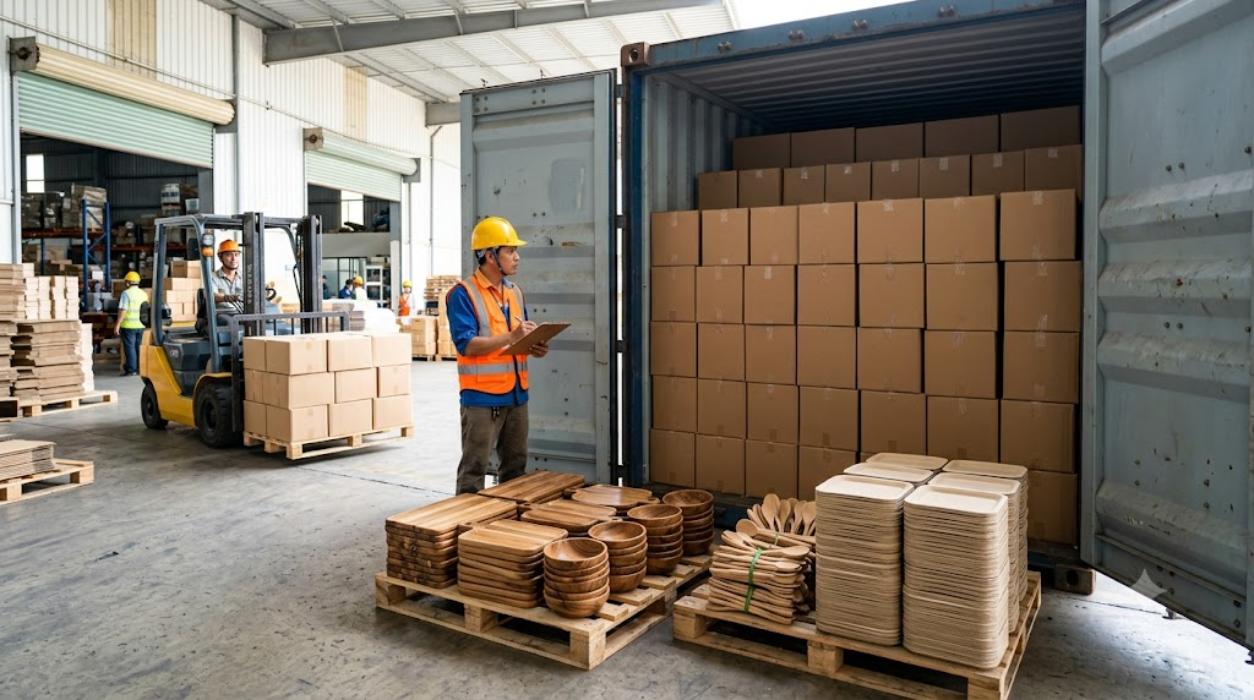
Ocean freight is quoted per container, not per piece. That single fact reframes the whole exercise. If a forty-foot high cube costs the same to move whether it carries 9,000 wooden spoons or 13,000, then the difference between those two numbers is pure margin, and it was created in the packaging specification rather than in the freight negotiation.
Two products with an identical ex-works price can land at meaningfully different costs because one nests and the other does not, or because one uses a carton that leaves three centimetres of void on every face. Over a full container, three centimetres of void per carton compounds into several cubic metres of paid air. Buyers who review carton drawings with the same attention they give to a price list routinely recover between five and twelve per cent of their freight cost without touching the factory price.
This is why the packaging conversation and the freight conversation should happen together, not in sequence. A factory optimising for line speed will choose the carton that is easiest to pack. A factory optimising for your landed cost will choose the carton that fits the container.
CBM Per Carton: The Number That Decides Everything
Cubic metres, written CBM, is the working currency of ocean freight. The calculation is elementary and every buyer should be able to do it from the packing list without assistance.
CBM per carton = (length in cm x width in cm x height in cm) divided by 1,000,000.
A carton measuring 60 x 40 x 35 cm is 84,000 cubic centimetres, or 0.084 CBM. If that carton holds 24 acacia serving boards, the cube per piece is 0.0035 CBM. If a forty-foot high cube realistically absorbs 62 CBM of cartons, the container holds roughly 738 cartons, or about 17,700 boards. Divide the all-in freight and origin charges by that piece count and you have the freight component of your landed cost per board. That figure, not the container rate, is what you should be comparing between suppliers and between packaging options.
Ask every supplier for outer carton dimensions, gross weight per carton, net weight per carton and pieces per carton on the quotation itself, not later. Two quotations that look identical on price frequently diverge by ten per cent or more once the cube per piece is calculated, and the cheaper unit price is not always the cheaper delivered piece.
One caution: measure the carton as it will actually ship, not as drawn. Cartons bulge. A carton specified at 35 cm high that is overfilled and taped under tension can present at 37 or 38 cm, which is enough to lose a whole tier in the container. Ask for the measurement of a packed sample carton, and have it confirmed at the pre-shipment inspection.
What Actually Fits Into a 20ft, 40ft and 40ft High Cube
Nominal container volume and usable container volume are different numbers, and quotations that assume the first will disappoint. Internal dimensions vary slightly by manufacturer and age of the box, but the working figures below are reliable for planning.
20ft standard: internal roughly 5.90 x 2.35 x 2.39 m, nominal volume about 33 CBM, realistic loaded volume 25 to 28 CBM, maximum payload commonly 21 to 28 tonnes depending on the box and the road limits at destination.
40ft standard: internal roughly 12.03 x 2.35 x 2.39 m, nominal volume about 67 CBM, realistic loaded volume 54 to 58 CBM, payload similar to the 20ft in tonnage terms.
40ft high cube: internal roughly 12.03 x 2.35 x 2.69 m, nominal volume about 76 CBM, realistic loaded volume 60 to 68 CBM. For light, bulky cargo this is almost always the correct choice, since the additional 30 cm of height is charged at a small premium over a standard forty and delivers roughly twelve per cent more usable volume.
The gap between nominal and realistic is not waste in the pejorative sense. It is the door recess, the taper of the corner posts, the tolerance needed to build stable tiers, and the space a loading crew needs to work. A supplier who promises 72 CBM in a high cube is either using inner-dimension arithmetic that ignores reality or is planning to load in a way that will produce crush damage.
For wooden houseware and compostable tableware the practical rule is straightforward: unless your cargo is unusually dense, specify the 40ft high cube and compare the rate per CBM rather than the rate per container.
LCL, FCL and the Break-Even Nobody Calculates
Less than container load shipping is charged on a weight or measurement basis, meaning the carrier bills whichever is greater: the cubic metres or the tonnes. For wooden kitchenware and compostable tableware the measurement side almost always governs, so LCL effectively becomes a per-CBM charge.
The trap is that the LCL ocean rate is only part of the bill. Consolidation at origin, container freight station handling at destination, delivery order fees, documentation fees and destination terminal charges are levied per shipment or per CBM and are frequently larger than the ocean leg itself. A buyer who compares an LCL ocean rate against an FCL container rate without adding destination charges to the LCL side will reach the wrong conclusion.
As a planning figure, the break-even between LCL and a full 20ft on Vietnam trades tends to sit somewhere between twelve and fifteen CBM, and the break-even against a 40ft high cube is reached well before the container is full. In practice, once a shipment exceeds roughly fifteen CBM it is worth asking a forwarder to price both structures side by side, all-in to your door, and to show the destination charges line by line.
There are non-price reasons to prefer FCL as well. A full container is sealed at the factory and opened at your warehouse, which reduces handling damage, reduces pilferage exposure, and keeps your goods out of a shared warehouse where a wet or contaminated co-load can affect them. For food-contact goods and for compostable tableware in particular, that isolation has real value.
Where volumes genuinely do not justify a container, the sensible intermediate step is to consolidate several product families with one Vietnamese supplier into a single FCL rather than running three separate LCL shipments from three suppliers. Mixed loads are discussed further below.
Why Compostable Tableware Cubes Out Long Before It Weighs Out
Containers fill in one of two ways. Cargo either cubes out, meaning the volume is exhausted while the payload allowance remains largely unused, or it weighs out, meaning the tonnage limit is reached with space to spare. Knowing which applies to your cargo changes how you optimise.
Bagasse plates, areca palm leaf plates, wooden cutlery, paper straws and moulded fibre bowls are extremely light for their bulk. A forty-foot high cube loaded to the roof with bagasse tableware will commonly weigh somewhere in the region of six to eleven tonnes, against a payload allowance of well over twenty. That cargo cubes out decisively, and every optimisation should therefore target volume: tighter nesting, shorter stacks per sleeve, thinner inner packaging, and carton dimensions chosen to tile the container floor without gaps.
Solid wooden kitchenware behaves differently. Acacia and rubberwood chopping boards, thick serving platters and heavy mortars are dense enough that a container can approach its weight limit, especially in a 20ft. If your load is boards and blocks rather than spoons and bowls, run the weight calculation before assuming you can fill the box. A 20ft that reaches its payload at 22 CBM is not a failure of loading; it is a cargo that should probably have been split across a larger container or paired with lighter goods.
Mixed loads exploit exactly this asymmetry. Pairing dense wooden boards with light compostable tableware in one container lets each compensate for the other, and is one of the few genuinely free improvements available in this category.
Nesting, Knock-Down and Carton Design That Pays for Itself
Most of the recoverable cube in this category sits inside the carton rather than inside the container. The questions worth asking a Vietnamese factory are specific.
Do the items nest, and how tightly? Wooden salad bowls, moulded fibre plates and areca plates all nest, but the pitch of the nest depends on wall thickness and on whether a separator is inserted. A thin glassine or paper interleaf protects the finish while adding almost nothing to the stack height; a foam separator protects slightly better and can add twenty per cent to the cube. That trade-off should be a conscious decision, not a factory default.
Can any component ship knocked down? Tiered serving stands, wooden trays with handles, utensil holders with removable dividers and cutting boards with feet can often ship flat with a simple assembly step, which is a decision for the buyer to weigh against retail presentation.
Is the carton right-sized? Factories tend to keep a small number of standard cartons in stock because it simplifies purchasing. A dedicated carton size, ordered in the same quantity, costs marginally more per unit but can eliminate several centimetres of void on two axes. Ask for the void percentage; anything above roughly eight per cent invites a redesign.
Does the carton footprint tile the container? A carton with a 60 x 40 cm footprint tiles a 235 cm container width almost perfectly at three across on the long side plus one turned, or with minimal loss. A 55 x 38 cm carton chosen for no particular reason may leave a fifteen-centimetre channel of dead air down the full twelve metres of the box. Container-aware carton sizing is one of the highest-return conversations a buyer can have with a factory, and it costs nothing to ask.
None of this should compromise protection. Cube gains that arrive with a rise in transit damage are not gains. The right sequence is to fix the protection standard first, then remove volume that does not contribute to it. Our guidance on export packaging and retail-ready presentation covers the protection side in detail.
Pallets or Floor-Loaded: The Vietnam Trade-Off
Palletised loading is faster to discharge, safer for warehouse staff and mandatory at many European and Gulf distribution centres. It is also expensive in cube terms. A standard pallet consumes roughly fifteen centimetres of height before a single carton is placed on it, and the pallet footprint rarely tiles a container as efficiently as loose cartons. Depending on carton size, palletising a container of wooden kitchenware typically costs between ten and eighteen per cent of usable volume.
Floor loading recovers that volume. Vietnamese labour costs make hand-stuffing economical at origin in a way that is no longer true in many destination markets, which is why Vietnamese factories quote floor loading as the default. The cost lands at your end instead, as slower discharge and more manual handling.
The decision should be made on total cost, not on either leg alone. If your receiving warehouse charges by the hour to devan a container, the freight saved by floor loading can be consumed at destination. If you operate your own facility with available labour, floor loading is usually the better economics. Many buyers land on a hybrid: floor-loaded to the door line, with the last tier palletised for a stable, quick opening.
If you do palletise, remember that wooden pallets are regulated wood packaging material and must be heat treated and marked under ISPM-15, with the treatment mark legible and photographed before the doors close. Plastic and pressed-wood pallets fall outside the ISPM-15 requirement and are worth considering where the destination is strict. This sits alongside the wider paperwork set covered in our guide to export documentation and certificates of origin.
Ports, Routing and Transit Times From Vietnam
Vietnam is a long country and the port your goods leave from is determined largely by where the factory sits. Wooden kitchenware and houseware production clusters around Binh Duong, Dong Nai and Ho Chi Minh City in the south, and around Bac Ninh, Hai Duong and the Red River Delta in the north. Compostable and disposable tableware production is spread across both regions, with sugarcane bagasse capacity concentrated where the mills are.
Cat Lai, Ho Chi Minh City handles the largest share of southern container volume and is closest to the southern furniture and woodware belt, but it is congested and truck turnaround can be slow at peak.
Cai Mep, Ba Ria-Vung Tau is the deep-water gateway serving the south and takes direct long-haul services on the Europe and North America strings. For long-haul destinations, routing through Cai Mep can remove a transhipment leg and several days of transit, at the cost of a longer inland trucking run from the factory.
Hai Phong serves northern Vietnam and is the natural gateway for northern factories, with strong intra-Asia frequency and growing deep-water capacity at Lach Huyen.
Da Nang serves the centre and is useful for central Vietnam handicraft and woodware suppliers, though service frequency is thinner than at the two main gateways.
Indicative port-to-port transit times from southern Vietnam, subject to service and season, run in the region of four to seven days to Singapore and Port Klang, seven to twelve days to Busan and northern China, twelve to eighteen days to Nhava Sheva, sixteen to twenty-four days to Jebel Ali and the wider Gulf, twenty to thirty days to Jeddah, and twenty-eight to thirty-eight days to North European base ports. Transhipment adds time and adds a handling event at which damage can occur; ask whether a service is direct before you commit to a lead time promise downstream.
Because the port is written into an FOB quotation, always insist that the named port appears. FOB Ho Chi Minh and FOB Cai Mep are not the same commercial offer, and the difference in inland trucking is real money. The mechanics of that are covered in our guide to payment terms and Incoterms.
The Surcharges That Turn a Cheap Rate Into an Expensive One
A quoted ocean rate is rarely the amount that is paid. The following charges appear routinely on Vietnam exports and should be requested in writing before a booking is accepted.
- Terminal handling charges at origin and at destination, quoted separately and both payable by somebody. Confirm which side carries each.
- Bunker and low sulphur adjustments, which move with fuel prices and with emissions regulation.
- Peak season surcharge, which appears on Asia-Europe and transpacific trades in the pre-Christmas window and around Tet.
- Container imbalance or equipment charges, applied when empties are scarce in Vietnam.
- Documentation, seal, telex release and delivery order fees, individually small and collectively not.
- Advance manifest filings such as ENS and ICS2 for Europe, with penalties for late or inaccurate data.
- Demurrage and detention after free time expires, which is where most unplanned freight cost actually arises.
Free time deserves particular attention. Fourteen days of combined free time at destination is a reasonable ask on most trades and is far easier to negotiate at booking than after the container has landed. If your customs broker is slow or your warehouse has no slot, the daily accrual on a detained container will erase the saving from an aggressively negotiated ocean rate within a week.
Ask your forwarder for an all-in quotation to a named place, itemised, with free time stated. Compare like with like. A rate that looks twelve per cent cheaper on the ocean leg and carries three additional destination line items is not cheaper.
Container Condition, Moisture and Why Wood Arrives Cracked or Mouldy
A container crossing from tropical Vietnam to a cold-water European winter, or into a Gulf summer, passes through large swings in temperature. Warm humid air sealed in at loading condenses on the container roof as the box cools and rains back onto the cargo. This phenomenon is well known to anyone who has opened a container of wooden goods and found water stains along the top tier.
Three defences are worth specifying and none is expensive. First, load wood at the correct equilibrium moisture content for the destination rather than at whatever the kiln produced; our guide to moisture content and kiln drying sets out the target ranges for Gulf, European and tropical markets. Second, hang desiccant bags rated for the container volume and voyage length, and record the quantity used on the packing list. Third, use a kraft or non-woven liner across the top tier so that any condensation runs to the walls rather than onto the cartons.
Container condition itself should be inspected before stuffing begins, and the inspection should be photographic. Look along the roof for pinholes by closing the doors and checking for daylight. Check the floor for oil, chemical residue or previous cargo contamination, which matters greatly for food-contact goods. Check the door gaskets. A container that fails any of these tests should be refused and replaced, and a supplier who has been asked in advance for container-condition photographs will refuse it themselves without a conversation.
Compostable tableware has its own sensitivity. Bagasse and moulded fibre absorb moisture readily, and a wet carton in transit can deform an entire stack. Palm leaf plates can develop surface mould if loaded warm and damp. The fix is the same: dry goods, sealed inner packaging, desiccant, and no loading during or immediately after rain with the doors open.
Mixed Loads: Wooden Kitchenware and Compostable Tableware in One Container
Consolidating dense and light goods into a single container is efficient, but it requires discipline in three areas.
Weight distribution. Heavy cartons belong low and spread along the length of the container, not concentrated at one end. A container loaded heavy at the door end can exceed axle limits on the road at destination even when the total gross weight is legal, and can be refused at the terminal gate. Ask for a loading plan that shows the distribution, not merely the total.
Segregation and identification. Different SKUs should occupy identifiable blocks with shipping marks facing the aisle, and the packing list should state carton number ranges by SKU. Devanning a mixed container where 900 identical brown cartons contain eleven different products, in no discernible order, costs hours of warehouse labour that nobody budgeted.
Compatibility. Oiled wooden goods and unwrapped food-contact fibre tableware should not share a tier without a barrier. Mineral oil and beeswax finishes can migrate onto adjacent packaging, and a stain on a retail carton is a rejected unit. Specify polybag or sealed inner cartons for oiled goods travelling in a mixed load.
Photographic loading records close the loop. A short sequence showing the empty container with its number visible, the progressive tiers, the final door-face and the applied seal takes ten minutes and settles almost every subsequent dispute about shortage, damage or sequence. This should be part of the same document set as the pre-shipment inspection report described in our guide to quality control and pre-shipment inspection.
A Container Loading Checklist Before You Confirm the Booking
- Outer carton dimensions, pieces per carton, net and gross weight confirmed from a packed sample, not from a drawing.
- CBM per piece calculated, and the freight component of landed cost per piece compared across suppliers and packaging options.
- Container type chosen on cube and weight, with the 40ft high cube priced per CBM against the standard forty.
- Void percentage inside the carton reviewed, and nesting or knock-down options considered against retail requirements.
- Floor loading versus palletising decided on total cost including destination devanning, with ISPM-15 treatment confirmed if wooden pallets are used.
- Port of loading named in the quotation, and the routing checked for direct service versus transhipment.
- All-in freight quotation obtained in writing, itemised, with origin and destination charges shown separately.
- Free time at destination agreed and stated on the booking, not assumed.
- Desiccant quantity, liner specification and moisture content target written into the purchase order.
- Container condition inspection agreed, with photographs of the empty box, the container number and the door seal.
- Loading plan for mixed cargo showing weight distribution and carton number ranges by SKU.
- Booking placed early enough to avoid peak-season and pre-Tet equipment shortages, as set out in our guide to lead times and capacity planning.
Frequently Asked Questions
How many wooden serving boards fit in a 40ft high cube?
There is no universal answer, because it depends entirely on board size and carton configuration, but the arithmetic is quick. Take the CBM per carton, divide 62 CBM of realistic loaded volume by it to get the carton count, then multiply by pieces per carton. For a medium acacia board packed 24 to a 0.084 CBM carton, that produces roughly 17,000 to 18,000 pieces. Run the same calculation for the weight, since dense hardwood boards can approach the payload limit before the volume is exhausted.
Is LCL worth it for a first order of compostable tableware?
For a genuine trial of a few cubic metres, yes, and it is often the sensible way to validate quality and packaging before committing capital. Ask for the destination charges in writing before you compare it against a container rate, because they are usually the larger half of the LCL bill. Once your requirement passes roughly fifteen CBM, price both options side by side to your door.
Should I ask for palletised or floor-loaded containers from Vietnam?
Decide on total cost. Floor loading recovers roughly ten to eighteen per cent of usable volume and is economical at the Vietnamese end, but transfers labour to your warehouse. If your destination facility charges by the hour to unload, or if your retail customer mandates palletised delivery, palletising may still be cheaper overall. If wooden pallets are used, insist on ISPM-15 heat treatment marks and photographs.
Why did my wooden kitchenware arrive with water stains?
Almost always container rain rather than a leaking box, though both should be checked. Warm humid air loaded in Vietnam condenses on the roof as the container cools in transit and drips onto the top tier. Specify the correct equilibrium moisture content for the destination climate, hang desiccant sized to the container and voyage, and require a liner over the top tier. If the roof was in fact perforated, the pre-loading photographs will show it.
Can I ship wooden houseware and compostable tableware in the same container?
Yes, and it is usually the most efficient structure available, because dense wooden goods and very light fibre tableware balance each other on weight and volume. Require a loading plan showing weight distribution along the container, carton number ranges by SKU on the packing list, and a barrier or sealed inner packaging between oiled wooden goods and unwrapped food-contact tableware.
Related Reading
- Wooden kitchenware FOB price and landed cost: how to build the real number
- Payment terms and Incoterms: T/T, L/C, FOB, CIF and where risk transfers
- Export packaging, barcodes, hangtags and retail-ready presentation
- Export documentation: certificates of origin, ISPM-15 and customs clearance
- Moisture content and cracking: specifying kiln drying by destination climate
- Lead times and peak-season capacity: planning around Tet and Q4
- Compostable tableware certifications: EN 13432, OK compost, BPI and PFAS
Buyers can consult the International Chamber of Commerce for the Incoterms rules that govern who arranges and pays for the voyage, the International Plant Protection Convention for the ISPM-15 standard applying to wooden pallets and dunnage, and the General Department of Vietnam Customs for export clearance procedure.
Where Viet Farm Vision Fits
Viet Farm Vision is a Vietnam-based OEM manufacturer and exporter of wooden kitchenware and houseware, compostable and disposable tableware, agricultural products and handcrafts, supplying wholesale and private-label buyers across the Middle East, Asia and wider international markets.
On loading we quote carton dimensions, pieces per carton and CBM per carton on the offer itself, so buyers can calculate cube per piece before they commit. We review carton footprints against container widths rather than defaulting to whatever is in stock, propose nesting and knock-down options where they do not compromise retail presentation, and will model palletised against floor-loaded volumes for the same order so the decision is made on numbers. Container condition photographs, desiccant quantity, liner specification and a loading sequence record are supplied as standard with every full container.
Buyers planning a first container of wooden kitchenware, wooden houseware or compostable tableware from Vietnam are welcome to send target quantities and destination port for a cube and weight study before pricing is finalised. Enquiries can be sent through the request a quote page at vietfarmvision.com.