
For card retailers, gift shops and corporate buyers in the Gulf, the wider Middle East and South Asia, the biggest card selling windows of the year are not Christmas and Valentine’s Day. They are Ramadan, Eid al-Fitr, Eid al-Adha and Diwali. These are occasions when people send greetings to family, colleagues and clients in large numbers, and when a card that looks handmade and generous carries real weight. Handmade quilling cards, with their raised coils of paper and rich colour, fit these occasions very naturally, but only if the range is designed around the culture of the occasion and ordered early enough to land on shelf before the season starts.
This guide is written for importers, stationery retailers, hotel and corporate gifting buyers and online sellers who want to source a festive quilling card range from Vietnam for the 2027 Ramadan, Eid and Diwali seasons. It covers motifs and colours that sell, how to handle Arabic and Hindi greetings safely, how to plan the order calendar backwards from the occasion, and how to pack cards for festive gifting.
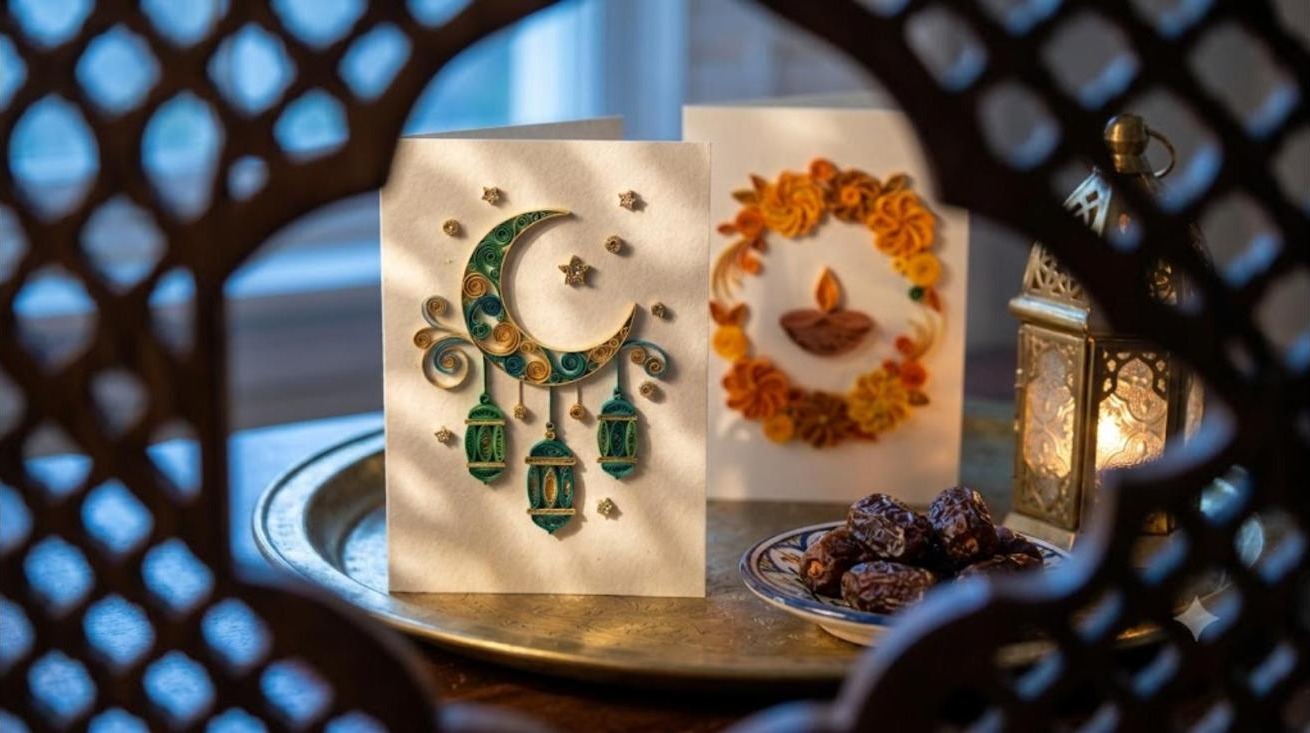
Why festive seasons matter more than Christmas in these markets
In the GCC and much of the Muslim world, Ramadan and the two Eids drive the year’s peak for greeting cards, gift boxes, hampers and hospitality décor. Corporate gifting is especially strong: companies send Ramadan Kareem and Eid Mubarak greetings to clients, partners and staff, often with a branded card tucked into a dates box or hamper. In India and in the large South Asian communities across the Gulf, the UK and Southeast Asia, Diwali plays the same role, with cards travelling alongside sweets, dried fruit and gift sets.
Because these occasions follow lunar or lunisolar calendars, the dates move earlier every year against the Gregorian calendar. Ramadan 2027 is expected to begin around early February 2027, with Eid al-Fitr around early March and Eid al-Adha around mid May, subject to moon sighting. That means the selling window for Ramadan 2027 opens in January, and for a handmade product the order needs to be placed in the last quarter of 2026.
Motifs and colours that sell for each occasion
Quilling suits festive designs because it builds texture and depth from simple shapes. The motifs below are the ones buyers in these markets ask for most often, and all of them translate well into paper coils.
| Occasion | Motifs that work in quilling | Colour palette |
|---|---|---|
| Ramadan | Crescent moon, hanging lanterns (fanous), stars, mosque domes and arches, geometric borders | Emerald, deep teal, navy, gold, ivory |
| Eid al-Fitr | Crescent and star, lanterns, floral arabesques, gift boxes, sweets | Gold with emerald, rose, turquoise or soft pastels |
| Eid al-Adha | Crescent, lanterns, Kaaba inspired geometric patterns, palm fronds, arches | Gold, black, deep green, sand |
| Diwali | Diya oil lamps, marigold garlands, rangoli patterns, lotus, peacock feathers | Saffron, marigold yellow, magenta, royal purple, gold |
| Corporate seasonal greetings | Single crescent or single diya, minimal geometric frame, space for a logo | Brand colours plus gold or ivory |
Many buyers for Ramadan and Eid ranges prefer designs without human or animal figures, keeping to geometry, architecture, lanterns, plants and the crescent. It is a good default for a range that will be sold across several Gulf markets. Metallic gold paper accents and a small amount of foil on the card base lift perceived value without making the card fragile.
Handling Arabic and Hindi greetings correctly
Greetings such as Ramadan Kareem, Eid Mubarak or Happy Diwali are what make a festive card sell, and they are also where most mistakes happen. Arabic is written right to left with connected letters, and a single misplaced dot or a broken ligature makes a card unsellable to a native reader. The safest approach is:
- Supply the greeting text yourself as vector artwork prepared by a native speaker, rather than asking the workshop to copy it from an image.
- Print or foil the greeting on the card base or on a printed insert, and keep the quilled coils for the motif. Hand coiled lettering in Arabic is beautiful but slow and much harder to keep consistent across thousands of cards.
- Approve a physical sample with the final greeting in place before mass production, and have a native reader check it.
- For bilingual cards, agree which language leads on the front and keep the second language inside, so the design stays clean.
- Avoid placing sacred text or the names of God on a product that may be discarded, unless your market specifically wants it and you have checked local sensitivities.
Planning the order calendar backwards from the occasion
Handmade quilling is limited by artisan hours, and every importer selling into these seasons is booking the same weeks. Working backwards from the date the cards must be in store is the most reliable way to avoid a late season.
| Step | Typical timing for Ramadan and Eid al-Fitr 2027 | What to settle |
|---|---|---|
| Range brief and design selection | October to early November 2026 | Occasions, number of designs, card sizes, greeting text |
| Samples and approval | November 2026 | Physical samples, colour and coil density, greeting proofs |
| Production | Late November to December 2026 | Artisan allocation, in line checks, packing |
| Shipping | Late December 2026 to early January 2027 | Air for smaller volumes or sea freight for larger orders, customs documents |
| In store and online | From mid January 2027 | Displays, listings, corporate orders before the season opens |
For Eid al-Adha the same steps move roughly three months later. For Diwali 2027, which falls in the autumn, a range brief in spring and production over the summer gives comfortable room. Buyers who sell into both seasons often place one development round for Ramadan, Eid and Diwali designs together, then split production into two shipments.
Packaging for festive gifting and corporate orders
During these seasons many cards are not posted at all. They are handed over with a gift, placed in a hamper or delivered with a box of dates or sweets. Packaging should support that use:
- Individual clear sleeves with a backer board, so the coils stay protected on shelf and in hampers.
- Gift boxes of four or six assorted designs, which sell well as a ready made set for families sending many greetings.
- Envelopes in colours that match the palette, such as gold, ivory, emerald or deep red, rather than plain white.
- For corporate buyers, a printed inside message, a logo on the back of the card and a branded envelope seal.
- Bilingual labels and barcodes on the sleeve when the cards are sold through retail in the GCC.
Trade context for Gulf and Asian buyers
Vietnam is a practical sourcing base for this kind of handmade range. The Vietnam and UAE Comprehensive Economic Partnership Agreement signed in early 2026 has raised attention on Vietnamese consumer goods among UAE importers, and Vietnam’s membership of RCEP links it with many of the largest Asian markets. For paper based handicrafts, the main advantages are skilled handwork, competitive labour costs and the flexibility to develop custom designs at modest quantities. Buyers should still confirm the exact tariff treatment and origin documents for their own HS code with their customs broker before ordering.
Common mistakes with festive quilling ranges
- Ordering after the season has started on the calendar, when artisan capacity is already booked.
- Approving greetings from a screen proof only, without a native reader checking the physical sample.
- Using Christmas style designs with a new greeting, instead of designing for the occasion.
- Making every design a large, deep card, which raises cost and shipping volume. A mix of flat folding cards and a few premium hero designs usually works better.
- Forgetting that lunar dates move about eleven days earlier each year, so last year’s calendar is already too late.
Building a Ramadan, Eid and Diwali range with Viet Farm Vision
Viet Farm Vision works directly with a handmade quilling workshop in Vietnam, where artisans create custom handmade quilling cards in the workshop itself. For festive ranges we can develop crescent, lantern, geometric and diya designs in your palette, add your printed or foiled greetings, include your logo and private label packaging, and plan production slots backwards from your in store date. To understand how the Islamic calendar shifts each year, see this overview of the Islamic calendar. Send us your target occasions, quantities and launch dates, and we will come back with design suggestions, a sample plan and a quotation in time for the 2027 season.