
Wooden Kitchen Utensils from Vietnam: A High-Margin Category Buyers Keep Reordering
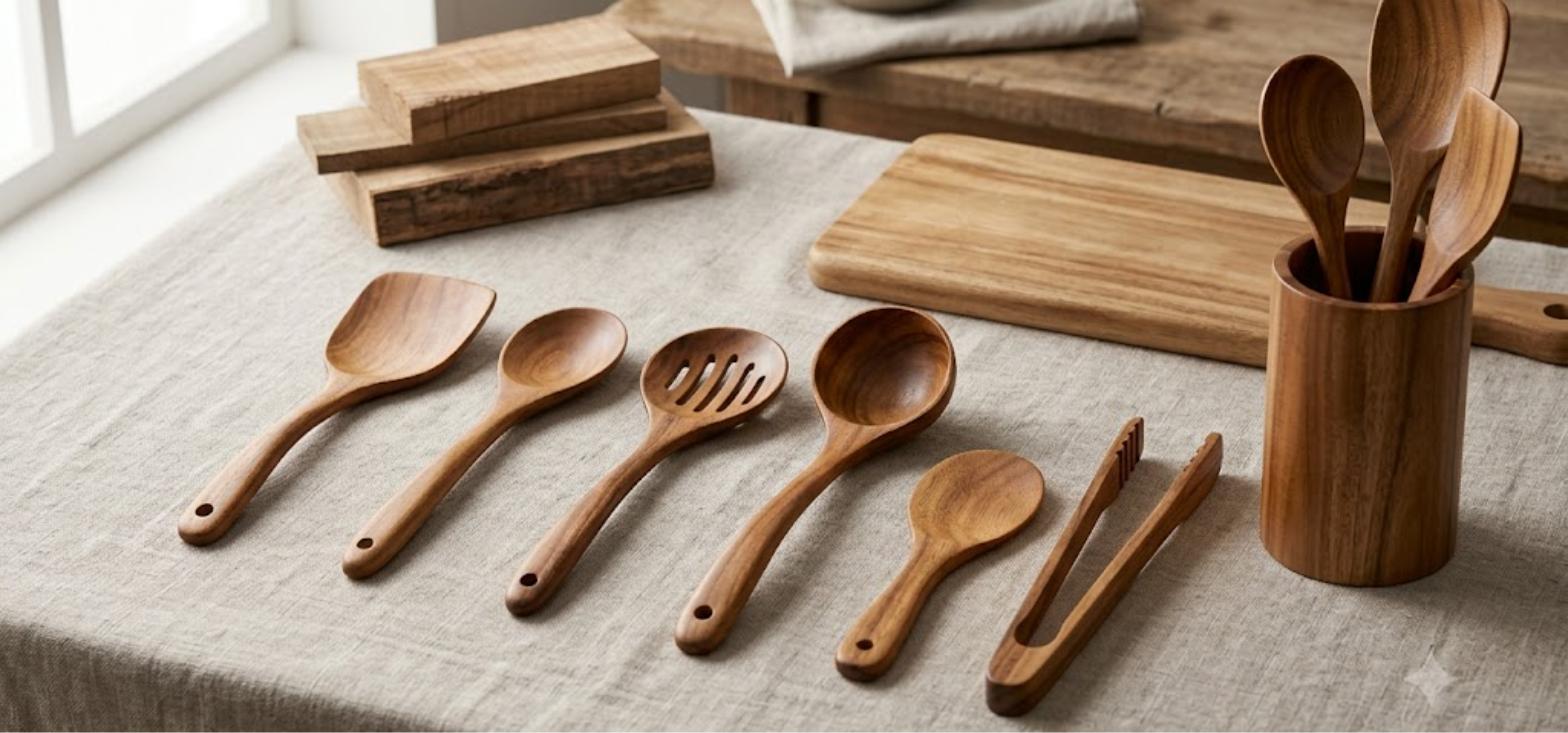
Wooden cooking utensils — spatulas, stirring spoons, slotted spoons, ladles, tongs and utensil holders — are one of the quietest but most dependable lines in the kitchenware category. They are inexpensive to ship, carry no electrical or battery compliance burden, and replace on a natural 12–24 month cycle as consumers move away from plastic. For importers building an eco-positioned houseware range in 2026, they are also one of the easiest categories to move out of China without sacrificing quality.
This guide covers what wholesale buyers need to specify, verify and negotiate when sourcing wooden kitchen utensils from Vietnam.
Why Vietnam for Wooden Utensils in 2026
Vietnam has three structural advantages in this specific product family:
- Domestic plantation acacia. Vietnam holds roughly 3.5 million hectares of planted production forest, much of it fast-growing acacia harvested on 6–8 year cycles. Utensil blanks are cut from the same log flow that feeds the furniture industry, so raw material is local rather than imported.
- Tariff position. Vietnamese goods entering the US in 2026 face a 20% reciprocal tariff, against 100%+ for comparable Chinese-origin goods. Under the EVFTA, most Vietnamese wooden houseware now enters the EU at 0%. VN–UAE CEPA, signed in February 2026, adds a similar path into the GCC.
- Craft depth. Utensil carving, sanding and finishing is labour-intensive handwork. Vietnam’s woodworking clusters around Bình Dương, Đồng Nai and the Hà Nội craft villages have decades of accumulated skill in exactly this kind of shaping.
If you are assessing the wider category, our guide to Vietnam wooden kitchenware OEM covers the full product family, and the acacia wood kitchenware sourcing guide goes deeper on the species itself.
Wood Species: What to Specify
- Acacia (Acacia mangium / hybrid) — the workhorse. Warm mid-brown grain, hardness around 1,100 lbf on the Janka scale, excellent value. Best all-round choice for mid to premium retail.
- Rubberwood (Hevea brasiliensis) — pale, uniform, very economical. Reclaimed from latex plantations after ~25 years, so it carries a genuine circularity story. Softer, so better for lower-price-point programmes.
- Teak — high natural oil content, exceptional water resistance, premium price. Reserve for luxury lines and gift sets.
- Bamboo — technically a grass, not a wood. Lightest and cheapest, but laminated construction means glue lines matter. See our bamboo kitchenware guide for the trade-offs.
For cooking utensils specifically, acacia is usually the right answer: hard enough to resist denting against pan edges, dense enough that the handle does not fuzz after repeated washing, and cheap enough to hit a $2–$5 retail spoon.
The Three Specifications That Decide Quality
1. Moisture content. Ask for 8–12% at the point of packing, verified with a pin meter and recorded in the inspection report. Utensils shipped above 14% will check, crack or warp inside a container crossing the equator. This is the single most common cause of claims in the category — we cover the testing detail in our guide to moisture content and kiln-drying standards.
2. Finish. Specify food-contact-safe finishing in writing. The standard options are refined coconut or mineral oil, or a beeswax–oil blend. Avoid unspecified “wood lacquer” — it is often a solvent-based coating that will fail EU Framework Regulation 1935/2004 and US FDA 21 CFR 175.300 food-contact review. Require a declaration of compliance and, ideally, an overall migration test report.
3. Sanding grade. Request a final sanding pass at 240 grit minimum and a specified edge radius (2–3 mm is typical). Utensils are handled constantly, so a rough handle edge generates returns far out of proportion to the cost of fixing it. Write the grit into the spec sheet, not just “smooth finish”.
Indicative FOB Pricing and MOQ
Ranges below are indicative FOB Ho Chi Minh City for acacia, unbranded, bulk-packed. Actual quotes depend on size, finish and packaging.
| Item | Typical FOB / pc | Typical MOQ |
|---|---|---|
| Cooking spoon / spatula (30–33 cm) | $0.75 – $1.60 | 1,000 pcs / SKU |
| Slotted spoon or skimmer | $0.90 – $1.80 | 1,000 pcs / SKU |
| Ladle (deep bowl) | $1.20 – $2.40 | 1,000 pcs / SKU |
| Serving tongs | $1.00 – $2.10 | 1,000 pcs / SKU |
| Turned utensil holder / crock | $2.80 – $6.50 | 500 pcs |
| 5-piece boxed utensil set | $5.50 – $11.00 | 500 sets |
MOQs are usually negotiable downward on a first order if you consolidate several SKUs into one container. A 20′ container typically absorbs 25,000–40,000 loose utensils, so most buyers reach efficient freight economics well before they reach a factory’s stated per-SKU minimum.
Private Label and OEM Options
- Laser engraving of your brand mark on the handle — typically $0.05–$0.12 per piece, no tooling cost, and the cleanest option for wood.
- Custom shapes from your own CAD or a physical sample. Expect a 2–3 week sampling cycle and a modest jig cost on complex profiles.
- Retail packaging — kraft sleeves, printed belly bands, FSC-certified gift boxes, hang tags with your own barcode and country-of-origin marking.
- Set curation — mixing utensils, a holder and a small board into a single boxed SKU is where the margin sits. Sets typically carry 15–25 points more gross margin than the same pieces sold loose.
Certifications to Ask For
- FSC Chain of Custody — increasingly requested by EU and Japanese retail buyers; also the simplest way to evidence legal harvest.
- EUDR readiness — the EU Deforestation Regulation requires geolocation data for the plot of origin. Ask suppliers whether they can supply plot coordinates for their acacia supply before you commit to an EU programme.
- Food-contact declaration — EU 1935/2004 and/or FDA 21 CFR 175.300, covering the finishing oil.
- BSCI or Sedex SMETA — social compliance audits, standard for supermarket and department-store channels.
- ISO 9001 — evidence of documented QC procedure rather than ad hoc inspection.
Our guide to Vietnam OEM certifications explains what each audit actually verifies and which ones your channel is likely to require.
Verifying Genuine Vietnamese Origin
Because the tariff differential is now large, some traders route Chinese-made utensils through Vietnam and re-label them. That exposes the importer, not the trader, to penalties. Protect yourself by requesting a Form B/E-UR or Form D certificate of origin issued by the Vietnam Chamber of Commerce and Industry, matching the factory’s business registration number to the exporter on the invoice, and asking for dated production-floor footage of your specific order. Our origin verification guide sets out the full checklist.
A Practical First-Order Sequence
- Shortlist 3–4 factories and request their existing utensil range with FOB pricing and stated MOQ.
- Order paid samples from at least two — never judge on photographs alone.
- Wash-test the samples: 20 dishwasher-free hand-wash cycles, then check for grain raising, handle roughness and finish loss.
- Issue a written spec sheet covering species, dimensions, moisture content, finish, sanding grit and packaging.
- Place a trial order of 500–1,000 pcs per SKU with 30% deposit, balance against a third-party pre-shipment inspection.
- Scale to full container volume once the trial order clears inspection and sells through.
Working with Viet Farm Vision
Viet Farm Vision supplies wooden kitchen utensils and the wider houseware range to wholesale, retail and HORECA buyers across the Middle East, Asia, Europe and Africa. We handle OEM shaping, food-safe finishing, laser branding, retail packaging and export documentation from a single point of contact — including moisture-content verification and pre-shipment inspection reports on every order.
To request a quotation, a product catalogue or paid samples, contact our export team at info@vietfarmvision.com or visit vietfarmvision.com/contact-us.