
Wooden Trays from Vietnam: The Houseware SKU That Sells in Four Different Rooms
A wooden tray is one of the few houseware items that never competes with itself on the shelf. The same acacia rectangle is merchandised in the kitchen as a serving tray, in the living room as an ottoman tray, in the bathroom as a vanity organizer and in seasonal retail as a gift-hamper base. One product, four planogram placements, no tooling and no moulds. For importers building a wooden houseware programme in 2026, that flexibility is exactly why trays and wooden organizers have become one of the fastest-turning lines in the Vietnamese wood export mix.
This guide covers what wholesale buyers actually need to specify when sourcing wooden trays and home-organization houseware from Vietnam: the SKU range, wood species economics, construction methods, food-contact finishes, warping and moisture control, indicative FOB pricing, certification paperwork and OEM private-label options.
Why Vietnam for Wooden Trays in 2026
Vietnam did not become a wooden houseware hub by accident. The country sits on a large planted acacia and rubberwood resource, and a significant share of that plantation area is certified under FSC chain-of-custody schemes, which is what makes documented, legal-origin timber available at volume rather than as a boutique upgrade. Around that resource sits a dense cluster of sawmills, kiln-drying yards, CNC shops and finishing lines in Binh Duong, Dong Nai and Binh Dinh, so a tray programme can be quoted, sampled and shipped without the raw material ever leaving the country.
The 2026 trade picture reinforces the case. Vietnamese goods entering the United States face a 20 percent tariff line against triple-digit exposure on many Chinese equivalents, the Vietnam-UAE Comprehensive Economic Partnership Agreement signed on 3 February 2026 opens a preferential lane into the Gulf, and RCEP gives buyers across Asia a fourteen-partner framework for reduced duties. For a low-value, high-volume category like trays, where duty and freight can be a third of landed cost, those margins decide the programme.
The Core Wooden Tray and Organizer SKU Range
Most first orders should stay inside a tight, merchandisable range. These are the SKUs that move consistently for wholesale, retail and HORECA buyers:
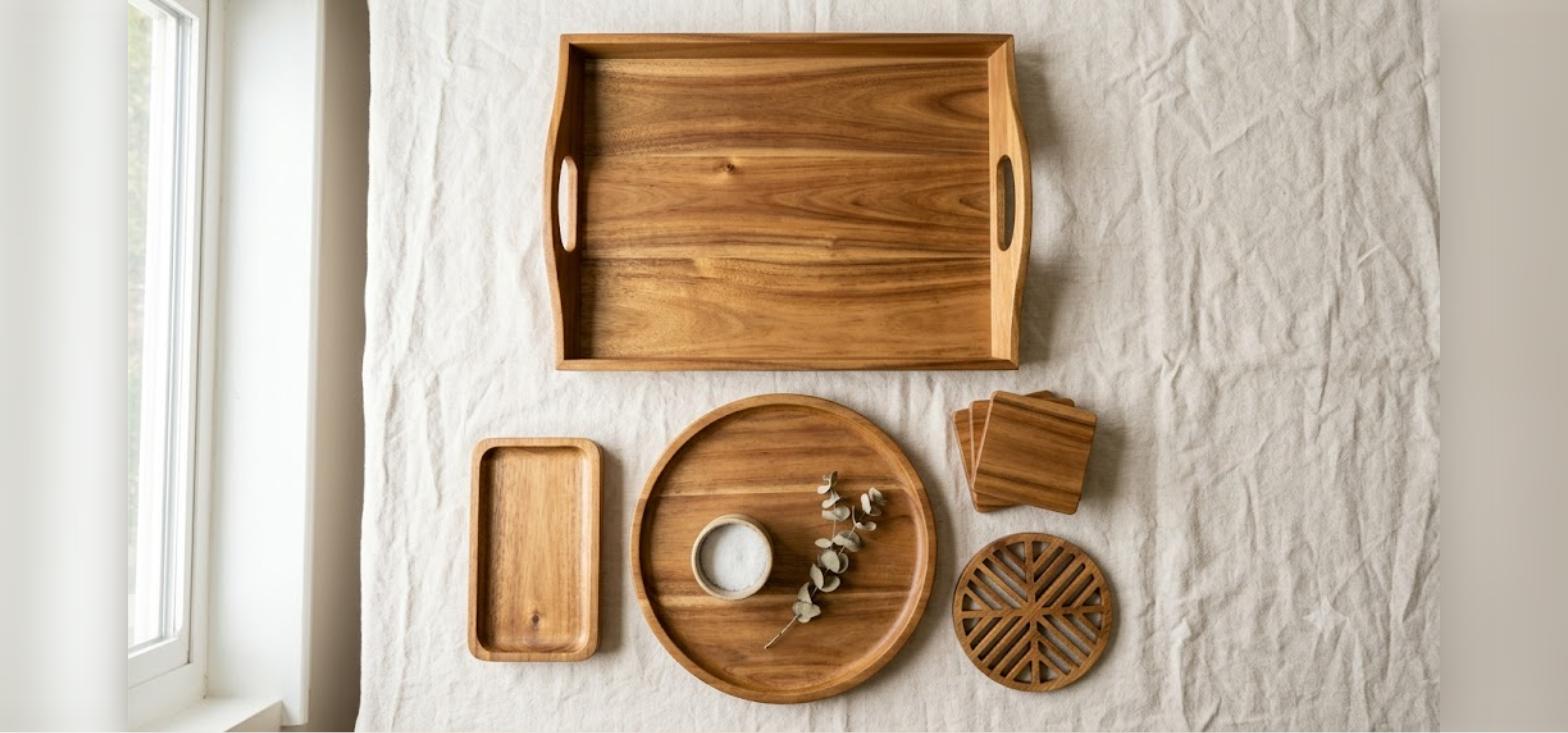
- Rectangular serving tray with cut-out handles — the volume driver. Typical sizes 35 x 25 cm, 40 x 30 cm and 45 x 32 cm, wall height 3 to 5 cm.
- Round serving and ottoman tray — 30, 35 and 40 cm diameter, low rim. Strong in home decor and hotel amenity channels.
- Vanity and catch-all tray — shallow 22 x 12 cm rectangle for bathroom, bedside and desk organization. Lowest FOB, highest attach rate.
- Nesting tray sets — sets of two or three sizes packed together. Raises basket value without adding SKUs to your system.
- Coaster sets with holder — square or round, 10 cm, packed in fours or sixes. A natural add-on to any tray order.
- Trivets and pot stands — slatted or lattice construction, 18 to 22 cm. Heat-facing SKU, usually unfinished or oil-only.
- Compartment drawer organizers — cutlery and desk inserts, 2 to 5 compartments.
- Riser and display trays — footed or handled trays for retail merchandising and cafe service.
A practical first container is usually four to six of these SKUs in two or three colourways, not fifteen. Retail buyers reorder depth, not breadth.
Wood Species: What Each One Costs and Where It Fits
- Acacia — the default. Warm honey tone, pronounced figure, good dimensional stability once kiln-dried, food-contact friendly. Best price-to-perceived-value ratio in the category and the species most Western buyers already recognise.
- Rubberwood — pale, even, low-figure. Roughly 10 to 20 percent below acacia. Ideal when the tray will be painted, stained or lacquered in a solid colour, because grain contrast is not part of the story.
- Mango wood — dramatic dark streaking, popular in the home-decor and gifting channel. Supply is less consistent than acacia; expect wider colour variance between production runs.
- Bamboo — technically a grass, but competes directly. Lighter, cheaper for flat panel work, and the right choice if your brand story is renewability. See our bamboo kitchenware and houseware guide for the trade-offs.
- Pine and plantation softwood — cheapest, but dents easily and is generally unsuitable for a premium tray positioning.
If you are undecided, our acacia wood kitchenware sourcing guide covers species selection in more depth.
Construction: Solid, Finger-Joint or Panel Base
Construction is where quotes that look identical stop being identical. Ask the factory to state the method on the pro forma invoice, not just the dimensions.
- Solid one-piece base — cut from a single board. Cleanest appearance, highest material cost, highest risk of cupping if moisture is not controlled. Realistic only up to roughly 30 cm width.
- Edge-glued panel — narrow staves laminated side by side. The industry standard for trays above 30 cm. Stable, efficient on yield, and the glue line is a legitimate design feature when the staves are colour-matched.
- Finger-jointed panel — short offcuts jointed end to end. Cheapest, and visible on the surface. Acceptable for painted or budget lines, rarely acceptable for a premium natural finish.
- Plywood or MDF base with solid rim — used on large ottoman trays to keep weight and warping down. Must be declared, and the core adhesive must be low-formaldehyde if you are shipping to the EU or the Gulf.
Handles matter more than buyers expect. Integrated cut-out handles have no failure point and no metal to corrode; applied metal or rope handles look premium but add a QC checkpoint, a second material declaration and a nickel-release question in some markets.
Finishes, Food-Contact Safety and Warping Control
A tray that holds a glass and a plate is a food-contact article in most jurisdictions, so the finish specification is a compliance document, not a styling note. In the EU the governing framework is Regulation (EC) No 1935/2004 on materials intended to come into contact with food; US buyers should be working to the equivalent FDA food-contact provisions.
- Food-grade mineral oil or oil-wax blend — natural matte look, consumer-refreshable, the safest default for anything that touches food directly.
- Water-based lacquer or PU — better stain and ring resistance for ottoman and vanity trays. Require the technical data sheet and a migration test report, not just a verbal assurance.
- Stain plus topcoat — for colour-matched programmes. Confirm the colourant is food-contact approved if the tray is marketed for serving.
- Unfinished — correct for trivets and some organizer inserts, but it raises the moisture and mould risk in ocean transit.
Warping is the single biggest cause of tray claims. Insist on kiln-dried stock at 8 to 12 percent moisture content, verified by pin meter at pre-shipment inspection and recorded on the report. Trays have a large flat surface and a thin section, which is precisely the geometry that cups when a container crosses from a tropical loading port into a dry winter warehouse. Our guide to wood moisture content and kiln-drying standards sets out the acceptance criteria to write into your purchase order.
Indicative FOB Pricing and MOQ
The figures below are indicative FOB Ho Chi Minh City ranges for acacia at commercial volumes in 2026. Actual quotes move with species, finish, packaging and order size, so treat them as a sanity check on offers you receive rather than a price list.
- Vanity and catch-all tray, 22 x 12 cm, oiled — approximately USD 1.60 to 2.80 per piece
- Round serving tray, 30 to 35 cm, oiled — approximately USD 3.50 to 6.00 per piece
- Rectangular serving tray with cut-out handles, 40 x 30 cm, oiled — approximately USD 5.50 to 9.50 per piece
- Nesting set of three rectangular trays — approximately USD 12.00 to 19.00 per set
- Coaster set of four with holder — approximately USD 2.20 to 4.00 per set
- Slatted trivet, 20 cm — approximately USD 1.80 to 3.20 per piece
Typical MOQ is 300 to 500 pieces per SKU per colourway for a standard catalogue item, and 1,000 pieces or more where a new profile, jig or custom size is involved. Lacquered and printed lines carry higher minimums than oiled ones because of setup and curing batch sizes. Sampling normally runs 7 to 15 days, mass production 35 to 55 days depending on finish and season, and both stretch around Tet in late January and February.
Certifications and Documents to Collect Before You Pay
- FSC or PEFC chain-of-custody certificate — required in practice for EU buyers under the deforestation-free regulation, and increasingly requested elsewhere.
- Food-contact test report — migration testing to EU 1935/2004 or FDA criteria, issued by an accredited third-party laboratory and dated within the last twelve months.
- Fumigation or heat-treatment certificate — solid wood packaging and product must comply with ISPM 15. Confirm which of the two treatments your destination accepts before booking.
- Certificate of Origin — Form B for general use, Form AANZ, AI, AK or the CEPA and RCEP equivalents where you are claiming preferential duty. This is the document that converts a tariff advantage into cash.
- Phytosanitary certificate — required by several Gulf and Asian destinations for untreated wooden articles.
- Social compliance audit — BSCI, Sedex SMETA or an equivalent, if you supply European or Middle Eastern retail chains.
- Pre-shipment inspection report — with moisture readings, glue-line checks, dimensional tolerances and carton drop-test results.
Packaging, Cartonisation and Container Loading
Trays are flat, which makes them one of the better categories for container economics, but only if the packing plan is designed rather than improvised. Nested and interleaved stacking of a 40 x 30 cm tray typically achieves several thousand pieces in a 20-foot container, and the practical limit is carton crush strength, not volume.
- Specify interleaving material between trays. Unprotected stacked trays rub and arrive with surface scuffing that fails retail QC.
- Use a minimum 5-ply export carton for anything above 35 cm, with corner protection on the outer layer.
- Add silica gel sachets for ocean freight to the Gulf and Northern Europe, and request a moisture-barrier liner in the carton for winter arrivals.
- Decide early whether retail packaging is a printed sleeve, a hangtag or a full colour box. Sleeves and hangtags cost cents; boxes can add 15 to 25 percent to the FOB of a low-value tray.
- Confirm barcode placement and whether the factory or your warehouse applies the retail price label.
OEM and Private-Label Options
Trays are an unusually good private-label entry point because the tooling burden is close to zero. Realistic customisation without a large minimum includes custom dimensions within the factory jig range, laser-engraved or branded burn-marked logos on the underside, custom stain and colour matching to a Pantone reference, brand-printed sleeves and hangtags, mixed nesting sets built to your assortment plan, and full carton and barcode specification to your warehouse standard.
Where a bespoke profile, moulded curve or bent-wood handle is required, expect a tooling charge and a higher minimum. Ask for the tooling to be quoted as a separate line so you know what is amortised and what is recoverable on repeat orders.
Five Mistakes That Cost Tray Importers Money
- Approving a sample without a moisture reading. The sample was made in a workshop in March. The container ships in July. Without a specified moisture band on the purchase order you have no basis for a claim when the trays cup.
- Comparing quotes that use different construction. A finger-jointed tray and an edge-glued tray of the same size can differ by 30 percent in cost and by a full retail tier in perceived quality. Force the method onto the quotation.
- Treating the tray as non-food-contact. If your packaging or listing shows food on the tray, customs and marketplace compliance teams will treat it as food-contact. Have the migration report before, not after.
- Ordering too many SKUs in the first container. Six SKUs with real depth outperform fifteen with none, and they give the factory a production run long enough to hold colour consistency.
- Losing the preferential duty for want of a Form. Certificate of Origin errors are the most common avoidable cost in this category. Confirm the exact form your customs broker needs before the goods leave the factory.
A Practical First-Order Checklist
- Lock four to six SKUs and two colourways, with target retail prices worked back to a landed-cost ceiling.
- Specify species, construction method, wall height, finish type and moisture band in writing on the purchase order.
- Order paid samples in the exact final finish, and keep one sealed as the retained reference sample.
- Request the food-contact migration report and the FSC or PEFC certificate before deposit.
- Agree the carton specification, interleaving, desiccant and barcode placement.
- Book a third-party pre-shipment inspection with moisture readings written into the scope.
- Confirm the Certificate of Origin form required for your preferential duty claim.
- Plan around Tet if your delivery window falls in Q1.
Working with Viet Farm Vision
Viet Farm Vision supplies wooden trays, coasters, trivets and the wider wooden kitchenware and houseware range to wholesale, retail and HORECA buyers across the Middle East, Asia, Europe and Africa. We handle SKU selection, species and finish specification, food-contact documentation, private-label packaging and export paperwork from a single point of contact, including moisture verification and glue-line checks on the pre-shipment inspection report for every order.
To request a quotation, a product catalogue or paid samples, contact our export team at info@vietfarmvision.com or visit vietfarmvision.com/contact-us.