
To import quilling cards into Germany from Vietnam, a German buyer needs four things in place before the first carton lands: correct customs classification and origin paperwork, its own registration under the German Packaging Act (VerpackG), its name and address on the product as the EU importer under the General Product Safety Regulation, and an order calendar that fits German retail seasons. Handmade quilling cards are a low-risk category, but almost every one of these duties sits with the German importer, not with the supplier in Vietnam.
This guide walks through each step from the importer’s side of the desk, so you can brief your customs broker, packaging compliance scheme and supplier in one go. If you are new to the product itself, start with our handmade quilling greeting cards page.
Who Counts as the Importer When Quilling Cards Enter Germany?
German packaging law does not look at who books the freight; it looks at who carries legal responsibility for the goods when they cross the border. The central packaging register explains that the obligated party is the one that bears responsibility for the goods at that moment, that the parties should settle this in their contract (Incoterms are a useful reference), and that a forwarder or carrier is never the obligated party (Stiftung Zentrale Stelle Verpackungsregister).
In practice, when a gift shop chain, stationery wholesaler or museum retailer in Germany buys FOB or FCA Vietnam and clears the goods in its own name, that business is the importer for customs, for packaging and for product safety. Decide this explicitly before the first purchase order. A buyer who assumes “the supplier handles compliance” usually discovers the gap at the worst moment: the week a marketplace or a large retail customer asks for proof of registration.
What Paperwork Ships with Quilling Cards from Vietnam?
Viet Farm Vision prepares a full export document set for every shipment. The table shows what each document does once it reaches Germany.
| Document | Prepared by | What the German importer uses it for |
|---|---|---|
| Commercial invoice | Exporter (Viet Farm Vision) | Customs value, description of goods, Incoterm, basis for import VAT |
| Packing list | Exporter | Carton count, weights and contents per carton; cross-check on arrival |
| Certificate of Origin (CO) | Issued in Vietnam on exporter application | Evidence of Vietnamese origin; supports preferential treatment where it applies |
| Transport document (bill of lading, air waybill or courier waybill) | Carrier or forwarder | Release of the goods; links shipment to customs entry |
| Pre-delivery photos and video | Exporter | Proof of carton count and packing condition before handover |
| Importer’s own records | German importer | LUCID registration number, compliance scheme contract, GPSR file |
Customs Classification and Origin: What German Buyers Should Check
Printed cards bearing personal greetings, messages or announcements fall under HS heading 4909, with or without envelopes or trimmings (heading 4909 text). Hand-applied quilling decoration does not automatically change that, but the boundary between greeting cards and other paper articles can be argued either way for unusual designs. If you plan a large or recurring programme, ask your broker whether a Binding Tariff Information ruling from German customs is worth requesting, and look up the current rate for your exact tariff line in the EU Access2Markets database rather than relying on a figure quoted in an email.
Vietnam and the EU trade under the EU-Vietnam Free Trade Agreement (EVFTA). For exports to the EU, Vietnam’s Ministry of Industry and Trade guidance says consignments above EUR 6,000 need a Form EUR.1 certificate of origin issued by an authorised body, while smaller consignments can be self-certified by the exporter (Vietnam Customs Magazine on MoIT guidance). Whether a preference actually lowers your duty depends on the rate for your tariff line, so treat the certificate of origin as standard paperwork and let your broker decide how to declare it. We covered classification in more depth in our customs and HS code guide for quilling cards.
Do You Need to Register in LUCID Before You Import Quilling Cards into Germany?
Yes, if you import packaged goods into Germany, you must register with the LUCID Packaging Register, whatever kind of packaging is involved. For retail, grouped and shipment packaging that typically ends up with private end consumers, you also need a contract with a dual-system operator and regular volume reporting to both the system and LUCID (Verpackungsregister: imports). Using a fulfilment provider does not transfer the obligation.
For a quilling card programme, that packaging usually includes:
- the cello sleeve or envelope wrap around each card,
- any private-label backing card, belly band or box set packaging,
- inner boxes that reach the shop floor or the end customer,
- master export cartons, which count as transport packaging: registration still applies, but system participation and volume reporting do not.
Ask your supplier for a packaging specification per SKU (material type and weight of each component). That turns your annual LUCID and scheme reporting into a simple calculation instead of guesswork. Our post on protective packaging for exported quilling cards explains how the layers are built.
GPSR Labelling: Putting Your Name on Imported Greeting Cards
Since the EU General Product Safety Regulation took effect in December 2024, importers must show their name, registered trade name or trade mark, and a postal and electronic address on the product or, where that is not possible, on the packaging or accompanying document. Importers must also check the manufacturer has done its part and keep technical documentation for ten years (Eurofins summary of GPSR importer duties).
This is where private label works in the German importer’s favour. Because Viet Farm Vision can print or apply your logo and produce private-label packaging, your importer details can be designed into the back of the card, the sleeve sticker or the box from the first proof, rather than hand-stickered in a German warehouse. Approve that text on the pre-production sample, exactly as you approve the artwork.
Does the EUDR Apply to Greeting Cards Imported into Germany?
Many German buyers are asking this ahead of December 2026. The amending Regulation (EU) 2025/2650 postponed the EU Deforestation Regulation so that it applies to large and medium operators from 30 December 2026 and to micro and small enterprises from 30 June 2027, and it removed printed products of Chapter 49 from the regulation’s product list (EY tax news; Packa content hub).
For cards classified under heading 4909, that means no EUDR due diligence statement for the cards themselves. Paper and board products in Chapter 48 remain in scope, so if you buy stationery items separately (for example boxed blank envelopes or gift boxes sold as products in their own right), check with your adviser. The Commission’s simplification review means the rules can still move, so recheck before each season. Our compliance evidence pack guide lists what to hold on file for paper products generally.
When Should German Buyers Place Orders for 2027 Seasons?
German card retail is strongly seasonal, and handmade production cannot be rushed at the end. The principle is simple: work back from the date the cards must be on your shelf, and leave room for sampling, approval, production, inspection, transport and customs clearance. The key 2027 dates are below.
| Occasion | 2027 date | What to have finished before you place the order |
|---|---|---|
| Valentine’s Day | 14 February | Designs approved now; order before Tet holidays in Vietnam slow production |
| Easter | 28 March | Motif range (spring flowers, birds) and sleeve/label text approved |
| Mother’s Day (Muttertag) | 9 May | Floral range and any gift-box packaging specified for LUCID reporting |
| Wedding season | Late spring to early autumn | Neutral and white-gold ranges sampled; reorder plan agreed |
| Christmas and Advent markets | From late November | Range approved by early summer so goods arrive before autumn trade fairs and store setup |
Because quilled cards are made by hand, sample approval is the step most worth doing early. Our sampling and golden sample guide explains how to lock a design so the bulk order matches it.
How Does the Four-Step Quality Check Protect a German Shipment?
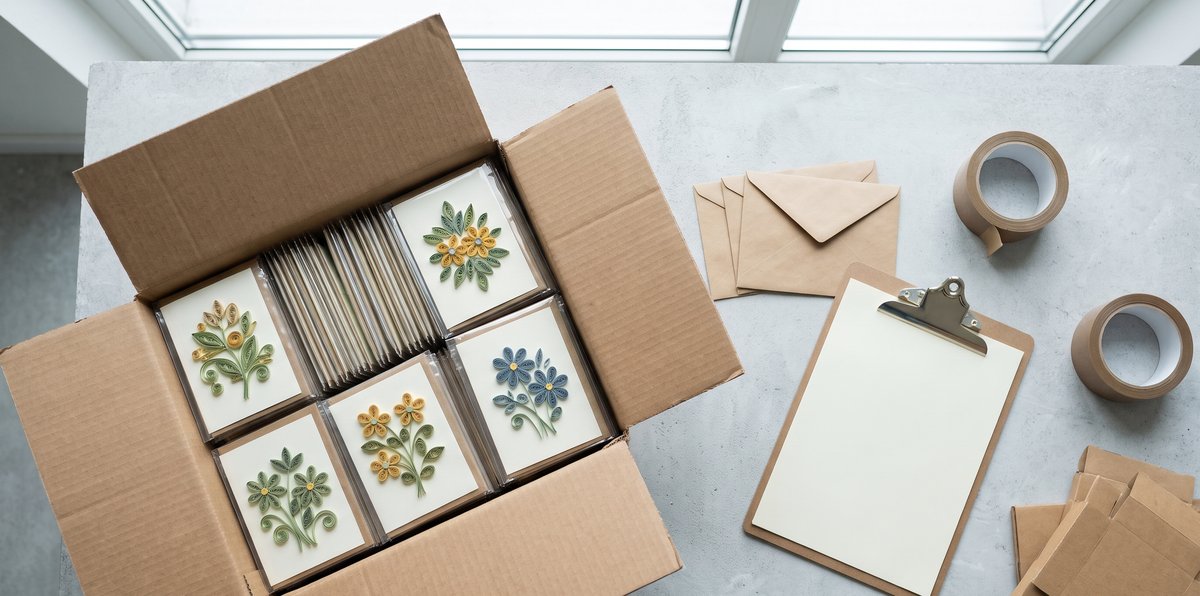
A shipment that arrives with crushed coils is a cost the German importer carries, not just the supplier. Viet Farm Vision runs a four-step check on every order: approval of a sample before production, a mid-production check at the partner workshop, inspection of every single card before packing, and a final carton count with photos and video sent to you before delivery. Cards are handmade at a partner workshop by skilled artisans, most of them local women living near the workshop.
First-Order Checklist for Quilling Card Importers in Germany
| Step | Owner | Done? |
|---|---|---|
| Agree Incoterm and who is importer of record | Buyer and supplier | ☐ |
| Register in LUCID and sign a dual-system contract | German importer | ☐ |
| Confirm tariff line and duty with broker or via Access2Markets | German importer and broker | ☐ |
| Approve design, logo and private-label packaging | Buyer, with supplier proofs | ☐ |
| Approve GPSR importer details on card, sleeve or box | German importer | ☐ |
| Approve pre-production sample | Buyer | ☐ |
| Receive commercial invoice, packing list and CO | Supplier | ☐ |
| Review carton photos and video before handover | Buyer | ☐ |
Frequently Asked Questions
Do I need an EORI number to import quilling cards into Germany?
Yes. Any business that lodges customs declarations in the EU needs an EORI number, and German businesses apply through German customs. Your broker can lodge the declaration for you, but it will be made against your EORI number.
Can my supplier in Vietnam register in LUCID for me?
Not when you are the importer. The obligation belongs to the party responsible for the goods when they cross into Germany and the register states that this obligation cannot be passed to a forwarder or fulfilment provider. If your contract makes you the importer, register in your own name.
Are quilling cards covered by the EU Deforestation Regulation?
Greeting cards under heading 4909 belong to Chapter 49, which was removed from the EUDR product list by Regulation (EU) 2025/2650. Separately sold paper and board products in Chapter 48 are still in scope, so check any non-card stationery you add to the order.
Can my company details be printed on the cards instead of stickered?
Yes. Viet Farm Vision offers custom designs, printed or applied logos and private-label packaging, so your importer name and address can be part of the approved artwork on the card back, sleeve or box. This is neater than relabelling after arrival.
How quickly will I get a reply to a German RFQ?
We respond within one business day. Send your designs or reference images, target quantities by design and the season you are buying for, and we will come back with questions, sampling steps and a quotation.
Ready to Plan Your German Quilling Card Programme?
If you are importing quilling cards into Germany for Valentine’s Day, Easter, Muttertag or Christmas 2027, now is the time to sample. Tell us your designs, packaging and labelling needs through our Request a Quote page, and browse the range on our handmade quilling cards page. We reply within one business day.