
If you want to import quilling cards into the USA from Vietnam, the paperwork is lighter than most buyers expect. Handmade greeting cards are usually entered under HTS heading 4909, which carries a Free general duty rate, but you still need a US importer of record, correct “Made in Vietnam” marking, and a customs broker who can confirm which additional duties apply on the day your cards arrive.
This guide walks through each step from the buyer’s side: classification, current tariff questions, documents, origin marking, packing and timing, so your first US shipment of handmade quilling greeting cards clears without surprises.
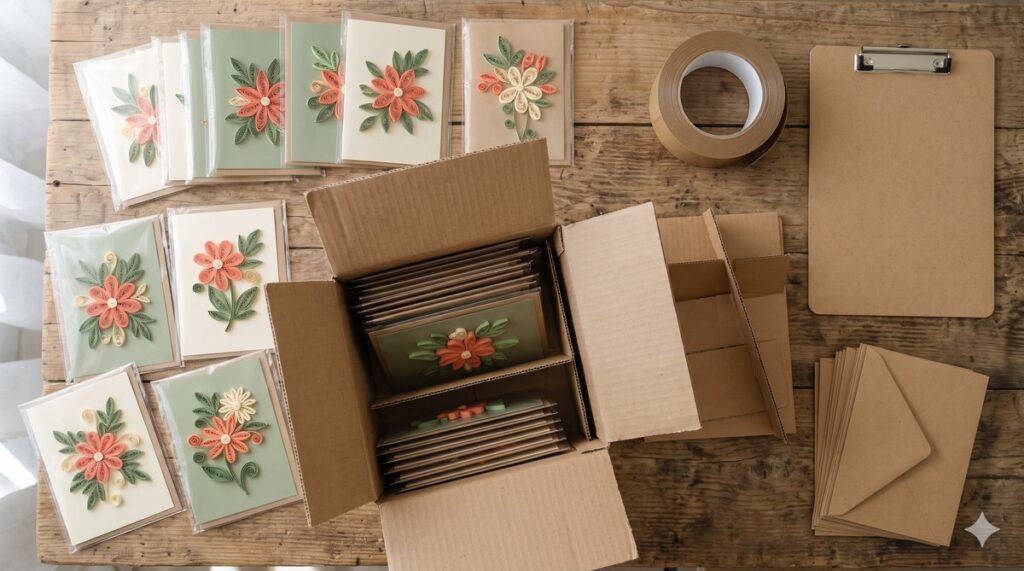
What does it take to import quilling cards into the USA?
Every commercial shipment into the United States needs a party that takes legal responsibility for it. For most gift shops, stationery retailers and brands, that is either your own company acting as importer of record (IOR) or a customs broker or freight forwarder acting on your behalf. U.S. Customs and Border Protection publishes a short list of tips for new importers that is worth reading before your first order.
In practice, the work splits into three groups:
- Your supplier in Vietnam produces the cards, packs them, and issues the commercial invoice, packing list and certificate of origin.
- Your forwarder books ocean or air freight, issues the bill of lading or air waybill, and in many cases files the Importer Security Filing for ocean cargo.
- Your customs broker classifies the goods, posts the customs bond, files the entry, and pays duties and fees on your behalf.
Which HTS code covers handmade quilling greeting cards?
Most finished greeting cards with a printed message, with or without envelopes, fall under HTS subheading 4909.00.40 (“printed cards bearing personal greetings, messages or announcements”). The general column 1 rate for that line is listed as Free; you can confirm the current wording in the official Harmonized Tariff Schedule published by the US International Trade Commission.
Two cautions apply. First, classification follows the product, not the word “card”. A blank quilled card with no printed greeting, a framed quilled artwork, or a gift set that mixes cards with other items may be classified differently. Second, it is the importer, not the supplier, who is responsible for the classification declared to CBP.
If your range includes unusual formats, ask your broker whether a binding ruling makes sense. CBP’s CROSS rulings database lets you search earlier decisions on similar greeting cards before you decide.
What duties and tariffs apply to Vietnam-made cards in 2027?
The base duty on most greeting cards is low, but the layer of additional duties on Vietnamese goods has changed several times since 2025. According to a 2026 US tariff tracker from Dimerco, the earlier IEEPA tariffs were overturned in court, a temporary Section 122 duty was scheduled to expire on 24 July 2026, and a Section 301 tariff tier that includes Vietnam took effect the same day.
Because these measures keep moving, we suggest three habits:
- Ask your broker for a landed-cost estimate on the date you place the order, and again before the cargo sails.
- Build a small tariff buffer into your retail pricing for the first season instead of assuming today’s rate will hold.
- Keep your commercial invoice values accurate and consistent. Any duty is calculated on the declared value, and mismatched documents are the most common cause of delays.
This section is general information, not legal or customs advice. Your licensed customs broker should confirm the rates that apply to your specific entry.
Can small quilling card orders still use de minimis?
No longer for most shipments. The United States suspended duty-free de minimis treatment for low-value commercial shipments from all countries from 29 August 2025, as summarised by KPMG. That means even a small air shipment of sample cards or a trial order for an online shop now goes through a formal or informal entry, with duties assessed.
For buyers who sell on marketplaces, this changes the math on shipping parcels direct from Asia. Consolidating into one larger shipment and distributing from a US warehouse is usually simpler. Our guide to quilling cards for online shops and marketplace sellers covers that model in more detail.
What documents do you need to import quilling cards into the USA?
| Document | Who prepares it | What to check |
|---|---|---|
| Commercial invoice | Exporter (Viet Farm Vision) | Buyer and consignee names, card descriptions, quantities, unit values and Incoterm match your purchase order |
| Packing list | Exporter | Carton count, gross and net weights, and which designs are in which carton |
| Certificate of origin (CO) | Exporter, issued in Vietnam | Vietnam shown as country of origin; descriptions consistent with the invoice |
| Bill of lading or air waybill | Carrier or forwarder | Consignee and notify party correct; cargo description matches invoice |
| Importer Security Filing (ocean only) | Importer or its agent | Filed before the cargo is loaded at the port in Vietnam |
| Customs bond | Importer, via broker or surety | Single-entry or continuous bond in place before arrival |
| Entry filing | Customs broker | HTS code, value and origin declared exactly as on the documents above |
The Importer Security Filing, often called “10+2”, applies to ocean cargo. CBP’s ISF frequently asked questions explain which data elements are required and who may file them. Ask your forwarder early whether they will file it, because a late ISF can lead to penalties.
How should quilling cards be marked “Made in Vietnam”?
US law requires most imported articles, or their retail container, to show the country of origin in English, legibly and permanently, so the end customer can see it. The detailed rules sit in 19 CFR Part 134.
For quilling cards, the simplest approach is to print “Made in Vietnam” on the back of each card and on any retail sleeve or box. If you order private label packaging with your own brand, include the origin line in the artwork from the start. Adding a sticker after production is possible, but it costs time and can look untidy on a premium handmade product.
What should the US retail packaging include?
- Country of origin in English, visible at the point of sale.
- Your brand name and contact information if the cards are sold under your private label.
- Any barcode or SKU label your retail customers ask for, supplied by you as artwork.
- Clear product description, for example “handmade quilling card with envelope”.
How do you protect quilled cards on the journey to the USA?
Quilled paper designs are raised from the card surface, so they need protection from pressure, not just moisture. Good export packing keeps each card in its own sleeve, adds stiff backing and carton dividers, and avoids overfilled cartons so stacked boxes do not crush the designs. Ask about humidity in transit too, and store cartons off the floor once they arrive. Our article on packaging and protection for export shipping explains each layer.
How does a US order move from sample to delivery?
Every order follows the same four-step quality process, which gives you checkpoints before money and time are committed further down the line:
| Step | What happens | What the buyer does |
|---|---|---|
| 1. Pre-production sample approval | Your custom design or chosen designs are made as samples, with your logo or private label packaging if ordered | Approve colours, layout, origin marking and packaging before production starts |
| 2. Mid-production inspection | Work in progress is checked at the partner workshop | Review progress photos and flag any change early |
| 3. Card-by-card check before packing | Every finished card is checked individually before it is packed | Confirm the final quantity per design |
| 4. Carton count with photos and video | Cartons are counted and sealed, and photos and video are sent to you before shipment | Give shipping approval and pass documents to your forwarder and broker |
Production time depends on design complexity, the number of designs, order size, custom packaging and the season, since many buyers book the same months before Valentine’s Day and Christmas. Share your target in-store date when you request a quote and we will plan backwards from it.
Checklist before your first US quilling card order
- Decide who will act as importer of record and appoint a customs broker.
- Confirm the HTS classification for each card format with your broker.
- Get a current landed-cost estimate, including any additional duties on Vietnam-origin goods.
- Arrange a customs bond and confirm who files the ISF for ocean shipments.
- Approve artwork that includes “Made in Vietnam” on cards and packaging.
- Agree Incoterms, payment terms and the documents you need with each shipment.
- Compare suppliers on the same basis; our RFQ pack guide lists the data points to send.
- Set your in-store date and work back to a sample approval date.
Buyers importing into other markets can compare this process with our guides for the UK and the UAE.
Frequently Asked Questions
Do I need an import license to bring greeting cards into the USA?
Greeting cards do not generally need a special import license. You do need an importer of record, a customs bond for commercial entries, and correct documents. Your customs broker can confirm whether any agency requirements apply to your specific products.
What is the HTS code for handmade greeting cards?
Most finished greeting cards with a printed message are entered under HTS 4909.00.40, which has a Free general duty rate. Blank cards, framed quilled art or mixed gift sets may be classified differently. The importer is responsible for the final classification, so confirm it with your broker.
Can quilling cards be shipped to the USA under my own brand?
Yes. We can make cards to your own designs, print or apply your logo, and pack them in private label packaging. Include “Made in Vietnam” in your packaging artwork so the origin marking meets US rules from the first run.
Which documents come with each shipment from Vietnam?
Each shipment comes with a commercial invoice, a packing list and a certificate of origin. Your forwarder issues the bill of lading or air waybill, and your broker files the entry. We send carton photos and video before shipment so you can check the goods before they leave.
How quickly will I get a quote?
We reply to every request within 1 business day. Send your designs or ideas, quantities per design, packaging needs and target in-store date, and we will come back with questions or a quotation.
Ready to plan your US quilling card order?
If you are planning a range of handmade quilling greeting cards for US shelves, send us your brief through our Request a Quote page. Tell us your designs, quantities, packaging and in-store date, and we will reply within 1 business day with next steps.