
To import quilling cards into Japan from Vietnam, most buyers classify them as printed greeting cards, pay no customs duty, pay Japan’s import consumption tax, and clear the shipment through a customs broker with a commercial invoice, packing list and certificate of origin. The harder part is not the paperwork: it is meeting Japanese retail expectations on finish, packaging and seasonal timing. This guide walks through both, step by step, for gift shops, stationery chains and importers planning orders for 2027.
Do you pay customs duty to import quilling cards into Japan?
For cards classified under HS heading 4909.00 (printed or illustrated postcards and cards bearing personal greetings, messages or announcements), Japan’s tariff schedule lists the general rate and the WTO rate as free. The same line is also free under the Japan–Vietnam EPA, CPTPP and RCEP, according to the Japan Tariff Association’s statistical code database.
Classification is the one point to settle early. A quilling card with a printed greeting inside fits the 4909 description cleanly. A blank card with no printed message, or a framed quilled artwork sold as decor, may be read differently by customs. Ask your Japanese customs broker to confirm the code using a physical sample, and keep that decision on file so every repeat order is declared the same way.
Why the certificate of origin still matters
When the normal duty rate is already zero, a preferential origin claim does not lower the duty on that line. Many importers still ask for a certificate of origin (CO) because their broker, their compliance team or their retail customer wants a documented country of origin on every shipment. We issue a CO with each export along with the commercial invoice and packing list, so the documents are ready whether or not you use them for a preference claim.
How much import tax applies to handmade cards in Japan?
Japan Customs explains that consumption tax on imported goods is charged at 10% (standard rate) or 8% (reduced rate), calculated on the customs value of the goods plus any customs duty payable (Japan Customs, Outline of Tariff and Duty Rates System). Greeting cards are not food, so plan for the standard rate. Because duty on 4909 is zero, the tax base is in practice the customs value of the shipment.
For landed cost planning, the main variables are therefore your unit price, freight and insurance, the consumption tax, your broker’s fees and domestic delivery. Design complexity, the number of designs per order, packaging specification and order volume all move the unit price. Asking for a quote on two or three packaging options side by side is the fastest way to see where the money goes.
Step-by-step: importing quilling cards from Vietnam to Japan
The table below shows the full route from first brief to shelf, and who normally owns each step. Most first orders follow this exact sequence.
| Step | What happens | Who handles it |
|---|---|---|
| 1. Brief | Designs, sizes, inner message (Japanese or none), logo, packaging and target season | Buyer |
| 2. Quotation | Unit price per design and packaging option, lead time, Incoterm | Viet Farm Vision, reply within 1 business day |
| 3. Pre-production sample | Physical samples for colour, coil density, glue finish and packaging; buyer approves in writing | Workshop and buyer |
| 4. Production | Cards handmade at our partner workshop; mid-production check against the approved sample | Partner workshop, our QC |
| 5. Final inspection | Every card checked before packing; cartons counted, photos and video sent to buyer before shipment | Our QC |
| 6. Export documents | Commercial invoice, packing list, certificate of origin | Viet Farm Vision |
| 7. Freight | Air for small or urgent orders, sea (LCL or FCL) for larger seasonal orders | Forwarder agreed by both sides |
| 8. Japanese clearance | HS classification, import declaration, payment of consumption tax | Buyer’s customs broker |
| 9. Distribution | Japanese-language retail labelling if required, delivery to stores or warehouse | Buyer or importer |
What do Japanese retail buyers expect from handmade quilling cards?
Japanese stationery and gift buyers are known for strict visual inspection, and handmade does not earn a pass on finish. Three things deserve attention before you approve a sample.
Finish and consistency
Shoppers accept that no two handmade cards are identical, but they notice visible glue, loose coil ends, crushed shapes and off-centre motifs. Agree on a written defect list at the sample stage, with photos of “acceptable” and “reject” examples. Our four-step quality process (sample approval, mid-production check at the workshop, inspection of every card before packing, and carton count with photos and video before shipping) is built around that kind of shared standard.
Size and envelope fit
Japanese buyers often think in terms of the standard postcard format (100 x 148 mm) and common envelope sizes, so a card that fits familiar envelopes and display racks is easier to sell. If you plan to use existing in-store fixtures, send their dimensions with your brief and we will size the card and its sleeve to fit.
Packaging that looks good on arrival
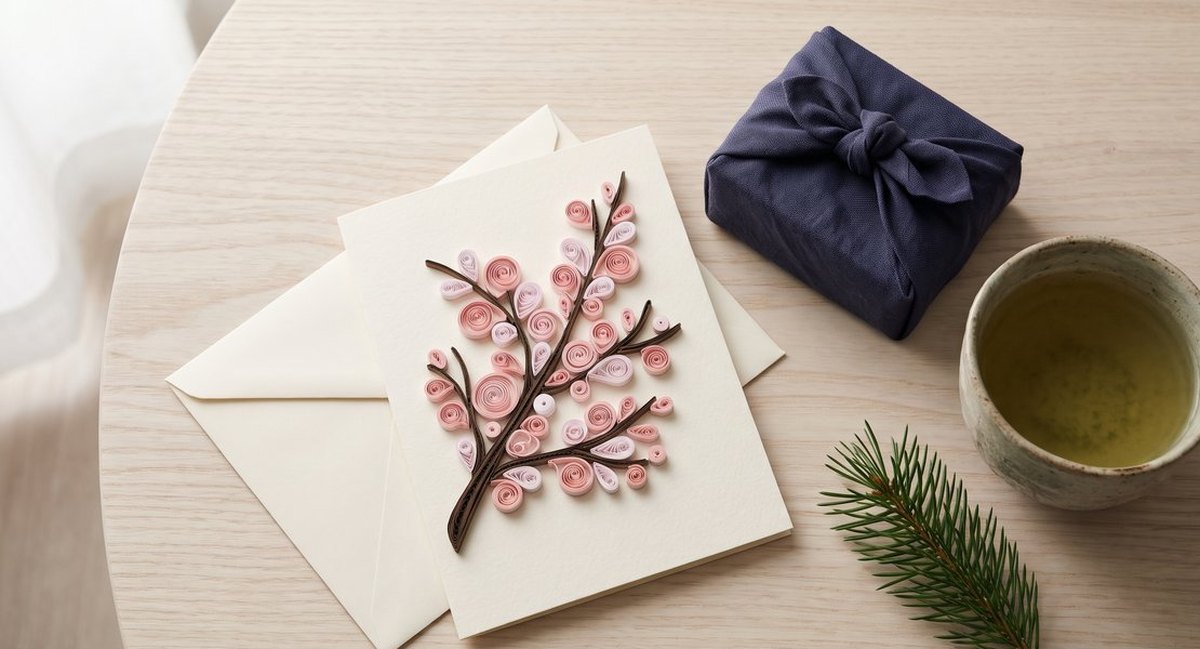
Quilled motifs are raised, so a card that is fine in the workshop can arrive crushed after a long sea route. Individual sleeves, rigid inserts and well-filled inner cartons are standard for our export orders; our guide to protecting quilling cards in export shipping covers the options in more detail. Private label packaging with your brand, and a logo printed or attached to the card, are available on request.
When should Japanese buyers order quilling cards for 2027?
Japan’s card calendar is different from Europe’s or the United States’. The New Year greeting card (nengajo) tradition is still large but shrinking fast: Japan Post’s initial print run of New Year lottery postcards for 2025 was 1.07 billion, down 25.7% on the year before and the lowest since records began in 2004 (Nippon.com / Jiji Press). For a specialty retailer, that suggests the opportunity lies less in mass New Year postcards and more in distinctive cards for moments where a handmade piece stands out.
The planning windows below assume sea freight. Air freight shortens the transit leg, but sampling and production time stay the same, so the order date matters more than the shipping mode.
| Occasion in Japan | Retail season | Suggested brief and order window |
|---|---|---|
| Valentine’s Day and White Day | February to mid-March | Brief by October, confirm order by November |
| Graduation and school entrance | March to April | Brief by October to November |
| Mother’s Day | May | Brief by December, confirm order by January |
| Father’s Day | June | Brief by January |
| Respect for the Aged Day | September | Brief by April |
| Christmas and year-end | November to December | Brief by May to June |
| Weddings, birthdays, thank-you | All year | Core range, replenish on a regular cycle |
Seasonal motifs translate well into quilling: plum and cherry blossom for spring, hydrangea for early summer, maple leaves for autumn, and camellia or pine for winter. Many Japanese buyers prefer softer, layered palettes over bright primary colours. If you are building a range across several markets, our note on quilling card designs by market compares motif and colour preferences.
Checklist before your first order to Japan
- Confirm the HS code with your customs broker using a physical sample.
- Decide whether cards carry a printed Japanese message, a blank interior or your logo.
- Send fixture or envelope dimensions so card and sleeve sizes fit your stores.
- Agree a photo-based defect list at the sample stage.
- Choose packaging: individual sleeves, private label boxes or mixed display packs.
- Agree the Incoterm and who books freight.
- Check who prints Japanese retail labels, and whether they go on before or after import.
- Work back from your retail date using the season table above.
Buyers who have imported into other markets will recognise most of this process. If you also sell in North America, compare it with our guide on how to import quilling cards into the USA, where duty and documentation work differently.
Frequently Asked Questions
Is there import duty on greeting cards from Vietnam to Japan?
Cards classified under HS 4909.00 are listed as duty-free under Japan’s general and WTO rates, and also under the Japan–Vietnam EPA, CPTPP and RCEP. Consumption tax still applies on import. Confirm the final classification with your customs broker, as blank cards or framed artwork may be treated differently.
Which documents do I need to import quilling cards into Japan?
The core set is a commercial invoice, a packing list and the transport document (air waybill or bill of lading). We also supply a certificate of origin with every export order. Your broker uses these to file the import declaration and calculate consumption tax.
Can you make cards with a Japanese message and our own branding?
Yes. We produce custom designs from your artwork or brief, print or attach your logo, and supply private label packaging. Send the exact Japanese text as a file so it is reproduced accurately, and approve it on the pre-production sample.
How long does an order to Japan take?
Total time depends on sample rounds, design complexity, order size and freight mode. Sampling and approval usually take longer than buyers expect, so start early. We confirm a realistic schedule with every quotation, and the season table above gives safe briefing windows.
Plan your Japan range with Viet Farm Vision
Viet Farm Vision is a Vietnam OEM and export partner for handcrafted quilling cards, made at our partner workshop by skilled artisans, most of them women from the surrounding community. Browse our handmade quilling greeting cards, then send your designs, target season and packaging needs through our Request a Quote page. We reply within one business day.