
Greeting card traditions differ from one market to the next. The differences show up in when people send cards, which occasions matter most, and which motifs feel right. If you buy handmade cards wholesale for more than one country, knowing these customs helps you choose designs and set order dates that fit each shelf, instead of shipping one range everywhere and hoping it sells.
Why do greeting card traditions matter to wholesale buyers?
A design that feels warm in one country can look odd, or arrive too late, in another. Buyers who know the local customs avoid three expensive mistakes. They stop stocking the wrong occasions, they stop missing the sending window, and they stop using motifs that carry the wrong meaning. Below are five traditions that shape demand in key markets, each with a practical takeaway.
The UK: a nation of everyday card senders
The modern commercial card is a British invention. In 1843 Henry Cole, the founding director of what became the V&A, commissioned the first Christmas card. Artist John Callcott Horsley designed it, and 1,000 copies were printed and sold at one shilling each (V&A). The habit has stuck. Research presented by Card Factory found that 76% of UK adults had bought a card in the previous 12 months, against 53% in the US, 50% in Canada and 46% in Australia. The same research puts the UK average at 22 cards per person per year (PG Buzz).
Buyer takeaway: UK shoppers buy cards all year, not only at Christmas. Birthday, thank-you, sympathy and “just because” designs earn steady shelf space, and a premium handmade card stands out in a market full of printed ones.
The US: Valentine’s Day began as a handmade trade
America’s valentine industry grew out of handwork. In 1849 Esther Howland began selling the first American-made valentines in Worcester, Massachusetts. She used embossed, lacy paper her stationer father imported, and she hired friends to assemble the cards from samples she made (Mass Moments).
Buyer takeaway: In the US, Valentine’s Day, Mother’s Day and graduation are the big seasonal peaks. A craft-heritage story works well on shelf talkers and product pages.
Japan: nengajo and the 1 January delivery
In Japan the main card occasion is New Year, not Christmas. Nengajo grew out of nenshi-mawari, the custom of New Year visits to thank people who helped you during the year. The post office starts accepting cards in early December and delivers them on 1 January. People also avoid sending them to families who are in mourning. The Embassy of Japan’s information centre puts the volume at around 4 billion cards a year (Embassy of Japan, JICC), though other reports say the custom is declining as messaging apps take over.
Buyer takeaway: Japanese buyers value precision and seasonal timing. Cherry blossom, plum and zodiac motifs, along with careful packaging, matter more than Western holiday themes. Our guide to importing quilling cards into Japan covers the practical steps.
South Asia and the Gulf: Eid cards and floral design
Mailed Eid cards spread across the Indian subcontinent in the late 19th century, helped by railways and new printing methods. The earliest were often European Christmas cards with Eid greetings stamped or written on them. By the early 20th century, printers in Lahore, Delhi and Bombay were making cards with local imagery, floral motifs and Urdu couplets (Dawn). Digital messages have since replaced many paper cards. A well-made paper card now feels more special as a gift.
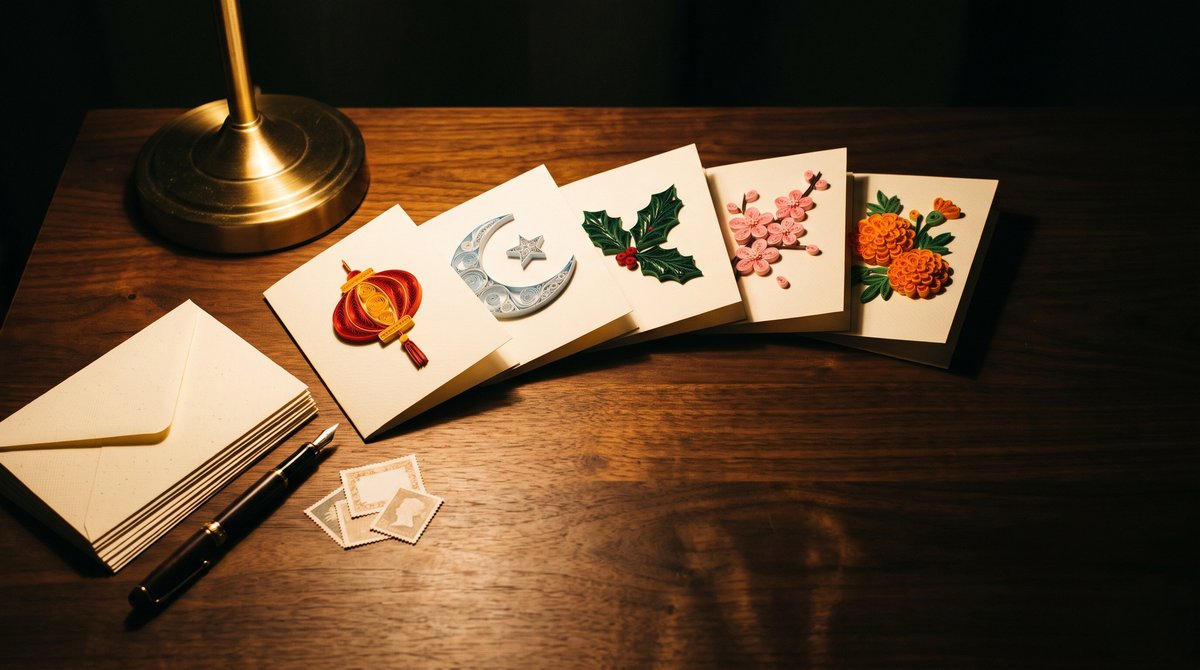
Buyer takeaway: For Ramadan and Eid ranges, crescents, lanterns, geometric patterns and florals in teal, gold and deep green work well. Because the Islamic calendar moves earlier each year, confirm the dates before you fix your order schedule. See our Saudi Arabia import guide for that market.
Lunar New Year markets: red, gold and good wishes
In Vietnam, China, Korea and diaspora communities around the world, Lunar New Year is a season of good wishes. Red and gold dominate, and lanterns, apricot and peach blossoms and zodiac animals are familiar motifs. Tight red and gold paper coils suit these themes well.
Greeting card traditions at a glance: a market planning table
| Market | Key card occasions | Timing habit | Motifs that fit |
|---|---|---|---|
| UK | Christmas, birthdays, Mothering Sunday, thank-you, sympathy | Cards bought all year; Christmas sets ranged early | Robins, holly, botanical florals, bees |
| US | Valentine’s Day, Mother’s Day (May), graduation, Christmas | Strong seasonal peaks | Hearts, roses, butterflies, laurel |
| Japan | New Year (nengajo), seasonal greetings, gift-giving | New Year cards delivered on 1 January | Cherry and plum blossom, zodiac animals, cranes |
| Gulf and South Asia | Ramadan, Eid al-Fitr, Eid al-Adha, weddings, Diwali | Dates move each year with lunar calendars | Crescents, lanterns, geometric patterns, marigolds |
| Lunar New Year markets | Lunar New Year, weddings, birthdays | Sold in the weeks before the new year | Red and gold lanterns, blossoms, zodiac animals |
How can buyers turn these traditions into a better card range?
Start with occasions, not designs. List the two or three occasions that drive sales in each market, then brief your supplier on the motifs and colours that belong to each one. Because quilling is made by hand, custom designs are realistic. Artisans at our partner workshops, mostly local women who live near the workshop, can work from your own artwork. We can also add your logo and supply private label packaging, so one supply partner can cover several cultural ranges. Flower symbolism matters as well. Our article on flower meanings on greeting cards explains which blooms suit which messages.
Then build your timeline backwards from the sending date in each market. A Japanese New Year range, a Gulf Eid range and a UK Christmas range all need different order dates, even if they ship from the same workshop. You can browse our handmade quilling greeting cards to see the styles we produce.
Frequently Asked Questions
Which country sends the most greeting cards?
The UK is usually cited as the most committed card-sending market. Research presented by Card Factory found that 76% of UK adults bought a card in a year, well ahead of the US, Canada and Australia.
Can quilling cards be designed for specific cultural occasions?
Yes. Because each card is shaped by hand, the motifs, colours and layout can follow your own design brief, whether that is Eid, Lunar New Year, nengajo or Christmas. We approve a sample with you before production begins, so the design is confirmed before any volume is made.
How early should I order seasonal cards for different markets?
Wholesale buyers usually plan seasonal ranges three to five months ahead of the occasion. Allow extra time for occasions whose dates move each year, such as Eid and Lunar New Year. Share your target in-store date when you request a quote, and we can work backwards from there.
Can I add my brand to culturally themed card ranges?
Yes. We can print or attach your logo and supply private label packaging, so every regional range carries your brand. Every order follows our four-step quality process, which includes checking each card before packing and sending you photos and videos of the cartons before delivery.
Plan your next cultural card range
If you are planning cards for several markets, tell us which occasions, countries and designs you have in mind. Send your brief through our Request a Quote page and we will reply within one business day.