
If you want to import quilling cards into Saudi Arabia, plan for three things: the customs duty and 15% import VAT that apply to printed cards, a SABER Shipment Certificate for every consignment, and permanent country-of-origin marking on each card or pack. Get those right, order early for Ramadan, Eid and National Day, and handmade quilling cards from Vietnam clear Saudi customs like any other routine stationery shipment.
This guide is for buyers in Riyadh, Jeddah, Dammam and Khobar: gift shops, bookstores and stationery chains, concept stores, hotel and corporate gifting teams, and online sellers planning a first range or a private label line of handmade quilling cards. It covers border costs, SABER, labelling, documents and the 2027 order calendar. It is general trade information, not legal or customs advice, so always confirm the final details with your licensed customs broker.
What customs duty applies when you import quilling cards into Saudi Arabia?
Quilling greeting cards are normally classified under HS heading 4909, which covers printed or illustrated postcards and printed cards bearing personal greetings or messages. Saudi Arabia applies the GCC common customs tariff, but it also amends its own Integrated Customs Tariff from time to time, and several revisions were published in 2026 (VATupdate). For that reason we do not quote a fixed rate here: ask your broker to confirm the duty on the exact 12-digit Saudi tariff line before you approve a landed cost.
Unlike the UAE, Saudi Arabia does not yet have a free trade agreement with Vietnam. The UAE–Vietnam CEPA took effect on 3 February 2026, while a Vietnam–GCC agreement is still at the planned negotiation stage (The Star). If you already buy for both markets, our guide to importing quilling cards into the UAE explains how the CEPA changes the numbers there.
How much VAT is charged on imported cards?
Saudi Arabia charges import VAT at the standard rate of 15%, calculated on the customs value plus duty and other import charges, and collected at clearance (ZATCA VAT guideline on imports). VAT-registered importers can usually recover it through their VAT return, so it affects cash flow more than final margin. Build it into your first shipment budget anyway.
Do quilling cards need a SABER certificate in Saudi Arabia?
Every shipment into Saudi Arabia needs a Shipment Certificate of Conformity (SCoC) issued through the SABER platform. SABER is linked to the FASAH customs system, and a shipment without an SCoC can be ordered back out of the country (QIMA, SABER overview).
What changes is the work needed before the SCoC. Products covered by a Saudi technical regulation also need a Product Certificate of Conformity backed by testing. Products that no technical regulation covers are treated as low risk, and a SASO self-declaration form is normally enough. SABER decides which path applies based on the HS code, so register the product early, using the same HS code your supplier puts on the commercial invoice.
Which documents do you need to import quilling cards into Saudi Arabia?
Saudi customs requires a commercial invoice, a bill of lading and a certificate of origin for imports, and the customs declaration must be filed in FASAH at least 48 hours before the shipment arrives (U.S. International Trade Administration). The table shows who usually prepares each document on a Vietnam to Saudi Arabia shipment.
| Document | Prepared by | What to check |
|---|---|---|
| Commercial invoice | Exporter (Vietnam) | Same HS code, description and values as the SABER record |
| Packing list | Exporter | Carton count, net and gross weight, carton marks |
| Certificate of origin | Exporter, issued in Vietnam | Matches invoice details and confirms Vietnamese origin |
| Bill of lading or air waybill | Forwarder or carrier | Consignee name matches the Saudi importer of record |
| SABER Shipment Certificate (SCoC) | Importer, via SABER | Issued before arrival, linked to the right product registration |
| FASAH customs declaration | Importer or customs broker | Filed at least 48 hours before arrival |
Two practical points: ask your broker whether your shipping documents need chamber of commerce authentication, and remember that Saudi ports are moving to require containerised imports to be palletised, under a phased rollout that began in May 2025 (trade.gov). Pallet-ready cartons also protect handmade cards better on long sea routes.
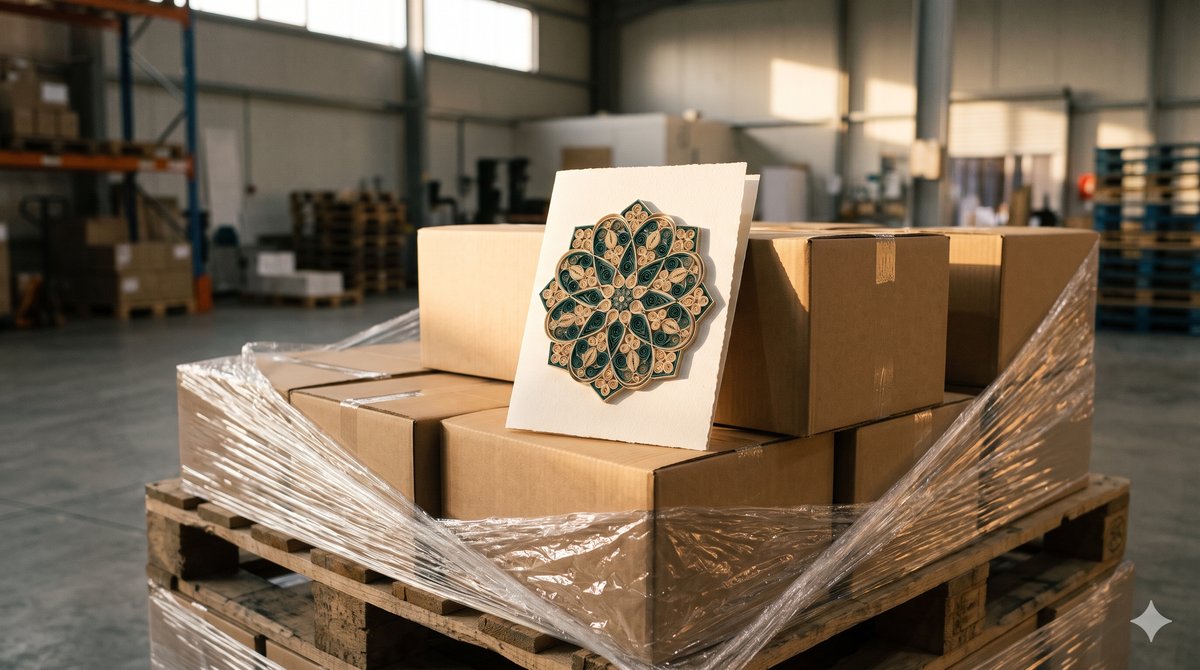
What labelling and design rules apply to greeting cards in Saudi Arabia?
Country of origin must be shown on all imported goods, in Arabic or English, and it must be hard to remove. Where marking the item itself is impractical, the origin can go on the package. Shipments that do not meet origin marking rules can be re-exported or destroyed at the importer’s expense (trade.gov, Saudi labelling requirements).
The same guidance sets out content rules worth building into your design brief:
- Origin marking: print “Made in Vietnam” on the card back or the cello sleeve and on the outer carton, not on a loose tag.
- Religious text: packaging should not carry Quranic verses or Islamic sayings. Seasonal greetings such as “Ramadan Kareem” or “Eid Mubarak” are widely used on cards, but confirm wording with your own team before artwork is approved.
- Imagery: avoid images that conflict with Islamic morals, avoid pig motifs, and depict any human figures tastefully.
- National emblem: using the Saudi national emblem needs prior permission, so keep National Day designs to colours, palms, geometric patterns and flowers.
Quilling works well within these limits. Geometric medallions, lanterns, starry night skies, desert florals and arabesque-style borders all translate naturally into rolled paper, and they look premium in a clear sleeve.
Step-by-step: importing quilling cards from Vietnam to Saudi Arabia
- Brief and quote. Share your occasions, design references, card size, logo and packaging needs through the Request a Quote form. We reply within one business day.
- Approve samples. Each design is sampled and approved before production starts, including your logo print and private label sleeve.
- Register in SABER. While samples are being made, your broker registers the product under the agreed HS code.
- Production and mid-run check. Cards are handmade at our partner workshop, mostly by local women who live near the workshop, and an inspection is done during the run.
- Final check and packing. Every card is checked before packing, then cartons are counted, and photos and video are sent to you before dispatch.
- Documents and SCoC. We issue the commercial invoice, packing list and certificate of origin, and you or your broker obtain the SCoC.
- FASAH and clearance. Your broker files the declaration at least 48 hours before arrival, then duty and VAT are paid and the goods are released.
When should Saudi buyers order quilling cards for 2027?
Saudi demand for cards clusters around a few fixed and moon-sighted dates. Ramadan 2027 is projected to begin on 8 February, with Eid al-Fitr expected on 9 or 10 March (The National). Founding Day falls on 22 February and Saudi National Day on 23 September every year (Saudipedia).
| Occasion (2027) | Date | Brief and approve designs | Goods in your warehouse |
|---|---|---|---|
| Ramadan and Eid al-Fitr | From about 8 Feb; Eid about 9–10 Mar | As early as possible; November is late | Mid-January |
| Founding Day | 22 February | November | Late January |
| Eid al-Adha | Late spring, set by moon sighting | December to January | About a month before Eid |
| Graduation and wedding season | Spring and summer | January to February | April |
| Saudi National Day | 23 September | April to May | Mid-August |
Treat the windows as planning guides, not promises. Lead time depends on how many designs you order, how complex the quilling is, your packaging and the freight mode. If you are briefing Ramadan and Eid ranges now, tell us your in-store date and we will say honestly what is still realistic. Our Ramadan, Eid and Diwali quilling card guide covers design ideas for these seasons.
Checklist before your first quilling card order to Saudi Arabia
- HS code agreed with your broker and used the same way on the invoice and in SABER
- Duty on the exact Saudi tariff line confirmed, and 15% VAT included in the landed cost
- SABER product registration started before production ends
- “Made in Vietnam” marked permanently on each card or sleeve and on every carton
- Design brief checked against Saudi packaging content rules
- Palletised loading agreed with your forwarder for container shipments
- In-store dates set for Ramadan, Eid, Founding Day and National Day
Frequently Asked Questions
Is there a free trade agreement that cuts duty on Vietnamese cards in Saudi Arabia?
Not yet. Vietnam’s only agreement in the Gulf so far is the CEPA with the UAE, and a Vietnam–GCC agreement is still being prepared. Until that changes, Vietnamese cards pay the normal Saudi tariff rate for their line.
Do I need a SABER certificate for every shipment of greeting cards?
Yes. Each consignment needs its own Shipment Certificate of Conformity, even if the product is already registered. For low-risk products that no technical regulation covers, a self-declaration is normally enough to support it. Your broker or a conformity body can confirm the path for your HS code.
Can you print our brand and Arabic text on the cards and packaging?
Yes. We make custom designs from your references, print or attach your logo, and supply private label packaging. Send final Arabic artwork as vector files, approved by a native speaker on your team, and we will match it on the pre-production sample.
How do you check quality before cards leave Vietnam?
We use four checks: sample approval before production, a mid-run inspection at the workshop, a check of every card before packing, and a carton count with photos and video sent to you before shipping. You see the goods before they leave, not when they land in Jeddah or Dammam.
Plan your Saudi quilling card range
Saudi Arabia rewards buyers who sort out paperwork and timing early. If you are planning Ramadan, Eid, Founding Day or National Day cards, or a year-round private label range, send us your brief through the Request a Quote page. We will reply within one business day with design options, sampling steps and a realistic timeline for your Saudi in-store dates.