
Sourcing handmade cards for subscription boxes works best when the card is treated as a planned component of the box, not a last-minute add-on: lock the design one full box cycle ahead, size the card and its sleeve to the mailer, and agree how every card will be checked and packed before it reaches your fulfilment team. Handmade quilling cards suit curated boxes well because they are tactile and clearly made by hand, but their raised paper coils mean depth, protection and timing need more thought than a flat printed card.
This guide is for subscription box founders, curators and sourcing managers in gift, wellness, stationery, tea, book and self-care boxes who want a recurring handmade card in their box, either as a featured product or as a branded welcome card. It walks through the box-cycle calendar, card format, private label options, packing for fulfilment and a first-order checklist.
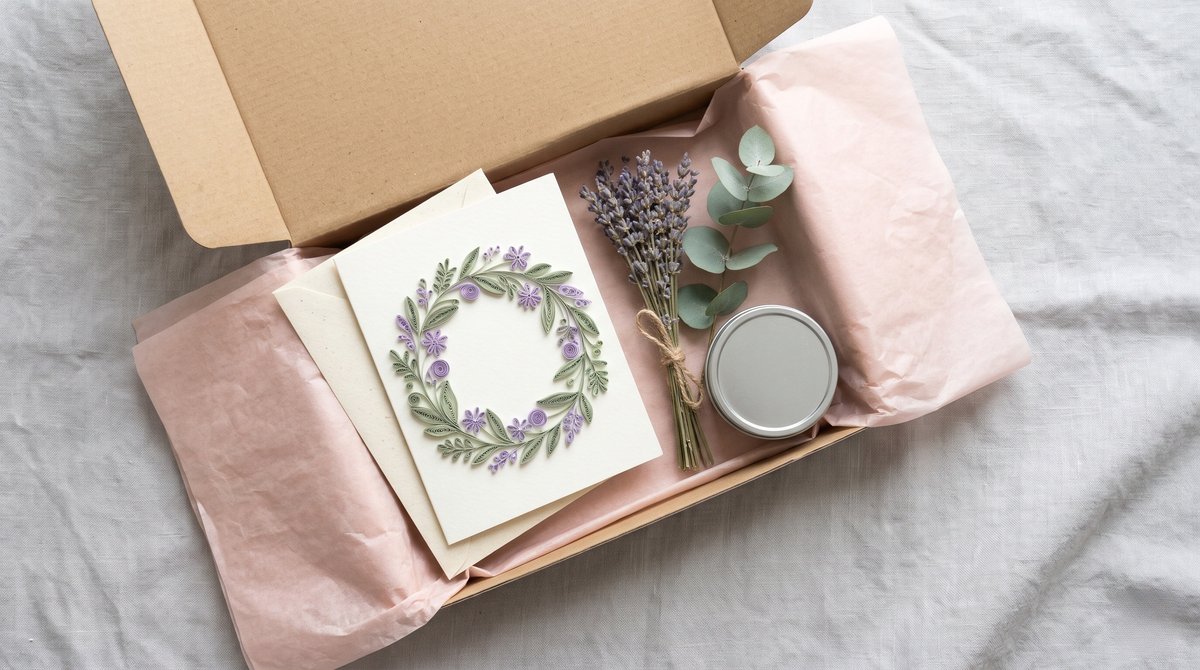
Why do subscription boxes use handmade cards?
A subscription box lives or dies on the moment the lid opens. Subscribers share that moment, compare it with last month and decide whether to stay. A handmade card gives curators three things that are hard to get from other small items:
- A visible human story. Each quilling card is built from rolled paper strips by hand, which gives your box copy something true and specific to say about who made it.
- A keepsake rather than a consumable. Tea, candles and snacks get used up; a well-made card is often framed, pinned up or given on, so your box stays in the home longer.
- A flexible slot. The same card can be a featured product one month, a seasonal theme the next, or a permanent branded welcome card in every first box.
The trade-off is that handmade production cannot be switched on overnight. Boxes that get the best results plan the card in the same rhythm as the box itself.
How do you source handmade cards for subscription boxes around the box cycle?
Most curators already work backwards from a ship date: theme, then products, then inserts, then packing. The card simply needs to slot into that calendar early enough to allow sampling, handmade production, inspection and freight. Because handmade output depends on design complexity, order size and how many other seasonal orders are in the workshop, we avoid quoting fixed lead times in general guides. The principle is to give the card at least one full box cycle of buffer beyond your normal product sourcing.
| Stage | What you decide or approve | What to send your supplier |
|---|---|---|
| 1. Theme brief | Box theme, colour story, card role (featured product or insert) | Mood board, box dimensions, target ship month |
| 2. Design and sample | Motif, card size, inside message or blank, logo position | Artwork or reference, Pantone or physical colour swatches |
| 3. Pre-production approval | Signed-off physical sample as the standard for the run | Written approval and final quantity |
| 4. Handmade production | Mid-production photos and any colour questions | Fast replies on queries so work does not pause |
| 5. Inspection and packing | Final photo and video check before shipment | Fulfilment centre labelling and carton rules |
| 6. Freight and receiving | Shipping mode and documents | Consignee details and delivery window at your warehouse |
If you run several themed boxes a year, it is usually easier to approve two or three designs in one sampling round and schedule them as a mini collection than to start a fresh brief each month. Our seasonal range planning guide shows how retailers group designs by season, which works equally well for box themes.
What card size and format fit a subscription mailer box?
Start from the inside of the box, not from a standard card size. Measure the internal footprint after tissue, crinkle fill and the other products are in place, then choose a card size that lies flat on top or slides into a side wall without bending. Three format questions matter more for boxes than for retail racks:
How deep is the quilled design?
Quilling is a relief technique, so the coils stand slightly proud of the card face. That depth is part of the appeal, but it also means a heavy item resting on the card can flatten it. Ask for a lower-profile design for boxes that are densely packed, and keep tall, layered motifs for boxes where the card sits on top.
Does the box ship as a letter-sized parcel?
Many slim boxes are designed to qualify for cheaper letter-style postage, and every millimetre counts. In the UK, Royal Mail limits a Large Letter to 353 mm long, 250 mm wide and 25 mm thick, up to 750 g. In the US, the Postal Service caps flats at 12 inches high, 15 inches long and ¾ inch thick. If your box is built to those limits, share the measurement with your supplier so the card, its sleeve and any backing board are designed to fit within the thickness budget alongside your other products.
Envelope, sleeve or both?
A matching envelope makes the card feel giftable and lets subscribers send it on. A clear protective sleeve keeps it clean in transit and through fulfilment. Most box curators choose both: card and envelope together inside one sleeve, so the packer handles one flat unit.
Can subscription box cards carry your own brand?
Yes. A subscription brand usually wants subscribers to remember the box, not the workshop, so our handmade greeting cards can be produced as a fully private label item. The options that matter most for boxes are:
- Custom designs from your brief. Motifs and colours built around your monthly theme, rather than picked from a general catalogue.
- Logo printed or attached. Typically on the back of the card or on a small tag, so the front stays a clean handmade design.
- Private label packaging. Your branding on the sleeve, header card or belly band, plus a short story card explaining how quilling is made, which also gives subscribers something to read.
- Blank or printed inside. Blank cards are easier to reuse across themes; a printed inside message works well for welcome or anniversary boxes.
Whatever you choose, confirm it on the physical pre-production sample. Logo size, ink colour on textured card and how a tag sits next to the paper coils are easier to judge in hand than on screen.
How should quilled cards be packed for fulfilment?
A subscription card is handled more than a retail card. It is shipped in bulk to your warehouse or third-party fulfilment centre, unpacked, counted, then picked into hundreds or thousands of individual boxes, often at speed. Packing should make that job easy and protect the raised design at every step:
- Each card sleeved individually, with a rigid backing where the box is tightly packed.
- Cards packed in inner bundles of a round number that matches how your team picks, so counting is quick.
- Inner bundles standing upright or laid flat with spacers so no weight presses on the coils.
- Outer cartons labelled with design name, quantity and any barcode or SKU your fulfilment partner requires.
We cover carton construction and transit protection in more detail in our guide to packing quilling cards for export shipping.
What quality checks protect a box launch?
A damaged or off-colour card in a subscription box reaches every subscriber at once, so checks happen before shipment, not after. Viet Farm Vision runs a four-step process with its partner workshop: pre-production sample approval, a mid-production check at the workshop, inspection of every single card before packing, and a final carton count with photos and video sent to you before delivery. That last step lets you confirm the run before it leaves Vietnam, with commercial invoice, packing list and certificate of origin prepared for your customs broker.
Checklist: handmade cards for subscription boxes, first order
| Check | Why it matters for a box |
|---|---|
| Internal box dimensions and target thickness shared | Card, envelope and sleeve fit without bending or breaking a postage limit |
| Card role defined (featured product or insert) | Sets design complexity, relief depth and packaging level |
| Theme, colours and ship month confirmed | Keeps the card aligned with the rest of the curated products |
| Logo, tag and story card artwork supplied | Avoids delays at sample stage |
| Physical sample approved in writing | Gives one clear standard for the handmade run |
| Fulfilment labelling and bundle size agreed | Makes receiving and picking fast at your warehouse |
| Export documents and consignee details confirmed | Smooth customs clearance before your packing window |
| Reorder plan for future themes | Lets the workshop schedule your next design early |
If you also sell single cards or bundles in your own web shop between box cycles, our notes on quilling cards for online shops and marketplace sellers and on pricing handmade cards for retail cover listing and pricing.
Frequently Asked Questions
Can each monthly box have a different card design?
Yes. Many curators approve several designs in one sampling round and schedule them across upcoming boxes. Grouping designs this way keeps sampling efficient and gives the workshop a clear production sequence. Minimum quantities per design are confirmed in each quotation.
Will quilled cards get crushed inside a subscription box?
Not if format and packing are planned for the box. Choose a lower-profile design for densely packed boxes, use a protective sleeve with rigid backing, and place the card on top or along a side wall. Share your box layout with the supplier at the brief stage so the design suits it.
Can you put our subscription brand logo on the cards?
Yes. Logos can be printed or attached, usually on the back of the card or on a tag, and the sleeve or header card can carry your private label branding. The placement is confirmed on the physical sample before production starts.
How early should a subscription box order handmade cards?
Plan the card at least one full box cycle ahead of your normal product sourcing, and earlier for peak gifting seasons when workshops are busiest. The exact timing depends on design complexity and quantity, so share your target ship month in your first enquiry and we will confirm a schedule.
Plan your next box with a handmade card
If you are building a subscription box and want a handmade card that fits the box, carries your brand and arrives checked and counted, send us your theme, box dimensions and target ship month through our Request a Quote page. We reply within one business day with design options, sampling steps and a quotation for your first run.