
A sound greeting card retail markup for handmade quilling cards starts from your full landed cost, not the supplier’s unit price, and then adds a margin that reflects how unique the card is in your shop. Many independent retailers begin at keystone (twice landed cost) and move up for one-of-a-kind, story-led ranges. Below is a practical way to set that number and defend it at the till.
What is a normal greeting card retail markup?
The most common starting point in gift and stationery retail is keystone pricing: the shelf price is set at double the cost, a 100% markup that gives roughly a 50% gross margin. Shopify’s guide to keystone pricing notes that it suits handmade, private label and hard-to-find products, where shoppers have fewer direct comparisons, and that some premium categories go well beyond two times cost.
The same guide gives the main warning: keystone looks only at the wholesale price. Freight, duty, card sleeves and shop overheads are not included, so a “50% margin” calculated on the factory price is usually thinner in reality. That is why the first step is always landed cost.
How do you work out the landed cost of an imported card?
Landed cost is everything you pay to get one sellable card onto your shelf. For cards imported from Vietnam it normally includes the items below. Your freight forwarder and customs broker can confirm the actual figures for your lane and HS code.
| Cost line | What to include | Tip for card buyers |
|---|---|---|
| Product cost | Supplier unit price for the card, envelope and any retail sleeve | Confirm whether logo printing and private label packaging are inside the unit price |
| International freight | Air or sea freight divided across all units in the shipment | Cards are light but bulky; ask for cost per carton, then per card |
| Duty and import taxes | Tariff on the declared value, plus any non-recoverable taxes | Check the rate for your market before you set prices |
| Clearance and local delivery | Broker fees, port charges, last-mile delivery to your store or warehouse | Small first orders carry a higher share of fixed fees per card |
| In-store preparation | Price labels, display stands, staff time to unpack and merchandise | Often forgotten, but real on a range of many designs |
| Allowance for damage or unsold stock | A small buffer for shop-soiled or end-of-season cards | Handmade cards with raised paper coils need careful display to keep this low |
A worked example of greeting card retail markup
The figures below are an illustration only, written in index units rather than any currency. They are not a quote and not Viet Farm Vision pricing. Suppose the landed cost of one quilling card comes to 100 units.
| Pricing approach (example) | Shelf price | Gross margin on landed cost | When it fits |
|---|---|---|---|
| Keystone (2.0x) | 200 units | 50% | Everyday handmade range, steady sellers |
| 2.5x | 250 units | 60% | Seasonal or occasion cards with strong demand |
| 3.0x | 300 units | About 67% | Exclusive designs, museum or gallery shops, gift bundles |
Once you have a calculated price, round it to a price point your customers already recognise in your store, and check it against the cards next to it on the wall. A handmade card priced in line with mass-printed cards undersells the craft; one priced far above everything else needs a reason the shopper can see.
Why can handmade quilling cards carry a higher markup?
Shoppers still buy cards in person. The UK Greeting Card Association’s market report for 2023, summarised by Progressive Greetings, found that single card sales reached £1.51 billion in retail value while volumes fell slightly, and that over 80% of single cards are bought in physical stores. In the US, Americans buy about 6.5 billion greeting cards a year, according to figures cited by Bloomberg. Value rising faster than volume suggests shoppers are paying more per card, which favours distinctive products.
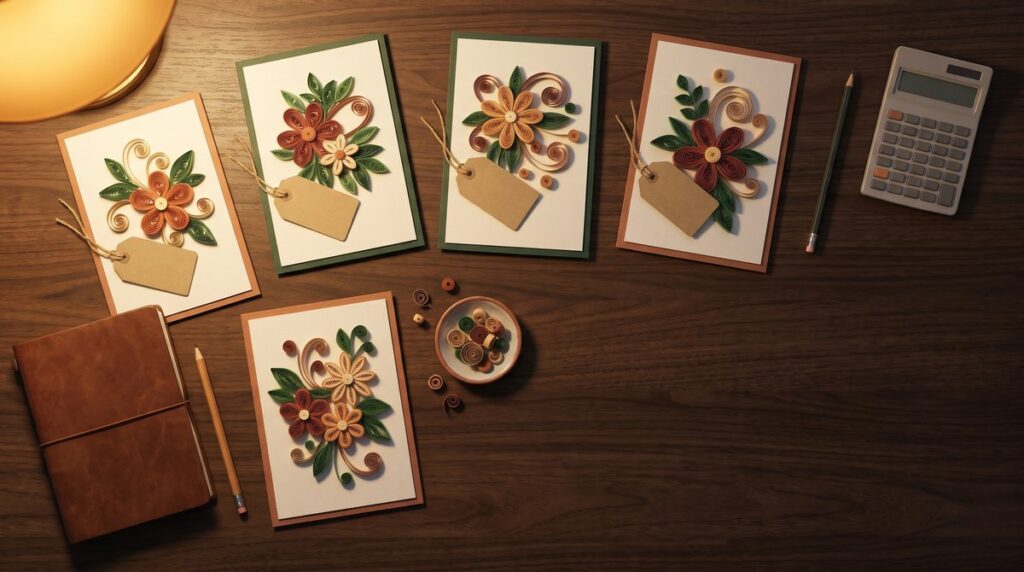
Quilling cards are easy to tell apart from printed cards on the shelf: the coiled paper stands off the card face and catches the light. Each one is shaped by hand at our partner workshop, mostly by local women who live nearby, so no two are perfectly identical. That visible handwork is what supports a markup above keystone, as long as your display and labelling make it obvious. Our guide on telling the craft story to retail customers covers the words to use, and these greeting card display ideas show how to give raised designs room to be seen.
How should you price a mixed range of designs?
- Use price tiers, not one price per design. Two or three price points across the range keep the wall easy to shop and simplify reordering.
- Price by complexity. A card with a full floral bouquet takes more hand-shaping than a single motif, so it can sit in a higher tier.
- Bundle for gifting. A boxed set or a card paired with a small gift lets you hold margin while giving the customer a reason to spend more.
- Protect your seasonal cards. Price Valentine’s, Mother’s Day and Christmas designs at full margin early in the season, then plan clearance before the date passes.
- Review after the first sell-through. Fast sellers at a given price can often move up a tier on the next order.
Custom designs and your own logo or private label packaging can also lift perceived value, because the product is exclusive to your shop. You can see the options on our handmade greeting cards page.
Frequently Asked Questions
Is keystone pricing enough for imported handmade cards?
Only if you apply it to landed cost rather than the supplier’s unit price. Freight, duty and clearance fees can take a noticeable share of the margin on small, light products like cards. Many retailers treat keystone on landed cost as the floor, not the target.
What is the difference between markup and margin?
Markup is the amount added as a share of cost; margin is profit as a share of the selling price. A 100% markup equals a 50% gross margin. Keeping the two terms separate avoids pricing mistakes when you compare suppliers.
Should online and in-store prices for the same card match?
Most small retailers keep them the same to avoid confusing customers. If online orders carry extra packing and postage costs, it is usually cleaner to charge shipping separately than to change the card price.
How can a supplier help me keep a healthy margin?
Ask for a clear breakdown of what the unit price includes, packing that reduces transit damage, and complete export documents (commercial invoice, packing list and certificate of origin) so clearance runs smoothly. A supplier who answers within one business day also makes reorders on fast sellers easier to time.
Get a quote to build your pricing
The fastest way to set a confident retail price is to start from a real unit cost for the designs, finish and packaging you want. Tell us your market, occasions and quantities through our Request a Quote page, and we will reply within one business day with a quotation you can plug straight into your landed cost sheet.