
A wooden kitchenware programme can be perfectly specified, correctly dried, beautifully finished and still lose money at the shelf. The wood is rarely the problem. The problem is that packaging, barcodes and retail presentation were treated as a detail to be settled after the price was agreed, and by then the carton is wrong, the label is in the wrong place, the cube is 14 per cent worse than it needed to be, and a retailer is charging back for non-compliant cases.
Packaging is not decoration around the product. For wooden kitchenware and houseware moving out of Vietnam, it is simultaneously a protection system, a freight cost multiplier, a legal compliance document and the only piece of marketing that reaches the buyer at the moment of purchase. This guide sets out how to specify all four properly in a 2026 sourcing programme, what each layer actually costs, and which decisions have to be locked before tooling and artwork are released.
Separate the Four Packaging Layers Before You Compare Any Quote
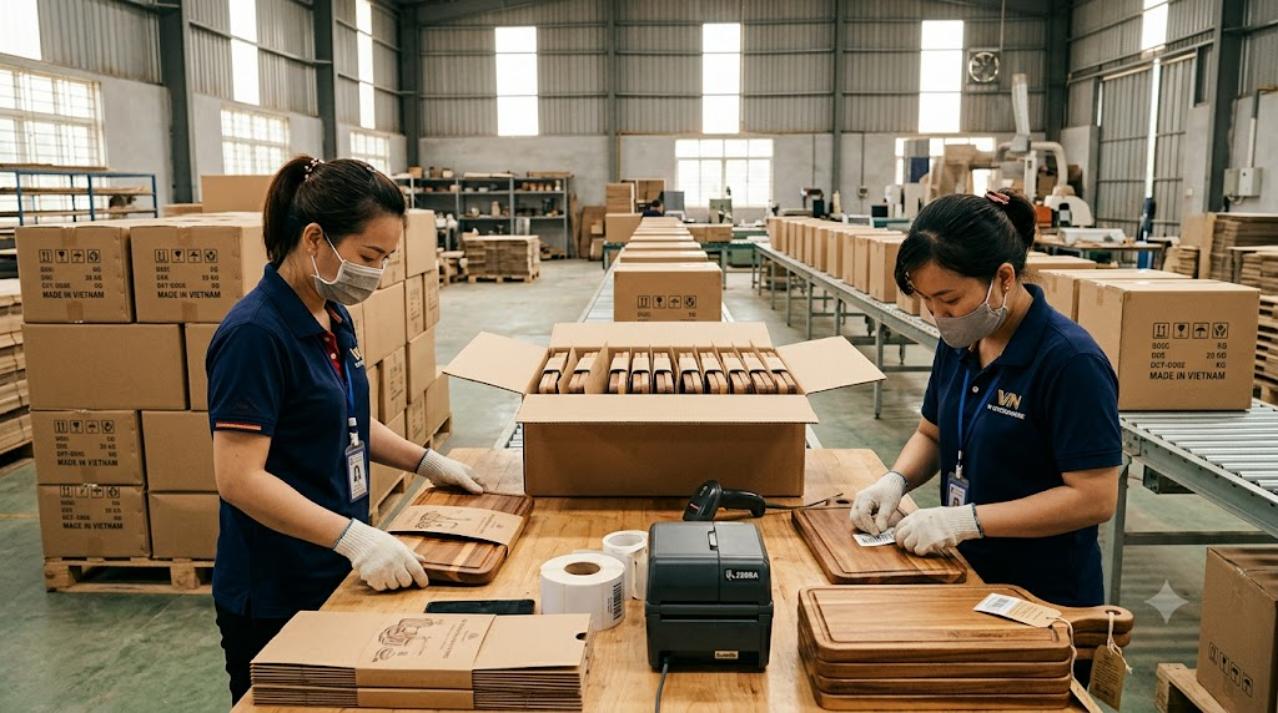
Most disputes about packaging cost come from comparing quotations that bundle different things. Ask every Vietnamese supplier to break packaging into four discrete layers and price them separately. Once they are separate, they are negotiable and comparable.
- Primary packaging — whatever touches the product: a kraft sleeve, a printed carton, a polybag, a shrink wrap, a cotton drawstring bag. This is the layer the consumer sees and the layer that carries most of your brand cost.
- Protective packaging — tissue, corner protectors, EPE foam sheet, kraft dividers, silica gel. Invisible to the consumer, decisive for damage rate. Under-specifying here is the single most common false economy in wooden kitchenware.
- Inner carton — the intermediate case of six, twelve or twenty-four units. Retailers and distributors care enormously about this number; it determines replenishment economics and whether your product can be cross-docked.
- Export carton — the master shipping case that has to survive stacking, a 30 to 45 day ocean transit, humidity swings and multiple handling points.
When a factory quotes “packing included”, it is almost always quoting layer four plus a polybag, and you will discover the rest as a variation order after the artwork is issued. Insist on the split at RFQ stage, not at PO stage.
Choosing a Primary Pack That Suits Your Channel
There is no universally correct primary pack. There is a correct pack for the channel the product is sold through, and the two most expensive mistakes are using a gift-grade pack for a value channel and using a bare polybag for a premium one.
For grocery and hypermarket in the Gulf and Southeast Asia, an open kraft sleeve with a die-cut window works well: it lets the shopper touch the wood, which sells cutting boards better than any photograph, while carrying the barcode, the care instruction and the origin statement. Sleeve board of 250 to 300 gsm printed one colour is inexpensive and recyclable, which matters increasingly for retailer scorecards.
For department store and gift channels, a rigid two-piece box or a printed folding carton with an internal kraft tray justifies a higher retail. Expect this layer alone to add materially to unit cost, and expect a tooling charge for the die.
For HORECA and food-service, skip retail presentation entirely. Bulk-pack in kraft interleave, protect the edges, and put the effort into carton count and case marking. Chefs do not read sleeves.
For e-commerce, the pack has to survive being shipped alone in a single parcel, which is a completely different mechanical problem from being shipped 24-up inside a master carton. That is covered separately below.
One practical rule: whatever you choose, ask the factory to build the primary pack around the largest item in the size run, not the average. Wooden boards vary by a few millimetres across a lot, and a sleeve dimensioned to the nominal size will jam on ten per cent of production and slow the line.
Barcodes: Whose Number, Which Symbol, and Where It Goes
Barcode errors are the most avoidable and most expensive packaging failure in a private-label programme, because they are usually discovered at the retailer’s door and resolved by relabelling an entire shipment.
Three points settle most of it. First, the GTIN belongs to the brand owner, not the factory. If you are the private-label buyer, you obtain your own GS1 prefix and issue the numbers. A supplier offering to “provide barcodes” is offering numbers from their own prefix, which means the product is registered to them in global databases and you will have problems the day you change supplier.
Second, EAN-13 versus UPC-A is a market question, not a technical one. Both are GS1 standards and every modern scanner reads both, but retailer master data systems in Europe, the Middle East and most of Asia expect EAN-13, while North American systems still often expect UPC-A. If a single SKU is going to several regions, EAN-13 is normally the safe default. Anything sold as a case rather than a unit needs a separate ITF-14 on the carton, and a mixed pallet needs an SSCC label if your customer runs an ASN process.
Third, placement and quiet zone are specified, not improvised. Put the requirement in the artwork brief in writing: minimum X-dimension, minimum bar height, a light quiet zone of at least ten times the X-dimension either side, and no printing over the symbol. On kraft-brown board, contrast is the usual failure — dark bars on unbleached brown often scan poorly at low ink coverage. Specify a white printed panel behind the symbol, or a white self-adhesive label applied over the kraft, and require a verified scan report from the factory rather than a photograph.
Finally, ask for a physical scan test on the first production carton. A supplier that can produce a grade report from a verifier, not just a phone scan, is a supplier that has done this for a demanding customer before.
Export Carton Specification: Where the Freight Money Actually Is
The export carton is where buyers lose the most money without ever seeing a line item for it. Two decisions dominate: board specification and cube efficiency.
On board specification, the relevant number is not “5-ply sounds stronger than 3-ply”. It is edge crush test and bursting strength, matched to stack height and transit humidity. Wooden kitchenware is dense; a carton of twelve acacia boards can exceed 15 kg, and cartons at the bottom of a nine-high stack in a container that swings between 25 and 90 per cent relative humidity will lose a significant part of their rated strength. For heavy wooden goods on ocean freight, a 5-ply BC-flute carton with an ECT in the range typically specified for heavy-duty export use is normal; asking for a 3-ply carton to save a few cents per case is a false economy that shows up as crushed corners and retailer rejections.
On cube, run the calculation before you fix the inner carton count. A 40 ft high-cube container gives roughly 76 cubic metres of usable space and, for wooden kitchenware, you will almost always cube out before you weigh out. Changing an inner count from 10 to 12, or trimming 8 mm of unnecessary void space per unit, routinely changes container quantity by five to ten per cent. On a full container of mid-priced boards that is a larger saving than anything you will win by arguing over the FOB unit price.
Ask your supplier for a loading plan with the quotation: carton external dimensions, gross and net weight, cartons per 20 ft and per 40 ft HC, and pallet configuration if the destination requires palletised delivery. If they cannot produce it, they have not thought about your freight cost.
Do not forget ISPM 15. Any solid wood packaging — pallets, dunnage, wooden crates — must be heat treated and stamped. The product itself is manufactured wood and is not caught by ISPM 15, but the pallet under it is, and a non-compliant pallet can hold an otherwise perfect shipment at the port.
Shipping Marks and Legal Marking You Cannot Improvise
Shipping marks are a document, not a design. The main mark on two opposing carton faces should carry the consignee reference, the PO number, the item code, the destination port, the carton number in the format 1 of N, and the net and gross weight. The side mark carries the country of origin and the handling pictograms. Every one of those fields should also appear identically on the packing list, because customs officers and warehouse receivers reconcile the two.
Country-of-origin marking deserves particular attention. Made in Vietnam should be permanently and conspicuously marked on the retail unit, not only on the outer carton, wherever the destination market requires unit-level origin marking. For wooden kitchenware the usual solutions are a laser-engraved mark on an inconspicuous face, a branded burn stamp, or a permanently applied label. Printing it only on a sleeve that a retailer discards is a compliance risk, and in the current tariff environment — with Vietnamese goods enjoying a materially better duty position than Chinese goods in several major markets — origin evidence is scrutinised more closely than it was even two years ago.
Food-contact declarations belong on the pack too if your market requires them, alongside the care instruction. A hand-wash-only instruction printed on the sleeve and engraved or labelled on the product itself is the cheapest warranty-claim reduction available in this category.
E-Commerce and FBA Prep at the Factory
If any part of your volume ships direct to consumers, decide early whether prep happens in Vietnam or in your destination warehouse. Doing it in Vietnam is normally cheaper by a wide margin, but it has to be specified precisely.
- Ship-alone durability. A parcel-shipped board needs corner protection and a fitted inner. Marketplace transit testing is unforgiving of a product that arrives with a chipped corner, and a single-star review costs more than the foam did.
- Polybag rules. If the primary pack is a polybag with an opening of a certain size, a suffocation warning is required, and the barcode must be scannable through the bag or applied to its outside.
- One scannable barcode. Marketplaces reject units where more than one scannable barcode is visible. If the retail pack carries an EAN and you also apply a fulfilment label, the EAN must be covered.
- Labelling method. Decide between factory-applied fulfilment labels and a transparent-supplier arrangement, and confirm the label size, print resolution and placement in writing before the first order.
- Case-pack limits. Weight and dimension caps on inbound cases are enforced. Design the inner carton to sit inside them rather than repacking on arrival.
Sustainability Claims: Print Only What You Can Evidence
Packaging is where environmental claims get made and where they get challenged. In 2026 the safest position is to print only claims that map to a document you hold.
An FSC label may only be applied if the product is covered by a valid chain-of-custody certificate and the licence code is used correctly — this is not a graphic you can add because the wood happens to be plantation-grown. A recyclable claim on a kraft sleeve is generally safe if the sleeve is uncoated and unlaminated; add a gloss lamination and the claim becomes questionable in several markets. Vague words such as eco-friendly, green or biodegradable, used without a standard reference, are exactly what European and Gulf regulators have been narrowing in on.
The practical approach: keep certification marks on the pack limited to those you can produce a certificate for, state factual attributes instead of adjectives, and put the sourcing story in your own marketing rather than in a regulated claim on the packaging.
Getting Artwork Approved Without Three Rounds of Rework
Artwork iterations are the quiet killer of lead times. Each round of dielines, proofs and courier samples costs a week or more, and three rounds can push a programme past its shipping window.
A brief that avoids most rework contains: the final dieline supplied by the factory with dimensions confirmed against the largest unit in the size run; the print process and number of colours; the substrate and finish; Pantone references rather than screen colours; the barcode specification described above; the exact origin, care and legal text as approved strings; and a clear statement of who signs off the wet proof.
Then take one step most buyers skip: request a physical proof on the actual substrate, not a digital PDF. Kraft board shifts colour substantially against a white-paper proof, and dark navy or deep green almost never looks on brown board the way it looked on screen. One courier package at sample stage prevents a container of packaging that is technically correct and visually wrong.
What Packaging Costs, and Where the MOQ Sits
Packaging economics in Vietnam are driven by print setup rather than by material. Material scales linearly; plates, dies and machine setup do not. That is why the same sleeve can be inexpensive at 5,000 units and uneconomic at 500.
As a broad orientation for wooden kitchenware programmes, an unprinted polybag with a plain label is the cheapest option and effectively has no minimum. A one or two colour printed kraft sleeve carries a die charge and a plate charge and typically becomes sensible from a few thousand pieces per design. A full-colour printed folding carton adds more setup and generally wants five thousand or more per design before the per-unit figure settles. Rigid gift boxes and custom-fit internal trays sit above that again and are usually reserved for programmes with a retail price that can carry them.
Two practical levers reduce the pain of these minimums. First, design one carton across several SKUs and differentiate with a small applied label or a printed variable panel — this is the single most effective way to keep small size runs viable. Second, run packaging on a separate lead time from production; print suppliers and wood factories have different bottlenecks, and having artwork approved and printed while the wood is still drying removes packaging from the critical path.
One warning about the cheapest quotation: if a supplier is materially below the others on packaging, look at the board grade and the print process before you celebrate. Packaging is the easiest place in a wooden kitchenware quote to hide a downgrade, because nobody inspects a carton specification the way they inspect a finish.
A Packaging Checklist to Attach to Your Purchase Order
- Primary, protective, inner and export packaging priced as four separate lines
- Primary pack dimensioned to the largest unit in the size run, with a confirmed dieline
- GTIN issued from the brand owner’s own GS1 prefix, symbology confirmed for each destination
- Barcode placement, X-dimension, quiet zone and background contrast specified in writing
- Verified barcode scan report required on first production carton
- Export carton board grade stated as ECT or bursting strength, not ply count alone
- Loading plan supplied: carton dimensions, gross weight, cartons per 20 ft and 40 ft HC
- Shipping marks matching the packing list field for field
- Country-of-origin marking applied permanently at unit level where required
- Care instruction on both pack and product
- Environmental claims limited to those covered by a held certificate
- ISPM 15 heat-treated stamp on all solid wood pallets and dunnage
- Physical proof on the actual substrate approved before mass printing
Frequently Asked Questions
Can the Vietnamese factory supply the barcodes?
They can supply numbers from their own GS1 prefix, and for a one-off order that is sometimes acceptable. For any programme you intend to own or move between suppliers, obtain your own prefix and issue your own GTINs. The cost is modest and it avoids a genuinely difficult problem later.
Is retail-ready packaging worth it if I sell through distributors?
Often yes, because the distributor’s own customer is a retailer. Retail-ready presentation shortens their sell-in conversation and reduces the chance they re-pack your product themselves, which is where brand control is usually lost. It is generally not worth it for pure food-service volume.
How much lead time should I allow for packaging?
Assume artwork approval takes longer than you expect and printing takes two to four weeks after final approval, depending on process and finishing. If packaging starts when the purchase order is issued rather than when it is being discussed, it will not delay the shipment.
Does heavier packaging solve damage problems?
Not by itself. Most wooden kitchenware damage is edge and corner impact plus abrasion between units, which is solved by dividers, corner protection and interleaving rather than by a thicker outer carton. Upgrade the protective layer before upgrading the export carton.
Can compostable and disposable lines use the same packaging approach?
The structure is the same, but the claims are stricter. Compostable tableware packaging usually needs to reference the certification scheme and the disposal route explicitly, and the pack itself is expected to be consistent with the product’s environmental positioning — a certified compostable plate in a laminated plastic-coated pack invites exactly the criticism you were trying to avoid.
Related Reading
- Private label and custom branding for Vietnam wooden kitchenware
- How a Vietnam wooden kitchenware FOB quotation is built
- Quality control, AQL levels and container loading checks
- Lead times and peak-season capacity planning for Q4 and Tet
- Moisture content and cracking: how to spec kiln drying
For the underlying standards referenced above, the identification-key documentation published by GS1, the labelling requirements set by the Forest Stewardship Council and the wood packaging standard maintained under the IPPC are the primary sources worth reading before you finalise artwork.
Where Viet Farm Vision Fits
Viet Farm Vision is a Vietnam-based OEM manufacturer and exporter of wooden kitchenware and houseware, compostable and disposable tableware, agricultural products and handcrafts, supplying wholesale and private-label buyers across the Middle East, Asia and wider international markets.
On packaging we quote the four layers separately by default, supply the dieline and a loading plan with the offer rather than after the order, and run a barcode scan verification on the first production carton before the line continues. Where a buyer is new to a destination market, we will flag the origin marking and claim requirements at specification stage instead of printing what was sent to us and leaving the compliance question with the importer.
If you are building or re-tendering a wooden kitchenware, houseware or compostable tableware programme, send us the destination market, the retail channel and your target case pack, and we will come back with a packaging structure, a cube and loading calculation and a costed option list before you commit to artwork.