
The Part of a Wooden Kitchenware Spec Sheet Buyers Skip — and Labs Fail
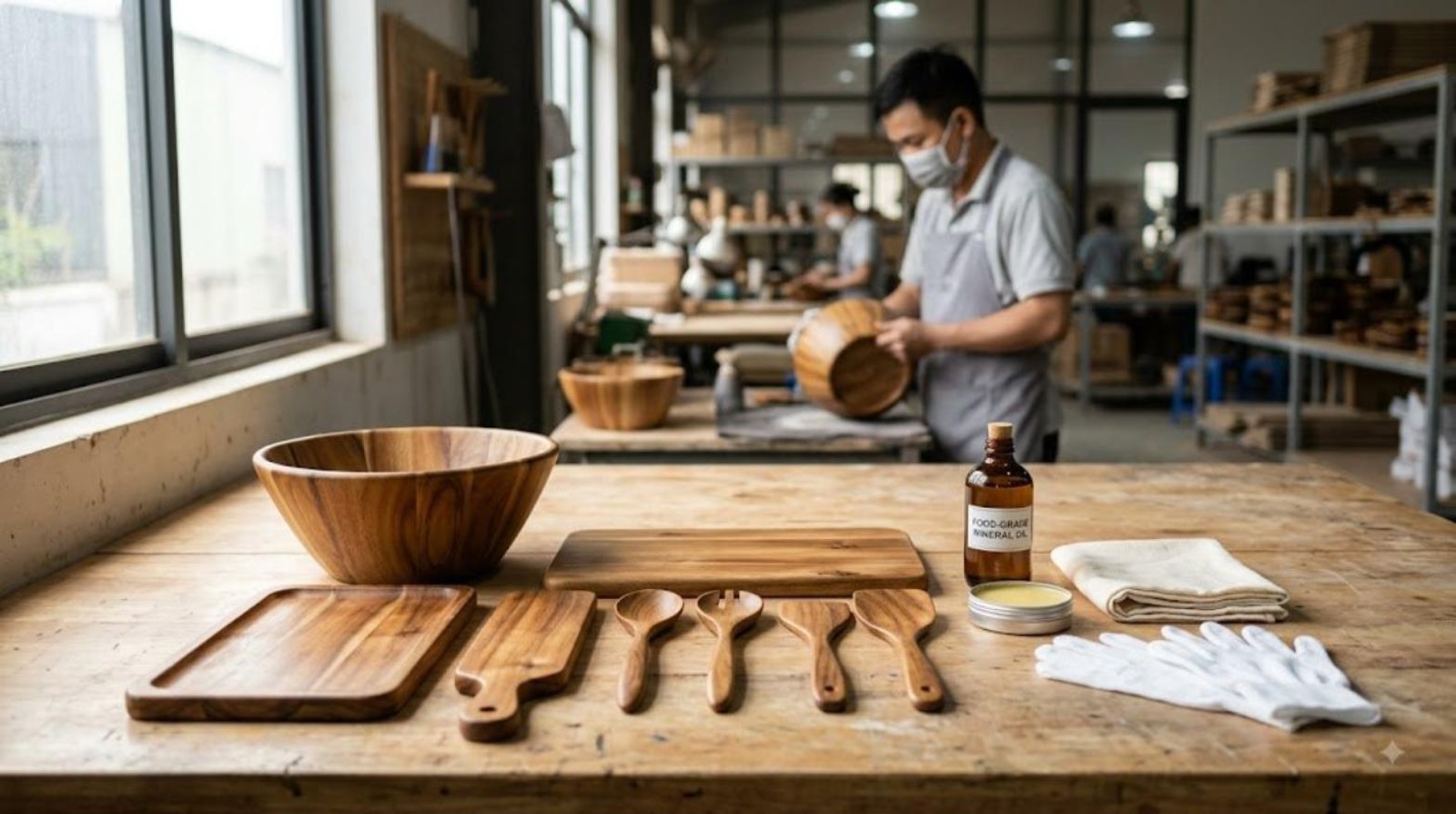
Most wooden kitchenware purchase orders describe the wood in detail. Species, thickness, moisture content, dimensional tolerance, edge profile, sanding grit. Then, in a single line near the bottom, they say something like “natural oil finish” or “food-safe coating” and move on.
That single line is where most compliance failures, most customer complaints and most rejected shipments actually originate. The wood itself rarely fails a migration test — the substrate is inert. What fails is the film or oil sitting on top of it: the wrong grade of oil, an unregistered lacquer, a rancid vegetable oil, a wax with an undeclared solvent, or a finish that was never fully cured before the goods were shrink-wrapped and stuffed into a container.
This guide sets out what “food-safe” means as a documentable claim rather than a marketing word, how the three main finish systems used in Vietnamese woodware factories differ commercially and technically, what to write into your specification, and which documents to demand before the first production run.
“Food-Safe” Is Not a Certification — It Is an Evidence Chain
There is no single global “food-safe” stamp a supplier can buy. What exists is a set of regulatory frameworks, and a finish is compliant only in relation to the market you are shipping to.
- European Union. Regulation (EC) No 1935/2004 is the framework law for all food-contact materials. Its core requirement is that a material must not transfer constituents to food in quantities that endanger human health, change the composition of the food, or alter its taste and smell. Wood and coated wood are not covered by a dedicated EU-wide specific measure the way plastics are under Regulation (EU) No 10/2011, so buyers and national authorities fall back on the framework regulation plus national rules.
- Germany — LFGB. Because Germany’s national provisions are the strictest widely applied benchmark in Europe, an LFGB test report has become the de facto European trade document for wooden kitchenware. When a European buyer asks for an “LFGB certificate”, what they actually need is a test report from an accredited laboratory covering the specific article and finish system — not a generic supplier letter.
- United States — FDA. Compliance is established by showing that every substance in the finish is authorised for food contact. The commonly cited authorisations for woodware finishes are white mineral oil under 21 CFR 172.878 and 178.3620, beeswax as a GRAS substance under 21 CFR 184.1973, and resinous or polymeric coatings under 21 CFR 175.300. Note the structure: the FDA does not certify your bowl — you assemble the evidence that each component is listed.
- Gulf and wider Middle East. Beyond food-contact safety, buyers frequently require that the finish contain no ethanol carrier and no animal-derived ingredient of uncertain origin. This is a sourcing decision, not a testing question, and it has to be raised before the factory buys its finish stock.
The practical consequence: a supplier who answers “yes, it is food-safe” without naming a regulation, a laboratory and a report number has told you nothing you can put in front of a customs officer or a retail compliance team.
The Three Finish Systems Used in Vietnamese Woodware Production
1. Food-grade mineral oil (penetrating oil)
Highly refined white mineral oil is the workhorse finish for cutting boards, chopping blocks, salad bowls and utensils. It penetrates rather than forming a film, it never goes rancid because it is not a triglyceride, and it is the easiest finish to document.
- Appearance: low sheen, wet-look grain enhancement, no surface build.
- Best for: end-grain and edge-grain boards, butcher blocks, utensils, and bowls intended for direct food contact and hand washing.
- Commercial reality: lowest unit cost, fastest cycle time, and the finish most tolerant of the humidity swings inside a 40-foot container.
- Buyer caution: insist on white mineral oil, USP / food grade. Technical-grade and industrial lubricating oils look identical on a bench and will not pass a migration test.
2. Mineral oil and beeswax blend (oil-wax)
A blend — typically in the range of four to five parts oil to one part wax — adds a thin protective wax layer over the penetrating oil. It is the finish most retail buyers actually want when they say “premium natural look”.
- Appearance: soft satin sheen, noticeably richer colour, a smoother hand feel that photographs well.
- Best for: serving and charcuterie boards, gift sets, wooden trays and houseware where perceived value matters more than dishwasher tolerance.
- Commercial reality: a modest cost uplift over plain oil, plus an extra buffing operation. It gives finished goods better water resistance through the first months of retail shelf life.
- Buyer caution: specify pure filtered beeswax or carnauba. Cheap wax pastes on the local market are frequently cut with petroleum solvents to soften them, and that solvent is what a laboratory will find.
3. Water-based lacquer or hardwax oil (film-forming)
Film-forming systems are used where the article must survive frequent washing, resist staining, or hold a specific gloss level across a retail range — decorative bowls, trays, coasters, and houseware that touches dry food only.
- Appearance: controllable from matt to gloss, uniform across every unit in the order, hides minor grain variation.
- Best for: decorative and dry-food houseware, colour-matched retail programmes, and items with printed or laser-marked branding under the topcoat.
- Commercial reality: highest finish cost, requires a spray line and controlled curing space, and carries the longest lead time because of cure and off-gassing.
- Buyer caution: this is the system that fails. Ask for the coating manufacturer’s own food-contact declaration, the product name and batch, and confirmation of the cure schedule. A film packed before it has fully cross-linked will off-gas inside the carton and arrive smelling of solvent — an odour complaint that is functionally impossible to fix at destination.
Finishes That Should Never Appear on Your Purchase Order
- Vegetable and nut oils — olive, sunflower, walnut, almond. They oxidise and turn rancid, producing a sour smell within months in tropical transit conditions. Nut-derived oils also raise a food-allergen declaration issue that most retail buyers will not accept.
- Unspecified “wood oil” or “furniture oil” — usually a drying oil containing metallic driers. Driers are a heavy-metal migration risk and a common reason for a failed report.
- Solvent-based polyurethane and nitrocellulose lacquer on food-contact surfaces, unless the coating supplier holds a specific food-contact authorisation for that grade.
- Shellac where the destination market has religious-certification requirements, because of both its insect-secretion origin and its alcohol carrier.
- Any finish the factory cannot name. “Our standard oil” is not a specification. If the supplier cannot give you a product name and a manufacturer, there is no evidence chain for you to inherit.
What to Write Into the Specification
Replace the “food-safe finish” line with the following block. It costs nothing at the quotation stage and eliminates the most expensive category of dispute later.
- Finish system — named: food-grade white mineral oil, mineral oil and beeswax blend at a stated ratio, or water-based lacquer.
- Product name, manufacturer and country of origin of the finish material.
- Number of coats and application method — dip, wipe, brush or spray.
- Cure and rest time before packing, stated in hours, with a written instruction that goods are not to be bagged before that period elapses.
- Target sheen and an approved gloss reference, if a film finish is used.
- Odour standard — a simple sealed-bag check 24 hours after packing, performed at final inspection.
- Test regime — which market, which standard, which laboratory, and who pays for the report and for any retest.
- Change control — a clause stating that no substitution of finish material is permitted without written approval, and that substitution voids acceptance of the lot.
Clause eight is the one that matters most. Finish substitution mid-season, when a factory’s usual supply runs short or a cheaper drum arrives, is the single most common cause of a second shipment failing a test that the first shipment passed.
The Document Set to Request Before Production
- Technical data sheet and safety data sheet for the finish material.
- The finish manufacturer’s food-contact declaration, referencing the relevant regulation for your destination market.
- A migration or composition test report from an accredited third-party laboratory, issued for the finished article — the actual bowl or board — not for the raw oil.
- The supplier’s own declaration of compliance, naming the article, the finish, the regulation and the report number.
- Batch traceability linking the finish lot to the production lot, so a problem can be contained rather than applied to the whole order.
Read the report before you approve it. Two details are routinely wrong: the report covers a different article from the one you are buying, or it is more than three years old and predates a change of finish supplier. Both are easy to spot, and both make the document worthless.
Finish and Moisture Are One Problem, Not Two
A finish applied to wood that is still above its target moisture content will not perform, whatever the certificate says. Oil cannot penetrate evenly into damp timber, and a film applied over a wet substrate will lift, cloud or crack as the wood releases moisture during the voyage. If you take one operational point from this guide, take this: the finish specification and the kiln-drying specification have to be agreed together, and both belong in the same inspection checklist. We cover the drying side in detail in our guide to wood moisture content and kiln-drying standards for Vietnam wooden kitchenware exports.
Material choice interacts with finish behaviour as well. Dense, closed-grain acacia takes oil differently from rubberwood, and bamboo — technically a grass — behaves differently again, which is why a single finish recipe rarely suits a mixed range. Our acacia, rubberwood and bamboo material comparison sets out where each substrate belongs in a programme.
Matching the Finish to the Product Category
- Cutting boards and butcher blocks — food-grade mineral oil, multiple coats. Nothing film-forming: knife cuts breach a film and create a place for moisture to sit underneath it.
- Serving and charcuterie boards — oil-wax blend, for appearance and shelf life.
- Salad bowls and wooden tableware — oil or oil-wax if used for wet food; lacquer only where the item is decorative or dry-food.
- Utensils, spatulas and ladles — mineral oil. These items are washed constantly and any film will fail early.
- Trays and home organisation houseware — water-based lacquer is legitimate here, since contact is incidental and colour consistency across a retail range is the priority.
Care Instructions Are Part of the Product
An oiled board sold without care guidance will generate returns, and those returns get logged against product quality rather than against the missing insert. Include a short care card in the retail pack: hand wash in warm water, dry immediately and upright, never soak, never place in a dishwasher, and re-oil every four to eight weeks in normal domestic use. Factories can print and insert this at negligible cost, and it measurably reduces first-year complaint rates. If your programme is destined for a market with a specific language requirement, agree the translation at sampling stage rather than at shipment.
Where Viet Farm Vision Fits
Viet Farm Vision is a Vietnam-based OEM manufacturer and exporter of wooden kitchenware and houseware, compostable and disposable tableware, agricultural products and handcrafts, supplying wholesale and private-label buyers across the Middle East, Asia and wider international markets.
On finishing specifically, we work to a named finish system per product category rather than a house default, provide the finish manufacturer’s documentation with the sample submission, treat cure and rest time as a controlled parameter before packing, and operate change control on finish materials so that lot two matches lot one. For buyers with religious-certification or allergen constraints, finish selection is made at the quotation stage, before any material is purchased.
If you are building or re-specifying a wooden kitchenware programme and want the finish documented properly from the first sample, send us your target categories, destination markets and volumes. We will come back with a recommended finish system per item, the document set you can expect, and indicative pricing.
Contact: vietfarmvision.com/contact-us | info@vietfarmvision.com
Regulatory references: Regulation (EC) No 1935/2004 on food contact materials; US FDA food contact substances. This article is general sourcing guidance and is not a substitute for testing your own articles against the requirements of your destination market.