
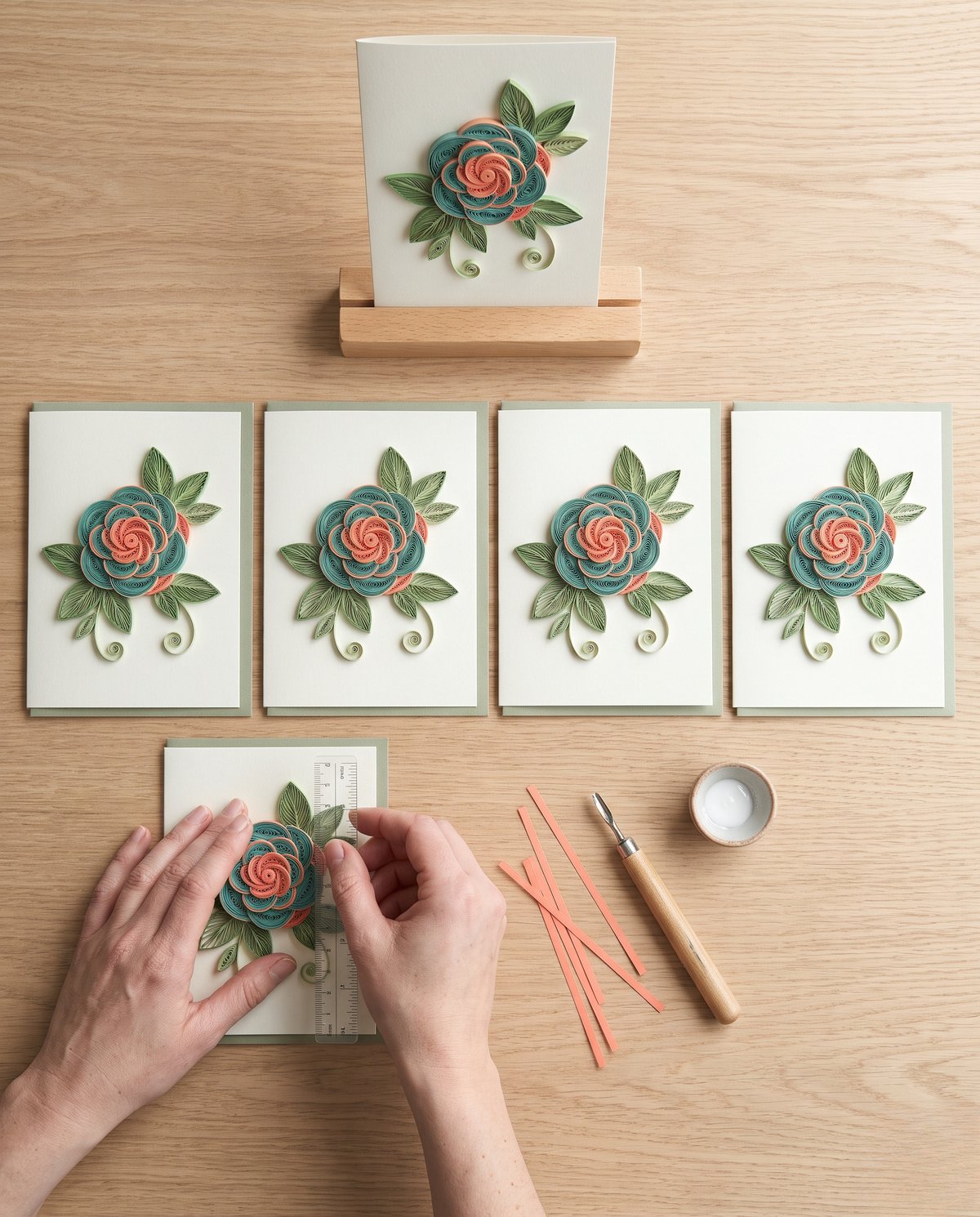
Handmade card consistency comes from a system, not from luck: every artisan works from the same approved master sample, the same pattern and the same strip colours, and the cards are checked against that master at several points before they are packed. Small variations are part of handmade work, but a buyer should still be able to put any two cards from one order side by side on a shelf and see the same design. Here is how our partner workshop in Vietnam keeps a quilling order matching from the first card to the last.
Why is handmade card consistency harder than with printed cards?
A printed card comes off a press identical to the one before it. A quilling card is built by hand from rolled paper strips, so each coil, petal and leaf is shaped by a person. The quilling cards we export are made at a partner workshop by artisans, mostly women who live near the workshop, and several of them may work on the same design at the same time. Without shared references, two careful artisans could easily produce two slightly different versions of one flower.
For a buyer, that difference matters most on the shelf. Customers compare cards in a display, and a range that looks uneven reads as lower quality, even when each card is well made on its own.
What does “consistent” mean for a quilling card?
It helps to agree on this before production starts. For our handmade card orders, consistency means the same things are true of every card in a design:
- The same layout: elements sit in the same place on the card front.
- The same colours, in the same positions, as the approved sample.
- Coils of a similar size, tightness and height, so the design has the same depth.
- Clean finishing: no visible glue marks, loose strip ends or bent card edges.
- The same logo, insert and private label packaging where these are ordered.
What it does not mean is machine-identical. A petal may curve a fraction differently from its neighbour. That is the character buyers pay for, and it is worth saying so in your product story.
How do artisans keep every card matching?
It starts with one approved master sample
Nothing goes into production until the buyer has approved a pre-production sample. That approved card becomes the master. It is the answer to every question on the bench: if an artisan is unsure about a colour or a coil size, the master decides, not memory or a photo on a phone.
A reference at every bench
Artisans working on a design have a reference card from the approved sample in front of them, together with the pattern for that design. Working next to a physical card is very different from working from a drawing, because the artisan can see the real height of the coils and how the light falls across them.
Colours are set per design, before work begins
The strip colours for each design are matched to the approved sample and prepared before production, so artisans are not choosing between similar shades mid-order. This is one of the simplest ways to avoid a design drifting from pink to coral halfway through a run.
Where is consistency checked in the 4-step quality process?
Our quality process for quilling cards has four steps, and each one compares the work against the approved master in a different way.
| Step | When it happens | What is compared for consistency | What the buyer sees |
|---|---|---|---|
| 1. Pre-production sample approval | Before any production starts | Design, colours, size, logo and packaging are fixed in one card | The sample to approve or comment on |
| 2. Mid-production check at the workshop | While the order is being made | Early finished cards from the bench are compared with the master to catch drift | Updates on progress and any issues found |
| 3. Card-by-card check before packing | After production, before packing | Every card is inspected; cards that do not match the master are set aside | Cards that match the approved design |
| 4. Carton count with photos and video | Before the goods are handed over for shipping | Quantities per design are counted and packed as agreed | Photos and video of the finished, packed order |
The mid-production check is the one buyers tend to underestimate. Catching a small change in coil size early means only a few cards need attention, rather than a whole batch at the end. For a closer look at the full workshop process, see how quilling cards are made, from paper strip to card.
How can buyers help keep a handmade order consistent?
A lot of consistency is decided at the briefing stage, on the buyer’s side. A few habits make a clear difference:
- Comment on the sample in writing. “Make the leaves a little smaller” is clearer than a voice note, and it travels with the order.
- Approve one master per design. If you change a colour after approval, ask for a revised sample so the new master is clear to everyone.
- Say what matters most. If colour accuracy matters more to you than coil height, or the reverse, tell us. It shapes what the checks focus on.
- Keep your own approved sample. When the order arrives, compare it with the card you approved, not with a screen image.
- Plan packaging early. Good protective packing keeps the depth of the design intact in transit. Our guide to greeting card packaging for retail covers the options.
Frequently Asked Questions
Will every card in my handmade order look exactly the same?
Every card should match the approved design in layout, colours and finish. Because each card is shaped by hand, you may see very small differences in the curve of a petal or a coil. These are normal for handmade work and are not the same as a card that is off-design.
What happens to cards that do not match the master sample?
They are set aside during the card-by-card check before packing and are not packed with your order. Finding them earlier, at the mid-production check, is the goal, because it keeps the rest of the run on track.
Can I see the finished order before it ships?
Yes. Before the goods are handed over for shipping, the cartons are counted and we send you photos and video of the finished, packed order. If you see something that needs discussion, that is the time to raise it.
Does a custom design or logo make consistency harder?
Not if the custom design is approved as a sample first. Once your design, logo placement and private label packaging are fixed in one approved card, artisans work to that card exactly as they would for any other design.
Plan a handmade range that looks right on the shelf
Handmade cards earn their place in a shop because they feel personal, and a well-run workshop can keep that character while still delivering a range that looks even and professional. Browse our handmade quilling greeting cards, then send your designs, quantities and target market through our Request a Quote page. We reply within one business day.