
To import quilling cards into Singapore, you register your business for a Unique Entity Number (UEN), activate a customs account, and have a declaring agent file an import permit through TradeNet before the goods arrive. Greeting cards are non-dutiable in Singapore, so the main border cost is the 9% Goods and Services Tax (GST) charged on the landed value. The rest of the work sits on the supply side: an approved sample, clean export documents from Vietnam, and packaging built for a humid, multi-festival retail market.
This guide walks Singapore gift shops, stationery retailers, museum stores and corporate gifting teams through the process of buying handmade quilling greeting cards from Vietnam, step by step, as of 10 November 2026. Always confirm the current rules with Singapore Customs or your freight forwarder before you ship.
Why are Singapore buyers looking at quilling cards from Vietnam?
Singapore is a short sea and air hop from Ho Chi Minh City, and its retail calendar is unusually full. The Ministry of Manpower’s 2027 public holiday list includes Chinese New Year (6 and 7 February), Hari Raya Puasa (10 March), Hari Raya Haji (17 May), Deepavali (28 October) and Christmas Day (25 December). Add Valentine’s Day, Mother’s Day, Teachers’ Day and graduation season, and a card buyer in Singapore has a gifting peak almost every quarter.
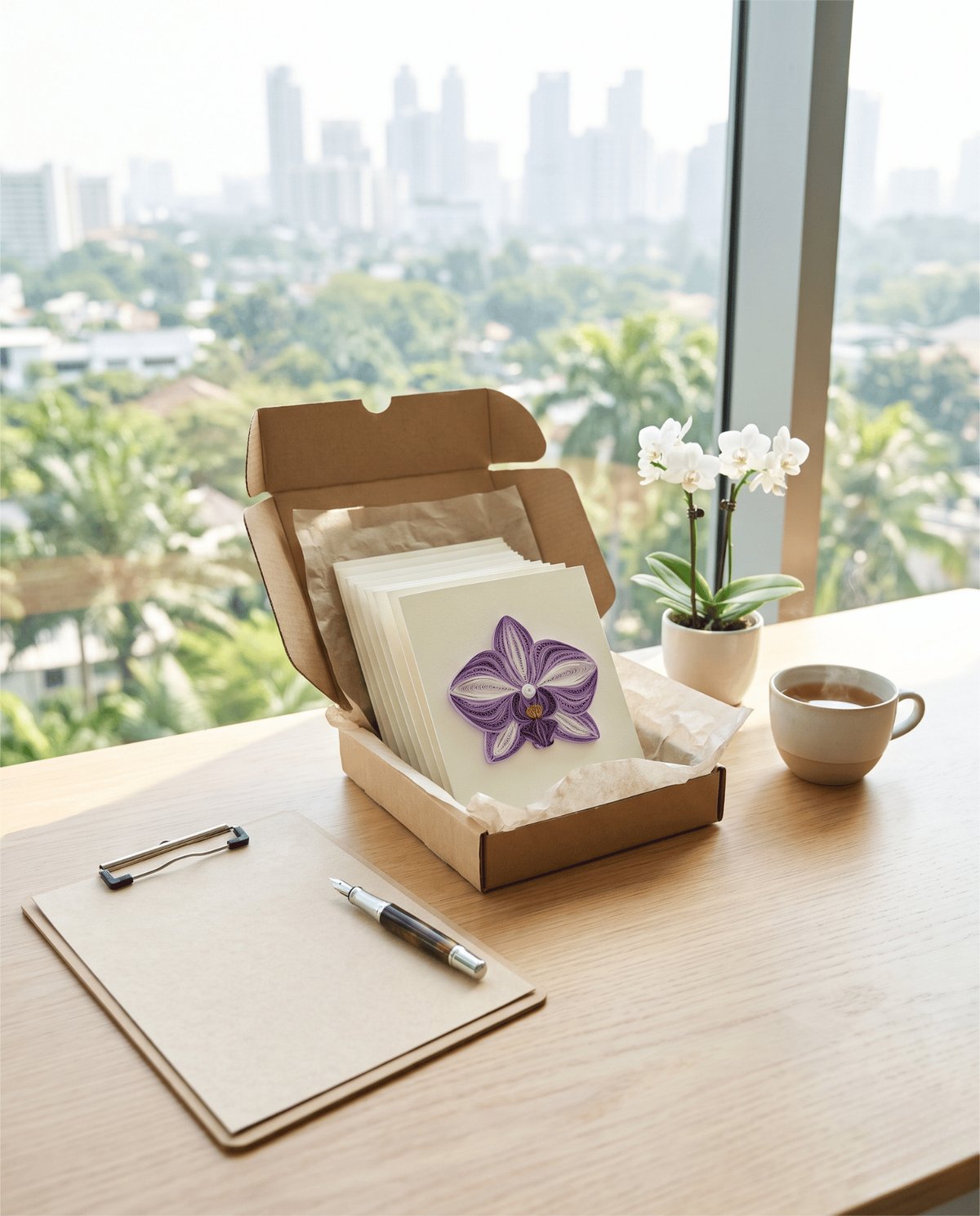
Handmade quilling cards suit that calendar well. Each design is built from coiled paper strips by artisans, so a single range can carry orchids for national pride, red and gold motifs for Lunar New Year, crescents and lanterns for Hari Raya, and oil-lamp patterns for Deepavali.
What do you need before you import quilling cards into Singapore?
Singapore Customs sets out the basics in its import procedures overview. In short, the importer of record needs three things in place:
- A UEN, which identifies your business on every permit. Singapore Customs warns importers not to lend their UEN to import goods that belong to someone else.
- An activated customs account, so permits can be filed under your UEN.
- A TradeNet permit, obtained before the goods arrive. Most retailers appoint a declaring agent, usually their freight forwarder or courier, to file it.
Give your declaring agent the full supporting documents up front. If the agent pays GST on your behalf, it will normally invoice you for reimbursement, so agree that arrangement before the first shipment.
How much duty and GST applies to greeting cards in Singapore?
Singapore is one of the simplest import markets for paper goods. According to Singapore Customs, only four groups of goods are dutiable: intoxicating liquors, tobacco products, motor vehicles and petroleum products. Everything else, greeting cards included, pays GST only.
GST is charged on the CIF value, meaning the cost of the goods plus insurance and freight to Singapore. The rate has been 9% since 1 January 2024, as confirmed by IRAS. If your business is GST-registered, import GST can usually be claimed as input tax in your GST return; check the detail with your accountant.
Small parcels are treated differently. Singapore Customs’ postal and courier page explains that goods imported by air or post with a CIF value not exceeding S$400 get GST relief at the border, but since January 2023 GST on these low-value goods is collected through the Overseas Vendor Registration regime instead. For a wholesale order of handmade cards, you will almost always be above that threshold and clearing through a normal permit.
Which documents should your Vietnam supplier send?
A tidy document set is what keeps a TradeNet permit accurate and avoids amendment requests. We prepare the following for every export order:
| Document | Who prepares it | Why your Singapore agent needs it |
|---|---|---|
| Commercial invoice | Exporter in Vietnam | Sets the value used to calculate GST on the CIF basis |
| Packing list | Exporter in Vietnam | Matches carton count, weights and contents to the permit |
| Certificate of Origin (CO) | Issued in Vietnam on request | Confirms Vietnamese origin for your records, for buyers who ask, and for any onward trade |
| Air waybill or bill of lading | Airline, forwarder or carrier | Links the shipment to the permit at arrival |
| Insurance and freight details | Exporter or your forwarder, depending on Incoterm | Needed to build the CIF value if you buy on FOB or EXW terms |
| Product photos and carton video | Exporter in Vietnam | Not a customs document, but lets you check the shipment before it leaves |
Because greeting cards carry no customs duty in Singapore, a preferential origin certificate such as ATIGA Form D does not reduce your border cost the way it would in a dutiable market. Many buyers still request a CO so their files are complete, and it costs little to arrange at the time of export.
Air or sea: how should you ship quilling cards to Singapore?
Cards are light but bulky once they are boxed with envelopes and sleeves, so the choice depends more on timing than weight.
- Air freight or express courier suits sample batches, reorders of best sellers and late seasonal top-ups. It costs more per carton but protects your selling window.
- Sea freight (LCL) suits planned seasonal orders. Transit from Vietnam to Singapore is short by ocean standards, but allow time for consolidation, port handling and permit filing at both ends.
- Incoterms decide who books freight and insurance. If you are new to importing, FOB lets your own forwarder control the Singapore side; if you prefer one point of contact, ask for a CIF or DAP quote.
Whichever route you choose, work backwards from the festival. For Deepavali or Christmas stock, the sample should be approved months ahead, not weeks. Our guide to Ramadan, Eid and Diwali quilling cards covers festive design planning in more detail.
How should quilling cards be packed for Singapore’s climate?
Singapore is warm and humid all year, and paper art does not like moisture or crushing. Quilled designs stand slightly proud of the card face, so packing has to protect the relief as well as the paper. Practical points to agree with your supplier:
- Individual clear sleeves for each card and envelope set, so shoppers can see the design without handling it.
- Inner boxes that hold cards upright or flat with spacers, so the coils are never pressed against each other.
- Moisture-absorbing sachets and sealed inner bags for sea shipments.
- Strong export cartons with clear carton marks, so your warehouse can check counts quickly.
- Private label sleeves, header cards or barcodes applied in Vietnam, so stock is retail-ready on arrival.
For a deeper look at retail presentation, see our recent article on greeting card packaging for retail.
How does quality control work before the cards leave Vietnam?
The cards are handmade at our partner workshops by skilled artisans, mostly local women who live near the workshop. Because every card is made by hand, consistency comes from process rather than machinery. We run a four-step check on every order:
- Pre-production sample approval. You sign off a physical or photographed sample before production starts.
- Mid-production inspection at the workshop, to catch colour or shape drift early.
- Card-by-card inspection before packing, so damaged or uneven pieces never reach the carton.
- Carton count with photos and video sent to you before the shipment is released.
For Singapore buyers who are not visiting Vietnam in person, that last step means you see exactly what is being shipped before it leaves.
Can you order custom designs and private label quilling cards for Singapore?
Yes. Many Singapore buyers want designs that feel local rather than generic. Common requests include orchid and skyline themes for souvenir shops, festive designs across the Chinese, Malay and Indian calendars, and corporate cards with a company logo printed or attached for client gifting. We work from your artwork or brief, develop a sample, and supply cards under your own brand with private label packaging.
Pricing and production timing depend on design complexity, the number of designs in the order, packaging choices and the season you are booking into. Rather than guessing from a price list, send us your brief and target dates and we will reply with a full quotation within one business day.
First-order checklist for Singapore importers
| Step | What to confirm |
|---|---|
| 1. Business setup | UEN registered and customs account activated |
| 2. Agent | Declaring agent or forwarder appointed, GST payment arrangement agreed |
| 3. Brief | Designs, card size, envelope, packaging and labelling sent to the supplier |
| 4. Sample | Pre-production sample approved in writing |
| 5. Terms | Incoterm, payment terms and target ship date agreed |
| 6. Documents | Commercial invoice, packing list and CO requested |
| 7. Pre-shipment check | Carton count photos and video reviewed |
| 8. Arrival | TradeNet permit filed before arrival, GST paid, goods received and checked |
If you are comparing Singapore with other markets, our guide to importing quilling cards into the Netherlands shows how the process changes when customs duty and EU rules come into play.
Frequently Asked Questions
Is there import duty on greeting cards in Singapore?
No. Singapore Customs only charges duty on intoxicating liquors, tobacco products, motor vehicles and petroleum products. Greeting cards pay GST only, currently 9%, on the CIF value. Confirm the treatment for your specific shipment with your declaring agent.
Do I need an import permit for a wholesale order of quilling cards?
Yes, a customs permit filed through TradeNet is needed before the goods arrive. Most retailers let their forwarder or courier act as declaring agent. Your business needs a UEN and an activated customs account for the permit to be filed in its name.
Do I need a Certificate of Origin to import cards from Vietnam into Singapore?
Because greeting cards are non-dutiable in Singapore, a preferential CO does not lower your border cost. We can still arrange one with the commercial invoice and packing list, and many buyers keep it on file. Ask your agent whether they want it for your records.
Can you make quilling cards for Chinese New Year, Hari Raya and Deepavali?
Yes. Festive designs can be developed from your brief or from our existing styles and adapted in colour and motif. Plan sampling well ahead of each festival so production and shipping fit your selling window.
How quickly will I get a quotation?
We reply to every quotation request within one business day. Include your designs or ideas, packaging needs, delivery port and target arrival date so the quote is as accurate as possible.
Ready to bring handmade quilling cards to Singapore?
Viet Farm Vision is a Vietnam OEM and export partner working with skilled partner workshops. We handle custom designs, logo printing, private label packaging, four-step quality control and full export documents. Tell us about your range and timeline through our Request a Quote page, and we will come back to you within one business day.