
To import quilling cards into Spain from Vietnam, you clear the cards into the EU under the common customs tariff (with EVFTA preference if the paperwork is right), pay Spanish import VAT, and make sure the cards and their packaging meet Spain’s own rules on Spanish-language product information and packaging registration. Get those three jobs lined up before you order, then time your range around the Spanish gifting calendar, which runs on dates that differ from the rest of Europe. This guide covers each step from the buyer’s side, as of 13 November 2026.
Spain is a market where paper gifts still travel with an occasion. Papelerías (stationery shops), librerías (bookshops), gift and concept stores, museum shops and wedding planners all sell cards as part of a gesture rather than as a commodity. That makes hand-rolled handmade quilling greeting cards a natural fit, especially for shops that want something visibly crafted next to mass-printed cards.
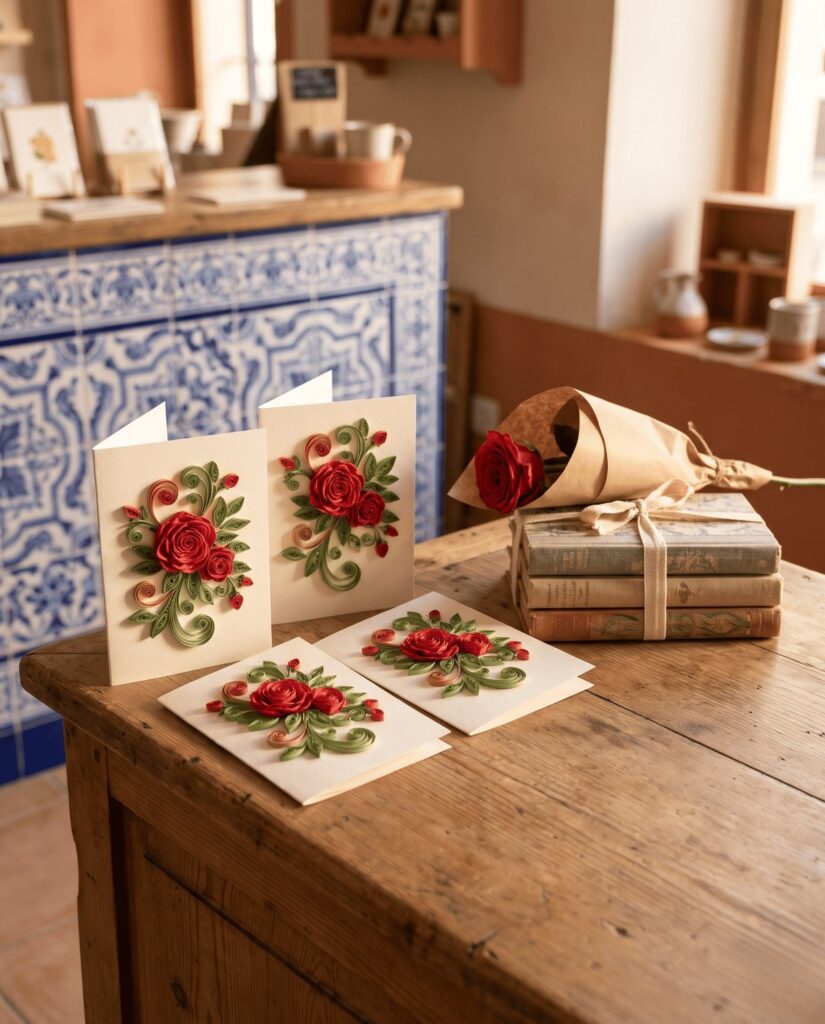
What does it take to import quilling cards into Spain?
Think of a first Spanish order as five checkpoints. Each one has a clear owner, and most delays come from a checkpoint nobody owned.
| Checkpoint | What it covers | Who usually handles it |
|---|---|---|
| Tariff classification | Confirming the customs code for your exact product (flat card, boxed card, gift set) | Your customs broker, with product specs from the supplier |
| Origin and EVFTA preference | Proof of Vietnamese origin so the preferential EVFTA rate can be claimed | Supplier issues the proof; broker checks it before arrival |
| Import VAT (IVA) | Spanish VAT on the customs value plus duty, recovered later by registered businesses | Importer of record, via the broker |
| Spanish product information | Importer details and product information in Spanish on cards or packaging | Buyer supplies text; supplier prints it on sleeves or labels |
| Packaging obligations | Registration and extended producer responsibility for packaging placed on the Spanish market | The Spanish company that first places the packaged goods on the market |
Customs duty, EVFTA and VAT when you import quilling cards into Spain
Spain applies the EU common external tariff, so the duty line is the same whether your cartons clear in Valencia, Barcelona or Madrid-Barajas. You can check the code, the standard third-country rate and the EVFTA preferential rate for your product in the European Commission’s Access2Markets database. We do not quote a rate here on purpose: the right figure depends on the code your broker confirms, and a quilled card boxed with a ribbon or packed as a gift set may not sit in the same line as a flat card in a cello sleeve.
To claim EVFTA preference, the goods must meet the agreement’s rules of origin and travel with a valid proof of origin. The EVFTA guidance on rules of origin explains the options. Ask your supplier at the quotation stage which proof they will issue, so it travels with the commercial invoice and packing list instead of being chased after the vessel sails.
Import VAT is charged on top of duty. Spain’s standard VAT (IVA) rate is 21%, and registered businesses normally recover it through their VAT return. One detail catches out first-time importers: the Canary Islands, Ceuta and Melilla sit outside the EU VAT area, and the Canaries apply their own indirect tax, IGIC, instead of IVA (see PwC Worldwide Tax Summaries for Spain). If you supply shops in Tenerife or Gran Canaria, plan that route separately with your broker.
Which Spanish labelling rules apply to imported greeting cards?
Product information in Spanish
Spain’s general rule for labelling industrial products sold to consumers, Royal Decree 1468/1988, requires the mandatory product information to appear at least in Spanish (Castilian). For a greeting card this is light work: typically the name and address of the responsible company in the EU, a short product description and the country of origin. The practical way to handle it is a back-of-card print or a small sticker on the cello sleeve, designed once and printed by the supplier with every reorder. If you sell in Catalonia, the Basque Country or Galicia, bilingual text is a commercial choice many retailers appreciate, but agree it before artwork is final.
Above the national rule sits the EU General Product Safety Regulation, which applies to consumer products placed on the EU market and requires a responsible economic operator in the EU for products bought from outside the Union (see this Baker McKenzie summary). For most Spanish wholesale buyers, the importer is that operator, and your details are what go on the label.
Packaging registration and producer responsibility
Spain’s packaging law, Royal Decree 1055/2022 on packaging and packaging waste, places extended producer responsibility on the company that first puts packaged products on the Spanish market. For imported goods, that is usually the importer. In practice this means registering in the Producer Register (Registro de Productores de Producto, packaging section) and meeting your obligations either individually or through a collective scheme; this Cuatrecasas note on the register is a useful starting point. Cello sleeves, header cards, display boxes and outer cartons can all count, so ask your supplier for a packaging specification listing each material and weight per unit. That one document saves hours when you file.
Step by step: importing quilling cards into Spain from Vietnam
| Step | What happens | Buyer tip |
|---|---|---|
| 1. Brief and samples | You share designs, sizes, occasions and branding; the supplier makes samples for approval | Approve a physical sample of every design, not just photos |
| 2. Quotation and paperwork plan | Price, packing method, Incoterm and proof of origin are agreed | Ask your broker to confirm the customs code before you sign off the quote |
| 3. Artwork and labels | Spanish product text, barcodes and private label sleeves are finalised | Send the label text as editable files, checked by a Spanish speaker |
| 4. Production and mid-run check | Cards are hand-rolled and assembled at the partner workshop; a mid-production inspection is carried out | Ask for photos of the first finished batch against the approved sample |
| 5. Final inspection and packing | Every card is checked before packing; cartons are counted and photographed or filmed for you | Check carton marks match your warehouse receiving requirements |
| 6. Shipping and clearance | Commercial invoice, packing list and certificate of origin travel with the goods | Share documents with your broker before the vessel arrives |
Our quality process follows four checks: pre-production sample approval, a mid-production inspection at the partner workshop, a card-by-card check before packing, and a carton count with photos and video sent to you before dispatch. Production time depends on design complexity, the number of designs, order size and the season, so we confirm a realistic schedule in the quotation rather than promising a generic figure.
When should you order quilling cards for the Spanish market?
Spain’s card calendar has its own rhythm. Father’s Day falls on 19 March, the feast of San José, rather than in June (see idealista), and Mother’s Day is celebrated on the first Sunday of May (idealista). In Catalonia, 23 April is Sant Jordi, the day of books and roses, when couples and friends exchange a rose and a book (Barcelona City Council). A quilled rose card sold beside a book is an easy add-on for bookshops and florists that day.
| Occasion | Date | Plan to approve samples by | Design ideas |
|---|---|---|---|
| Father’s Day (Día del Padre) | 19 March | Early autumn of the previous year | Muted blues and greens, bicycles, coffee, olive branches |
| Sant Jordi (Catalonia) | 23 April | Autumn of the previous year | Red roses, open books, dragon-and-rose motifs drawn as patterns |
| Mother’s Day (Día de la Madre) | First Sunday of May | Autumn of the previous year | Florals, carnations, soft pinks and lilacs |
| Wedding season | Spring to autumn | Winter | White and gold, olive and lemon branches, Mediterranean blues |
| Christmas and Three Kings | December to 6 January | Late spring | Nativity stars, poinsettias, gold and deep red |
These are planning windows, not production promises. The earlier samples are approved, the more room there is for sea freight and for a second round of design tweaks. If Mother’s Day is your biggest moment, our Mother’s Day wholesale card guide goes deeper on design choices, and our Italy import guide is useful if you supply both markets from one EU warehouse.
What sells well in Spanish card shops?
- Mediterranean palettes. Terracotta, olive green, lemon yellow and tile-inspired blues sit well next to ceramics and home goods.
- Florals with meaning. Roses for Sant Jordi and anniversaries, carnations for Mother’s Day, orange blossom for weddings.
- Blank inside. Many shops prefer cards without printed greetings so customers can write their own message, which also lets one design serve several regions and languages.
- Your own brand. Private label sleeves and back-of-card printing turn a handmade card into a house product, not an anonymous import.
Checklist before your first order of quilling cards for Spain
- Customs code confirmed by your broker for each format (flat, boxed, gift set).
- EVFTA proof of origin agreed with the supplier at quotation stage.
- Spanish product information drafted and checked by a native speaker.
- Registration in the Producer Register for packaging, or confirmation of who covers it.
- Packaging specification with materials and weights per unit.
- Physical samples approved and kept as the reference for inspection.
- Seasonal dates mapped back to sample approval and shipping windows.
- Separate plan for the Canary Islands, Ceuta or Melilla if you supply them.
Frequently Asked Questions
Do I pay customs duty when I import quilling cards into Spain from Vietnam?
Duty depends on the customs code your broker confirms and on whether you can claim the EVFTA preferential rate with a valid proof of origin. Check the current rates in Access2Markets and confirm with your broker before pricing. Import VAT is charged separately and is normally recoverable for registered businesses.
Do the cards need Spanish text?
Mandatory product information for consumer goods sold in Spain must appear at least in Spanish. For cards this is usually a short back-of-card print or sleeve sticker with the responsible company’s details, a product description and origin. We print it as part of your private label packaging.
Can you produce cards from our own designs and branding?
Yes. Our partner workshop’s artisans, mostly local women living near the workshop, hand-roll cards from your designs, and we can print or attach your logo and supply private label sleeves and boxes. Every new design starts with a sample for your approval.
What documents come with each shipment?
Each shipment travels with a commercial invoice, a packing list and a certificate of origin, plus carton photos and video taken before dispatch. Share them with your broker early so clearance in Spain goes smoothly.
Ready to plan your Spanish range?
Send us your designs, target occasions and packaging ideas through our Request a Quote page. We reply within one business day with questions, sample options and a quotation built around your Spanish selling calendar.