
Good handmade card product descriptions do three jobs in under 150 words: they tell the shopper what the card shows, explain why a hand-quilled card is different from a printed one, and answer the practical questions (size, blank inside, envelope) before anyone has to ask. If you stock quilling cards, a short, honest, specific description will sell more than a long, flowery one, both on the shelf and online.
Below is the structure we suggest to retail and online buyers who stock our handmade quilling greeting cards, plus the claims to avoid so your copy stays accurate.
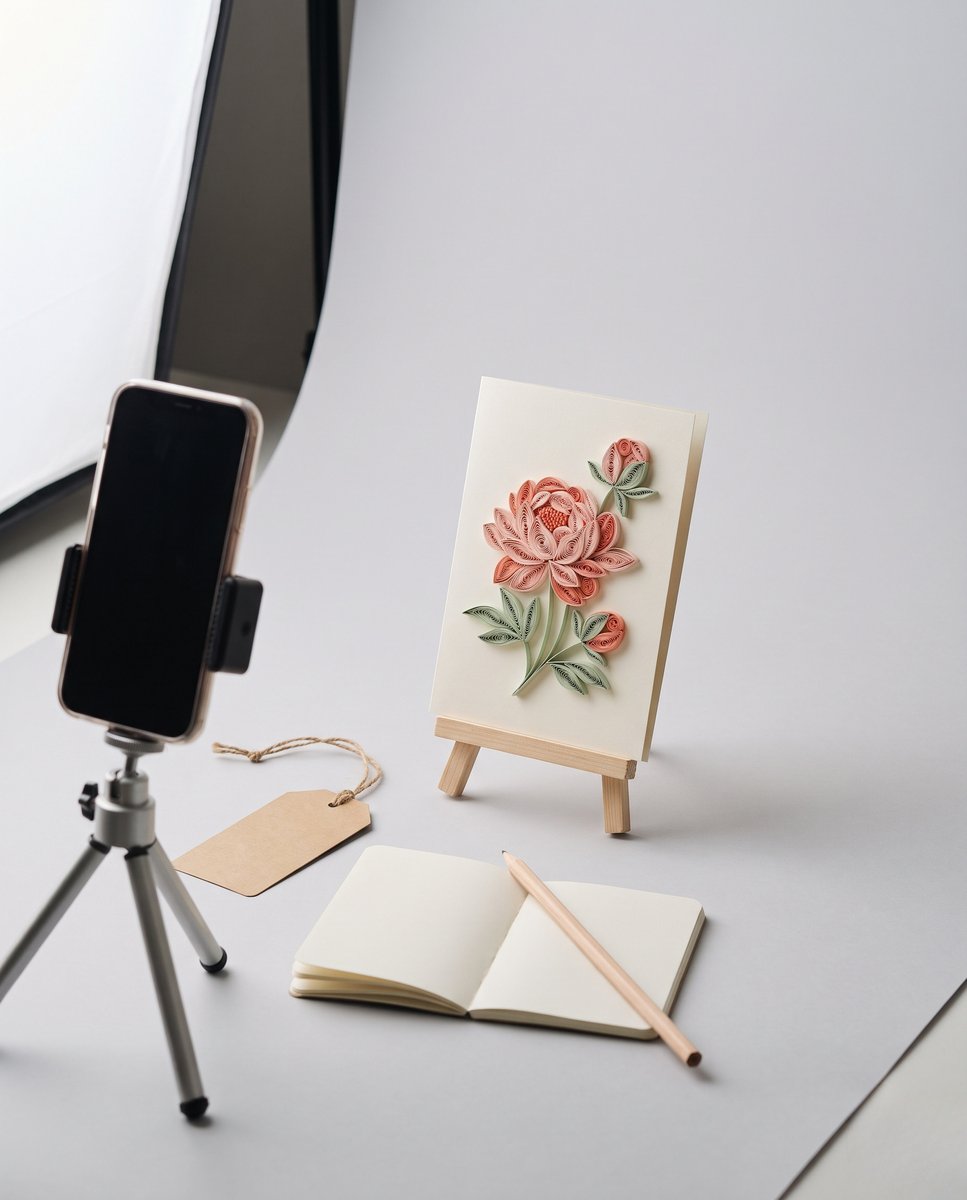
Why do handmade card product descriptions matter more than for printed cards?
A printed card is understood at a glance. A quilled card is not. In a photo, the raised coils can look like a print or an embossed pattern, and on a crowded shelf a shopper may not notice the depth until they pick it up. The description is where you close that gap.
Shoppers buying a card are usually buying for a person and an occasion. They scan for three things: does this fit my occasion, is it special enough, and will it arrive or travel safely. Answer those in order and the copy almost writes itself.
What should a handmade quilling card description include?
Use the same five building blocks for every card in the range.
| Block | What to write | Example line (illustrative only) |
|---|---|---|
| 1. Hook | The occasion or feeling, in one line | “A peony in full bloom for the person who deserves a little celebration.” |
| 2. What you see | Motif, colours, layout, in plain words | “Blush and coral petals with sage leaves on a cream card.” |
| 3. How it is made | The quilling technique and the fact it is assembled by hand | “Each petal is a strip of paper rolled and shaped by hand, then set in place one piece at a time.” |
| 4. Practical facts | Size, blank or printed inside, envelope, sleeve, posting tips | “Blank inside. Comes with an envelope in a protective clear sleeve.” |
| 5. Care or keepsake note | How to keep or display it | “Raised paper detail: store upright or flat, away from damp.” |
Lead with the occasion, not the technique
“Handmade quilling card” is a category, not a reason to buy. Open with who the card is for. Birthday, thank you, wedding, new baby, sympathy: the occasion is what shoppers type into a search box and what they are thinking about at the card rack.
Describe the craft in one or two concrete sentences
Shoppers respond to specifics they can picture: strips of paper rolled into coils, pinched into petals and leaves, and glued edge-on so the design stands up from the card. Avoid stacking adjectives (“exquisite, stunning, artisanal”). One accurate sentence about how the card is made is more persuasive than five superlatives.
Add meaning where it is real
Flowers, birds and colours carry traditional associations, and a short note about them gives the shopper a message to pass on. Our guides to flower meanings on greeting cards and bird and butterfly symbolism are a good starting point. Keep it to one line and phrase it as tradition (“often associated with”), not as fact.
Which claims should you avoid in handmade card copy?
Accuracy protects both your customers and your listings. A few rules we recommend:
- Be clear about origin. Cards made in Vietnam should not be described in a way that suggests they were made in your own country. In the US, the FTC’s Complying with the Made in USA Standard explains why origin claims must be truthful and substantiated; other markets have similar consumer protection rules.
- Do not invent makers. Only name or describe an individual artisan if you have real, permitted information. “Handmade by skilled artisans at our partner workshop in Vietnam” is accurate; a made-up name and backstory is not.
- Check marketplace rules. If you sell on Etsy, read its Creativity Standards on how items must be described and what disclosure is required when a production partner is involved.
- Skip unverifiable materials claims. Do not describe paper, glue or inks with technical or environmental claims you cannot document. The FTC’s Advertising FAQs for small business sets out the basic principle: claims must be truthful and backed by evidence.
How should descriptions differ on the shelf and online?
In store, space is tiny. The back-of-card sticker or sleeve insert should carry blocks 1, 3 and 4 in about 30 words. A small shelf talker can tell the longer craft story once for the whole display, which is more effective than repeating it on every card. Our greeting card display ideas show where shelf talkers work best.
Online, the shopper cannot touch the card, so the description has to work harder. Use all five blocks, put the occasion and motif in the product title, and pair the copy with a raking-light or side-angle photo that shows the coil depth. If you are building a web shop, our guide to selling handmade cards online covers titles, photos and categories.
What can your supplier provide to help you write descriptions?
When you order from us, ask for the information that makes accurate copy easy: the design name and motif notes, colour descriptions, finished card and envelope sizes, packing format (sleeve, backing card, private label insert) and photos taken during our four-step quality check. Because we produce custom designs and print or attach your logo on request, we can also put your short description directly onto a private label sleeve insert or back sticker, so every card arrives shelf-ready.
Frequently Asked Questions
How long should a handmade card product description be?
For an online listing, roughly 80 to 150 words is enough to cover the occasion, the design, the craft and the practical details. On a back sticker or sleeve insert, aim for around 30 words. Shorter, specific copy is easier to scan on a phone.
Should I mention that the cards are made in Vietnam?
Yes. Being clear about country of origin is good practice and, in many markets, part of labelling and consumer protection rules. Many shoppers also value knowing a card was handmade by artisans in a specific place. Check your local requirements with your customs broker or a compliance adviser.
Can you print our product description on the packaging?
Yes. We offer private label packaging, so your copy, logo and barcode can go on a sleeve insert, backing card or sticker. Send the final text with your artwork and we will include it in the pre-production sample for approval.
Do I need a different description for every design?
Keep the structure the same but change the hook and the “what you see” line for each design. Reusing the craft and care lines across the range saves time and keeps your collection consistent, while unique opening lines help each card rank and stand out.
Ready to stock quilling cards with shelf-ready copy?
Tell us your designs, occasions and packaging needs, and we will reply within one business day with options, samples and full export documents (commercial invoice, packing list and CO). Request a quote to get started.