
A baby and toddler brand in the Gulf wanted to add a wooden feeding set to its range: a divided plate, a suction bowl, two spoons and a cup. The adult version of the same plate was already in production at a Vietnam workshop, so the brand assumed the kids set would be a simple resize. It was not. The first samples had edges that were fine for an adult serving board but too sharp for a toddler, the suction ring was glued instead of fitted, and nobody had asked which lab report the retailer would need before listing. Three rounds of samples later, the set launched four months behind plan.
Wooden children’s tableware is one of the most attractive niches in wooden kitchenware. Parents pay more for natural materials, the products photograph well, and repeat purchase is strong as children grow. It is also the category where buyers are least forgiving, because the end user is a small child. This guide explains how baby and kids brands, gift retailers and private label importers can spec wooden plates, bowls, spoons and cups from Vietnam so the samples are right the first time.
Why wooden children’s tableware is worth a place in your range
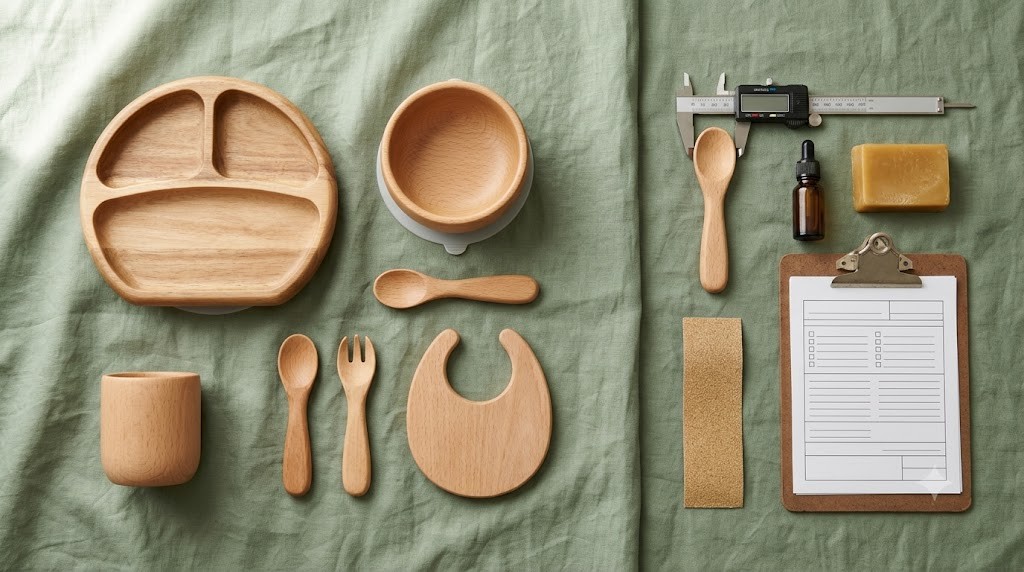
- Natural material story: many parents actively look for plastic free feeding products, and wood gives a warm, premium look that supports a higher retail price than plastic or melamine.
- Gift and bundle potential: a plate, bowl, spoon and cup set packs neatly into one gift box, which lifts order value for baby shower, first birthday and Ramadan or Eid gifting.
- Personalisation: laser engraved names or animal motifs turn a standard set into a keepsake, which works well for online shops and boutique retailers.
- Shared production with your adult range: the same acacia and beech supply chain, finishing line and packaging partners can serve both ranges, which keeps sourcing simple.
The five product types that sell, and what each one needs
1. Divided toddler plates
Usually turned or CNC shaped from solid acacia or beech, with two to four sections. The key specs are section depth, the radius on every inner and outer edge, and wall thickness. A thin wall saves wood and weight but is more likely to crack after repeated washing, so agree a minimum thickness on the drawing.
2. Suction bowls
A wooden bowl with a removable food grade silicone ring underneath. The ring should be a friction fit or a mechanical groove, not glued, so parents can remove it for cleaning. The silicone part usually comes from a separate supplier, so treat it as a mixed material product and test both parts.
3. Spoons and forks
Short, chunky handles sized for small hands, with fully rounded tips and no sharp tines. Beech is common here because of its fine, even grain. Ask for the tip radius and the minimum thickness at the neck, which is where a spoon snaps if it is too thin.
4. Cups and snack bowls
Small turned pieces that are simple to make but sensitive to moisture, because a cup holds liquid for long periods. Confirm the finish and the care instructions before you approve the sample, and be realistic on the label: wooden cups are for hand washing.
5. Bib shaped boards, teethers and play kitchen pieces
These sit on the border between tableware and toys, and that matters for compliance. If a product is designed or marketed for play or mouthing, your market may treat it under toy safety rules instead of, or as well as, food contact rules. Decide the intended use before you write the listing.
Design rules that keep samples right the first time
- Edges: specify a minimum edge radius on the drawing for every edge a child can touch, not just “smooth edges”. A number gives the workshop and the inspector something to measure.
- Small parts: avoid anything that can detach and become a choking hazard, such as glued decorations, loose rings or thin handles. If a part is removable by design, it should be large.
- Surface finish: mouth contact surfaces need a finer sanding sequence than an adult serving board, and a check for raised grain after the first oiling.
- One piece where possible: solid, single piece forms are easier to clean and inspect than laminated or glued constructions.
- Weight and stability: a plate that is too light slides and tips, one that is too heavy is hard for a toddler to handle. Agree a target weight band per item.
Wood, moisture and finish: the three things buyers ask about first
Acacia and beech are the most common choices for children’s tableware made in Vietnam. Acacia gives the rich colour and grain that parents like in photos; beech gives a lighter, more uniform look and is often preferred for spoons. Rubberwood can work for some pieces but is less common in this niche. Whatever the species, the wood should be kiln dried to an agreed moisture range before shaping, because a small bowl that cracks after a month of washing will come straight back as a return. Our guide to moisture content and food safe finishes covers the numbers to put in your spec.
For finishes, most kids ranges use a food grade mineral oil, a beeswax and oil blend, or a water based coating that has been tested for food contact. Ask the workshop to name the exact finish product on the sample approval sheet, and do not let it change between samples and bulk without your written approval.
Testing and documents to plan before the first order
Requirements depend on your market and on how the product is described, so confirm them with your own compliance team or testing lab. In practice, buyers usually plan for the following:
- Food contact testing on the wood with its finish, and separately on any silicone or other second material, against the rules of the destination market. For the EU, Regulation (EC) No 1935/2004 is the framework, and many brands also test to German LFGB requirements.
- Child use and care standards where relevant. In Europe, EN 14372 covers cutlery and feeding utensils for children and is a common reference for spoons, forks, bowls and cups.
- Toy safety checks such as EN 71 parts if any item is designed for play or mouthing, for example teethers or play kitchen pieces.
- Timber legality documents for the wood itself, including traceability records if you sell into the EU.
- Labelling: age grading, hand wash only, adult supervision and care instructions, printed in the languages of each sales market.
The cleanest approach is to send the approved golden sample to an accredited lab before mass production, so any issue with the finish or the silicone is found while it is still cheap to fix. See our article on MOQ, samples and the golden sample for how to structure that step.
Packaging and inspection for a product parents will scrutinise
- Retail packaging: kraft gift boxes with a window or a printed sleeve work well. Use moulded pulp or cardboard inserts so pieces do not rub against each other in transit.
- Moisture control: pack only after the final moisture check, add desiccant to cartons, and avoid sealing warm, freshly oiled products in plastic bags, which invites mould on long sea routes.
- Inspection checklist: add kids specific checks to your AQL plan, such as edge radius with a gauge, a fingertip test for splinters, the suction ring fit and a label check. Our pre-shipment inspection guide explains how to classify these defects.
- Personalisation: if you offer engraved names, keep engraving away from the eating surface, and see our notes on private label branding for engraving options.
A simple brief to send to a Vietnam supplier
- Product list with drawings, including edge radius, wall thickness and target weight for each item.
- Wood species, moisture range and the exact finish product.
- Any second material (silicone ring, lid) with its own supplier and test requirement.
- Target markets, so the right tests and labels are planned from day one.
- Packaging spec, quantity per design and target delivery date, working back from Tet 2027 if you need stock for spring.
FAQ: wooden children’s tableware from Vietnam
Is wooden children’s tableware dishwasher safe?
Generally no. Wood dries out and can crack in a dishwasher, so most brands label wooden kids tableware as hand wash only and recommend regular oiling. The silicone suction ring, if removable, can often be washed separately.
Which wood is best for baby spoons?
Beech is a common choice because of its fine, even grain and smooth finish. Acacia is popular for plates and bowls because of its colour and figure. The right choice depends on your design, price point and the look of your brand.
Can a Vietnam workshop make custom shapes such as animal plates?
Yes, CNC shaping makes custom outlines practical, but every new shape needs its own tooling and sample round. Keep the number of custom shapes small in the first order and build the range once sell through is proven.
Who pays for lab testing?
Usually the brand owner, because the test report needs to match the brand’s market and listing. Testing is easier to budget when it is planned at the sample stage rather than after bulk production.
How Viet Farm Vision supports children’s wooden tableware projects
Viet Farm Vision works as a manufacturing network and export partner for wooden kitchenware made in Vietnam. For kids ranges we help buyers turn a concept into a measurable spec, coordinate the wood workshop and any second material supplier, line up golden samples for lab testing, and add child specific checks to the inspection plan before goods ship.
Baby and kids brands, gift retailers and private label importers planning wooden feeding sets for 2027 are welcome to send a drawing, a reference photo or a target retail price to info@vietfarmvision.com. We will reply with feasibility notes, packaging suggestions and indicative FOB ranges.