
Private Label Is a Costing Decision, Not a Finishing Touch
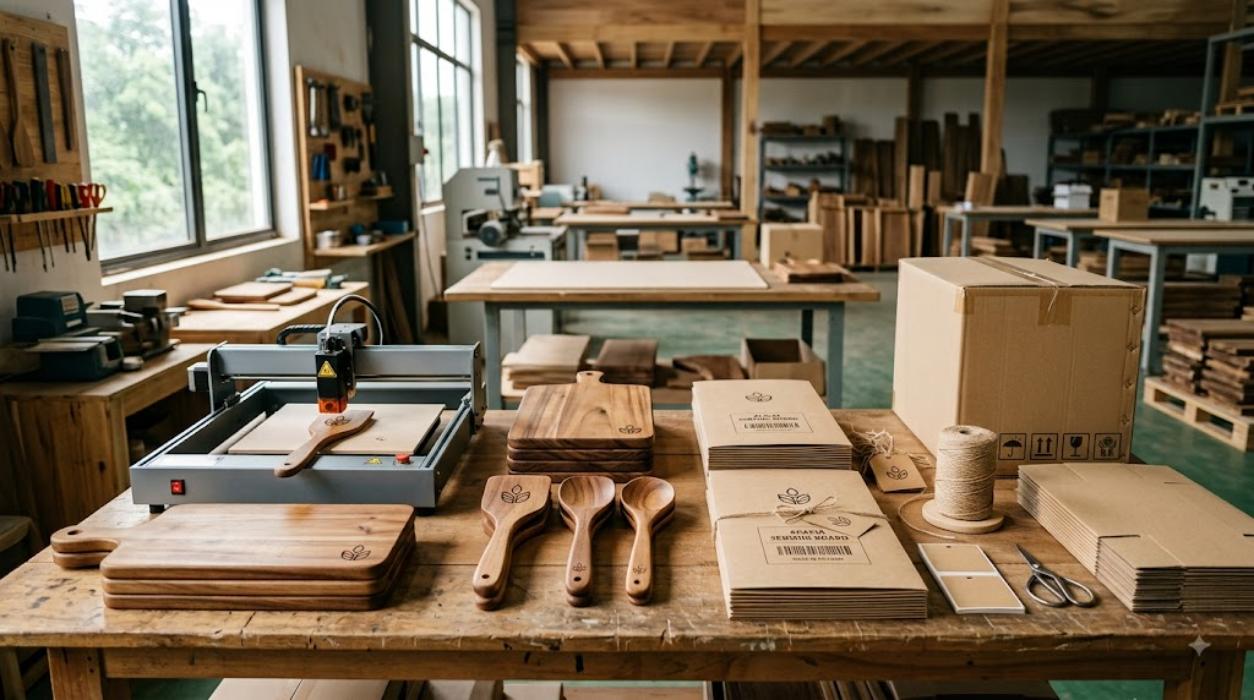
Most private-label enquiries arrive in the same shape: a product photo, a logo file, and the question “can you brand this?” The answer is almost always yes. The more useful question — the one that decides whether the programme lands at a workable cost — is which branding method, on which surface, in which packaging tier, at which order quantity. Those four variables move the FOB price of a wooden serving board more than the wood species does.
This guide sets out how private label and custom branding actually work in Vietnamese woodware and houseware production in 2026: the four marking methods and what each one costs, the origin-marking and food-contact rules you cannot design around, the five packaging tiers, where minimum order quantities genuinely come from, and the artwork specification that prevents three weeks of file ping-pong before the first sample is cut.
The Four Ways to Put Your Brand on Wooden Kitchenware
1. Laser engraving
A CO2 laser burns the mark into the wood surface. It is the default for acacia, rubberwood and walnut-toned hardwoods because there is no consumable to fail: no ink, no foil, nothing that can be judged a food-contact additive. Setup is a file, not a tool, so artwork changes between orders cost nothing but engraving time. Fine detail holds down to roughly 0.3 mm line width, and the mark outlasts the finish above it.
The limitation is contrast. Laser marks read as a darker brown on a brown substrate. On dense, dark or heavily figured grain — some walnut-stained pieces, oiled rubberwood — a delicate logo can disappear at arm’s length. Ask for the engraving to be trialled on the actual production species and finish, not on a bare offcut. Species behaviour differs enough that it belongs in your material selection decision.
2. Hot stamping and branding irons
A heated metal die presses the mark into the surface. It produces a deeper, more artisanal impression than laser and is popular on rustic charcuterie and cutting boards. The trade-off is tooling: each artwork requires a physical die, typically USD 60 to 150, with a lead time of five to ten days. Once the die exists, per-unit cost is negligible. Hot stamping suits artwork that is fixed for years; it is the wrong choice when you expect seasonal or SKU-level variation.
3. Pad printing and screen printing
Ink-based marking is the only route to a colour logo on wood. It requires a screen or cliché per colour, so a two-colour logo means two setups. The critical constraint is regulatory rather than technical: if the printed area sits on a food-contact surface, the ink becomes part of your food-contact compliance file and must be documented alongside the finish system. A practical rule is to keep printed marks on non-contact surfaces — handle backs, tray undersides, the outer face of a lid — and let laser handle anything that touches food. The same logic governs food-safe finish selection.
4. Applied marks: metal badges, woven labels, silicone bands
An inset metal plate or a woven cotton loop reads as premium and gives you colour and typography that wood cannot. It also introduces a second material into a product you may be selling as single-material and compostable, and it adds an assembly step, an inspection point and a component supplier. Reserve applied marks for gift and hospitality lines where perceived value justifies the complexity.
| Method | Tooling / setup | Added unit cost | Artwork flexibility | Best for |
|---|---|---|---|---|
| Laser engraving | None (digital file) | USD 0.05-0.25 | High – change per order | Boards, utensils, bowls, trays |
| Hot stamp / branding iron | USD 60-150 per die | USD 0.03-0.10 | Low – fixed per die | Rustic boards, fixed brand marks |
| Pad / screen print | USD 40-90 per colour | USD 0.08-0.30 | Medium | Colour logos, non-contact surfaces |
| Applied badge / label | USD 100-400 mould or die | USD 0.20-0.90 | Medium | Gift, hospitality, premium lines |
The Marking Rules You Cannot Brand Around
Private label removes the factory’s name from the product. It does not remove your obligations to the customs authority at the port of entry.
Country of origin. Goods entering the United States must be marked with the country of origin in a conspicuous place, legibly, indelibly and permanently enough to reach the ultimate purchaser, under 19 CFR Part 134. For wooden kitchenware this normally means “Made in Vietnam” laser-engraved on the article itself, not printed only on a sleeve the retailer discards. Where the article is genuinely too small or the mark would damage it, marking on the immediate container may be accepted — but that determination belongs in writing in your file, agreed before production, not improvised at the port.
Food-contact declarations. In the EU, food-contact articles must carry either the words “for food contact” or the glass-and-fork symbol, or be clearly intended for that use, under Regulation (EC) No 1935/2004. That symbol has to be positioned in your artwork layout, so it is a private-label decision, not an afterthought.
Barcodes. Retail-ready packaging needs a GS1-issued GTIN under your own company prefix. Factories should never generate barcode numbers for you. Send the assigned GTIN with the artwork and have it scan-verified on the pre-production sample.
Regional language rules. GCC markets generally expect Arabic alongside English on consumer-facing packaging, and several Asian markets require local-language product identity and importer details. Confirm the destination list before the sleeve is printed, because language is the single most common reason a packaging run gets scrapped.
Five Packaging Tiers and What Each One Actually Costs
Packaging is where private-label programmes gain or lose their margin. The tier you choose sets not only the material cost but the labour minutes per unit, the carton cube, and therefore the freight cost per piece.
| Tier | What it is | Indicative cost/unit | Lead time impact | Typical use |
|---|---|---|---|---|
| 0 – Bulk export | Interleaved in master carton, no inner pack | USD 0.02-0.06 | None | Distributors who repack locally |
| 1 – Polybag plus hang tag | OPP bag, printed tag, twine | USD 0.10-0.22 | Plus 2-3 days | Wholesale, market stalls |
| 2 – Kraft sleeve / belly band | Printed kraft wrap, barcode label | USD 0.18-0.40 | Plus 3-5 days | Retail shelf, eco positioning |
| 3 – Printed retail box | Full-colour folding carton, insert | USD 0.55-1.60 | Plus 7-12 days | Branded retail, e-commerce |
| 4 – Gift set | Multi-piece box, tray insert, ribbon | USD 1.80-4.50 | Plus 10-18 days | Corporate gifting, hospitality |
Two points catch first-time buyers. First, e-commerce changes the brief entirely: if the item ships as its own parcel, the retail box has to survive a courier network, which usually means a heavier board grade and a drop-test requirement written into the specification. Second, packaging tier drives cube. Moving from a kraft sleeve to a rigid gift box on a serving board programme can cut units per 40HC container by a fifth, which raises freight cost per piece well beyond the packaging cost itself. Ask for carton dimensions and the units-per-container figure at quotation, not after the PO.
Where Private Label MOQs Actually Come From
Buyers often treat MOQ as a single number the factory invents. In practice a private-label MOQ is the sum of three separate minimums, and knowing which one is binding tells you exactly what to negotiate.
- Production MOQ — driven by setup on the CNC or lathe, kiln batch scheduling and sanding line changeover. This is the floor for the bare product.
- Branding MOQ — near zero for laser engraving, but real for hot stamping (die cost amortisation) and printing (screen setup).
- Packaging print MOQ — set by the printing supplier, not the woodware factory. This is usually the binding constraint, because a printer will not run 300 kraft sleeves at a sensible unit price.
| Element | Typical minimum | What relaxes it |
|---|---|---|
| Product per SKU | 300-500 pcs | Combining SKUs on one shared blank or species |
| Laser engraving | No practical minimum | Not applicable |
| Hot stamp die | 500-1,000 pcs to amortise | Paying the die cost upfront as tooling |
| Printed kraft sleeve | 1,000-2,000 pcs | Ganging several SKUs on one print sheet |
| Printed retail box | 1,000-3,000 pcs | Generic box plus variable-data sticker |
| Hang tag / label | 1,000-2,000 pcs | Digital print for short runs |
The most effective MOQ reduction in this category is not haggling — it is packaging architecture. A single kraft sleeve design carrying a variable-data label per SKU lets you order one print run across eight products instead of eight runs of 1,000. For buyers testing a new range of wooden kitchen utensils or trays and home organisation houseware, this is usually the difference between a viable trial order and no order at all.
The Artwork Specification That Saves Three Weeks
More private-label timelines slip on artwork than on production. Send this set with the first enquiry and the sampling cycle compresses noticeably.
- Vector logo in .ai, .eps or outlined .pdf. Raster files below 600 dpi cannot be laser-engraved cleanly at small sizes.
- Minimum stroke width of 0.3 mm at final engraved size. Hairline serifs and thin script fill in on open-grain acacia.
- A monochrome, single-weight version of the logo. Gradients and drop shadows do not exist in engraving.
- Placement drawing — a dimensioned sketch showing mark position and size on the article, per SKU. “Centre of the handle” is not a specification.
- Pantone references for any printed element, plus the substrate they will print on, since kraft shifts colour noticeably against white board.
- Packaging dieline if you have an existing box format, or a request for the factory to supply one.
- Assigned GTIN per SKU and the barcode placement zone.
- Mandatory copy block — origin marking, food-contact statement, care instructions, importer details, material declaration.
A Realistic Private-Label Timeline
| Stage | Working days | What decides the duration |
|---|---|---|
| Quotation with branding and packaging options | 2-4 | Completeness of your brief |
| Artwork review and engraving trial | 3-6 | Vector file quality; species contrast test |
| Pre-production sample, branded and packed | 10-15 | Packaging print lead time, not woodwork |
| Buyer approval and revisions | 3-10 | Your internal sign-off chain |
| Mass production | 25-40 | Order size, kiln capacity, season |
| Inspection, packing, documents | 4-7 | Third-party inspection booking |
Note where the time actually sits. Woodworking is rarely the bottleneck on a first order; artwork approval and packaging printing are. Buyers who front-load the artwork package routinely bring a twelve-week first order down to eight. Note too that kiln-drying schedules are fixed physical processes — see our guidance on moisture content and kiln-drying standards — and cannot be compressed to recover lost artwork weeks.
Eight Lines to Put in Your Private-Label Brief
- Destination markets, so origin marking, language and food-contact statements are set once.
- Sales channel — wholesale, bricks-and-mortar retail, or e-commerce parcel — because this decides the packaging tier.
- Branding method preference, or a request for the factory to recommend one per SKU.
- Whether the brand mark must be visible on the article, on the pack, or both.
- Target FOB price band per SKU, so branding and packaging can be engineered to it rather than quoted against it.
- Annual forecast alongside the first order quantity, since it changes what tooling investment is rational.
- Who owns the artwork and tooling, stated explicitly.
- Whether you require exclusivity on a bespoke mould, die or design.
Frequently Asked Questions
Can I get private label on a first trial order?
Laser engraving on the article, yes — it carries no tooling and no meaningful minimum. Fully printed retail packaging on a first trial is usually uneconomic. The practical route is engraved product with a stock kraft sleeve and a variable-data label, then a move to printed packaging on the repeat order once volume justifies the print run.
Who owns the tooling and the artwork?
Whatever your contract says. If a branding die, a bespoke mould or a packaging dieline is paid for by you, state in the purchase order that it is your property, that it will not be used for other customers, and that it will be returned or destroyed on request. Silence on this point is a common source of dispute in OEM relationships.
Does private label affect my origin documentation?
No. Your brand on the product does not change where it was manufactured. The Certificate of Origin, the substantial-transformation position and any preferential-tariff claim rest on production facts, not on the label. Buyers should be wary of any supplier who offers to adjust origin documentation to match a brand’s marketing story.
Can compostable and disposable lines be private labelled?
Yes, though the mechanics differ. Bagasse, areca palm and wooden disposables are usually branded through the packaging rather than the article, and any compostability claim printed on that packaging must match the certification actually held for the product. Print the claim you can evidence, not the claim you would like to make.
Where Viet Farm Vision Fits
Viet Farm Vision is a Vietnam-based OEM manufacturer and exporter of wooden kitchenware and houseware, compostable and disposable tableware, agricultural products and handcrafts, supplying wholesale and private-label buyers across the Middle East, Asia and wider international markets.
On private label specifically, we quote branding and packaging as separate line items rather than folding them into an opaque unit price, run the engraving trial on the actual production species and finish before the sample is submitted, state the binding MOQ driver for each SKU so buyers know what is negotiable, and confirm carton dimensions and units per container at quotation so freight can be modelled before the purchase order is issued. Artwork and tooling paid for by the buyer remain the buyer’s property.
If you are building or re-specifying a private-label wooden kitchenware or houseware programme, send your target categories, destination markets, sales channel and volumes. We will come back with a recommended branding method per item, a packaging tier costed against your target price, and the binding MOQ for each element.
Contact: vietfarmvision.com/contact-us | info@vietfarmvision.com
Regulatory references: 19 CFR Part 134, country of origin marking; Regulation (EC) No 1935/2004 on food contact materials; GS1 GTIN standard. Costs and lead times in this article are indicative 2026 ranges for guidance only and are not a quotation.