
Most wooden kitchenware claims do not start with a broken product. They start with an inspection that was booked too late, written against a specification that never defined what a defect was, and signed off by someone who counted scratches but never put a moisture meter into a bowl. By the time the container is opened at destination, the argument is no longer about quality — it is about who agreed to what, and in writing.
This guide sets out how quality control on a Vietnamese wooden kitchenware or houseware order should actually be structured in 2026: the four points where inspection happens, how AQL sampling translates into real sample sizes and accept numbers, a defect classification table that reflects how wood behaves rather than how garments behave, the on-site tests worth insisting on, and the carton and container checks that decide whether the goods arrive in the condition they left in.
Wooden Kitchenware Fails Inspection for Reasons Other Products Never Do
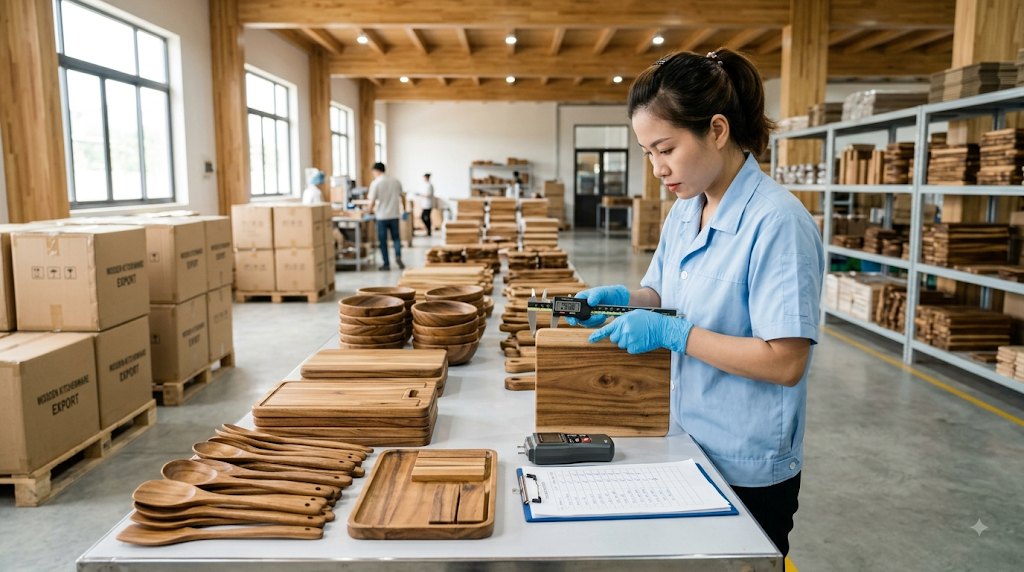
Wood is a hygroscopic material that keeps moving after it leaves the factory. A cutting board that passed a visual check at 14% moisture content in a humid Vietnamese workshop can arrive in a Gulf showroom or a European heated warehouse and split along the glue line within weeks — not because anyone did anything wrong on the line, but because nobody measured the one variable that predicted it. That is the structural difference between inspecting wooden houseware and inspecting almost anything else: a large share of the failures are latent at the time of inspection.
Three failure families dominate claims on this category, and each needs a different control:
- Dimensional and moisture-driven failures — warping, cupping, end-splits, glue-line separation on edge-glued boards. Controlled by kiln-drying records and a moisture reading at inspection, not by looking at the product.
- Surface and finish failures — sanding marks, uneven oil absorption, blotching, raised grain after the first wash, residual odour. Controlled by an approved golden sample plus a written finish specification.
- Packing and transit failures — corner crush, abrasion between unwrapped items, mould from packing warm goods into sealed polybags. Controlled by carton specification, drop testing and a loading supervision at stuffing.
A buyer who only books a single pre-shipment inspection is covering the second family reasonably well, the first family partially, and the third family not at all.
The Four Inspection Points in a Wooden Kitchenware Order
Inspection is not one event. On a wooden kitchenware programme it is four, and the cheapest ones sit earliest.
| Stage | When it happens | What it actually catches | Typical cost position |
|---|---|---|---|
| Pre-production meeting (PPM) | Before cutting starts | Wrong species, wrong finish, artwork not released, carton spec undefined | Free — an email and a call |
| First article / golden sample sign-off | On the first 10–20 pieces off the line | Profile, thickness, colour tone, engraving depth, finish sheen | Cost of one air courier sample |
| During production inspection (DUPRO) | At roughly 20–30% output | Systematic sanding, glue-line and dimensional drift while it is still correctable | One inspector day |
| Pre-shipment inspection (PSI) | At 80–100% packed | Final AQL verdict, moisture, packing, carton marking, loading readiness | One to two inspector days |
The single highest-return change most buyers can make is adding the DUPRO. At 20–30% output there is still material, time and goodwill available to correct a systematic problem. At 100% packed there is only a discount negotiation, a rework quotation or a delayed vessel.
For first orders, and for any order where the species or finish has changed, treat the golden sample as a contractual document: photographed from six angles, signed and dated by both sides, sealed, and retained at the factory for the inspector to compare against. A verbal “same as last time” is the most expensive sentence in this category.
AQL in Plain Terms, and the Sample Sizes That Follow
AQL — Acceptable Quality Limit, defined under ISO 2859-1 — is not a quality target. It is a statistical rule for how many pieces an inspector pulls from a lot and how many defects that sample may contain before the whole lot is rejected. Buyers routinely write “AQL 2.5” into a purchase order without knowing what it obliges either side to do.
The standard convention for wooden kitchenware and houseware is General Inspection Level II, single sampling, normal severity, with separate limits for each defect class. The table below shows what that means in practice at common order sizes.
| Lot size (pieces) | Sample size | Accept / Reject at AQL 2.5 | Accept / Reject at AQL 4.0 |
|---|---|---|---|
| 151 – 280 | 32 | 2 / 3 | 3 / 4 |
| 281 – 500 | 50 | 3 / 4 | 5 / 6 |
| 501 – 1,200 | 80 | 5 / 6 | 7 / 8 |
| 1,201 – 3,200 | 125 | 7 / 8 | 10 / 11 |
| 3,201 – 10,000 | 200 | 10 / 11 | 14 / 15 |
| 10,001 – 35,000 | 315 | 14 / 15 | 21 / 22 |
Read one row carefully. On a 5,000-piece order of wooden serving boards at AQL 2.5, the inspector checks 200 pieces. Ten minor defects among those 200 is a pass. Eleven is a rejection of the entire 5,000. That is a very fine line to leave undefined — which is exactly why the defect classification matters more than the AQL number itself.
A workable default for this category: Critical 0 / Major AQL 2.5 / Minor AQL 4.0. Tightening minors to 2.5 on a hand-finished natural material usually buys arguments rather than quality; tightening majors to 1.5 is where the real leverage sits if you need it.
A Defect Classification Table Built for Wood, Not for Garments
Generic inspection checklists classify defects as critical, major and minor without ever saying what a “major” looks like on an oiled acacia bowl. The result is an inspector making a judgement call that neither side agreed to. Put a table like this into the purchase order and the judgement disappears.
| Defect | Class | Working definition |
|---|---|---|
| Splinter, sharp edge or protruding staple on a food-contact or hand-contact surface | Critical | Any occurrence — safety defect, zero tolerance |
| Mould, fungal staining or musty odour on opening the polybag | Critical | Any occurrence |
| Wrong species, wrong finish system or missing origin marking | Critical | Any occurrence — compliance and customs exposure |
| Glue-line separation or visible gap on an edge-glued board | Major | Any gap admitting a 0.2 mm feeler gauge |
| Crack or end-split | Major | Length over 10 mm or any depth through the finish |
| Warp or cupping | Major | Deviation over 2 mm across a 300 mm span on a flat-laid board |
| Moisture content outside contract range | Major | Any reading outside the agreed band on a core sample |
| Dimensional deviation | Major | Outside the stated tolerance, typically ±2 mm length/width, ±1 mm thickness |
| Engraving or print misplacement | Major | Over 2 mm from the specified position, or depth outside the approved sample |
| Sanding marks, raised grain or uneven oil absorption | Minor | Visible at 60 cm under 1,000 lux normal viewing |
| Colour tone variation against the golden sample | Minor | Outside the approved light/dark sample pair |
| Small surface knot, mineral streak or natural grain variation | Not a defect | Inherent to solid wood — state this explicitly to prevent over-rejection |
| Carton marking error, missing barcode or wrong inner count | Minor | Per carton; escalates to Major if it affects customs or retail scanning |
The final two rows do as much work as the rest of the table. Declaring natural grain variation as acceptable protects the factory from an inspector rejecting solid wood for being solid wood; declaring barcode errors as inspectable protects the buyer from a retail chargeback that no factory will ever reimburse.
The On-Site Tests Worth Insisting On
Visual AQL alone will not detect the failures that generate claims. Five physical checks belong on every wooden kitchenware inspection report, and all five can be done in a factory canteen with equipment costing less than a single rejected pallet.
| Test | Method | Pass criterion |
|---|---|---|
| Moisture content | Pin-type meter, reading taken on the core of a cut or drilled sample, minimum 5 pieces per lot | Within the contract band — typically 8–12% for temperate and tropical markets, 6–9% for Gulf and other dry, air-conditioned interiors |
| Finish adhesion / rub-off | White cotton cloth, 20 firm strokes on a finished surface | No colour transfer to the cloth, no tackiness |
| Odour | Sealed piece in a closed polybag for 24 hours, opened and smelled | No solvent, sour or musty odour |
| Water resistance spot check | Droplet left on the finished surface for 10 minutes, wiped off | No white ring, no grain raise beyond the approved sample |
| Assembly and function | Full articulation of lids, handles, hinges, stacking fit on nesting bowls and trays | Operates smoothly; nested items separate without binding |
Moisture is the one that pays for the inspection on its own. If you are specifying kiln-drying and moisture bands for the first time, our guide to wood moisture content and kiln-drying standards for Vietnam wooden kitchenware exports sets out the target ranges by destination climate, and the food-safe finishes guide explains which finish systems will and will not survive a rub-off test.
Carton, Drop Test and Container Loading Checks
Wooden houseware is heavy, hard-cornered and abrasive against itself. More product is damaged between the packing bench and the destination warehouse than is ever damaged on the production line, and almost none of that damage is visible at a pre-shipment inspection that stops at the carton.
- Carton specification. Confirm the burst strength or edge crush test value on the printed carton certificate, not on the purchase order. Five-ply is standard for boards and heavier bowls; three-ply is acceptable only for light utensils in small inner counts.
- Drop test. One packed export carton, ten drops in the ISTA 1A sequence — one corner, three edges, six faces — from the height matched to gross weight. Open, photograph and record. This is a 30-minute test that has saved entire containers.
- Inner protection. Every hard-cornered item individually bagged or paper-wrapped, with corrugated dividers between layers. Unwrapped boards stacked face-to-face will arrive scuffed, and scuffing is a Major defect at destination even though it was not one at origin.
- Humidity control. Silica gel or desiccant bags inside the carton for any sea shipment through the tropics, and a firm rule that goods are never bagged warm straight off the finishing line — trapped warm air condenses in a reefer-cold container and grows mould.
- Wood packaging material. Pallets, crates and dunnage are regulated separately from the product itself under ISPM 15 and must carry the heat-treatment stamp. The finished kitchenware is a manufactured wood product and falls outside ISPM 15, but the pallet under it does not — and it is the pallet that gets a container held at the port.
- Loading supervision. Container photographed empty, floor and roof checked for leaks, carton count verified as loaded, seal number photographed against the container number. Ask for the photo set as a deliverable, not on request.
Plan volumetrics at quotation rather than at booking. A 20 ft general purpose container gives roughly 28–33 CBM of usable stowage and a 40 ft high cube roughly 67–76 CBM once pallet height and dunnage are accounted for. Wooden kitchenware almost always fills the volume before it reaches the weight limit, so the carton dimension — not the product weight — is what determines your landed cost per piece.
What a Usable Inspection Report Contains
An inspection report that says “PASS” and attaches twelve photographs is not evidence. If a claim is ever raised, the report has to stand on its own. Require these elements before the inspector leaves site:
- Order reference, SKU list, lot size actually presented, and percentage packed at the time of inspection
- Sampling plan stated explicitly: standard, inspection level, severity, sample size, and accept/reject numbers per class
- Defect log with quantity, class and photograph reference for every defect found — not just a total
- Measured results for all five physical tests, with instrument readings written down, not summarised as “OK”
- Carton photographs: shipping mark, side mark, barcode close-up, inner arrangement, and the opened drop-test carton
- Quantity verification: cartons counted, inner count verified on at least three cartons, total pieces reconciled against the packing list
- A clear verdict — PASS, FAIL or PENDING — with the specific clause that triggered it, and the signature of the factory representative acknowledging receipt
The last element is the one buyers most often skip and most often need. An inspection result the factory has not acknowledged in writing on the day is very hard to enforce three weeks later.
Ten Lines to Put in Your Inspection Clause
Copy these into the purchase order rather than the inspection booking. A booking is an instruction to a third party; a purchase order clause is an obligation on the supplier.
- Standard and plan: ISO 2859-1, General Inspection Level II, single sampling, normal severity
- Limits by class: Critical 0, Major AQL 2.5, Minor AQL 4.0
- Defect classification table attached as an annex and agreed before production starts
- Golden sample signed, sealed and retained at the factory; inspection is against the golden sample, not against opinion
- Moisture content band stated by destination market, verified on core samples of at least five pieces
- DUPRO booked at 20–30% output in addition to the pre-shipment inspection
- Pre-shipment inspection at minimum 80% produced and 100% packed for the inspected portion
- One ISTA 1A drop test on a packed export carton, photographed and reported
- Loading supervision with empty-container, stuffing, seal and container-number photographs as a deliverable
- Consequence of failure defined in advance: 100% sorting at supplier cost, re-inspection at supplier cost, and who pays the freight difference if the vessel is missed
The tenth line is the one that changes behaviour. An inspection with no defined consequence is a report; an inspection with a pre-agreed re-inspection cost is a control.
Frequently Asked Questions
Should I use a third-party inspection agency or the supplier’s own QC?
Both, for different jobs. In-line QC belongs to the factory and should be running continuously with its own records. Third-party inspection is what you show a bank, an insurer or a court. For first orders, high-value programmes or any order going into a retail chain with chargebacks, use a third party for the DUPRO and the pre-shipment inspection. For repeat orders of a proven SKU, a supplier QC report plus loading photographs is often proportionate.
What does third-party inspection cost on a wooden kitchenware order?
Inspection is quoted per man-day, and a typical mixed wooden kitchenware order needs one to two man-days for a pre-shipment inspection and one for a DUPRO. Against a container of houseware, that is a fraction of a percent of order value — and materially less than the cost of sorting a rejected lot or air-freighting replacements to hit a season.
Can an order be re-inspected after a failure?
Yes, and it should be. The correct sequence after a FAIL is: supplier submits a written root-cause and corrective-action note, sorts or reworks 100% of the lot at their cost, and the lot is re-presented for a fresh inspection under tightened severity. Re-inspection at normal severity on a lot that has just failed tells you very little.
Does inspection replace laboratory testing?
No. Inspection verifies that the produced goods match the approved sample and specification. Laboratory testing verifies that the specification itself is legal in your market — food-contact migration under Regulation (EC) 1935/2004 for the EU, or the equivalent food-contact requirements for the Gulf and Asian markets. Test once at specification approval, then inspect every shipment against that approved specification.
How much notice does an inspection need?
Book the pre-shipment inspection at least seven working days before the target inspection date, and confirm the actual packed percentage 48 hours beforehand. The most common wasted inspection in this industry is an inspector arriving to find 40% of the order packed and being sent away — billed in full.
Where Viet Farm Vision Fits
Viet Farm Vision is a Vietnam-based OEM manufacturer and exporter of wooden kitchenware and houseware, compostable and disposable tableware, agricultural products and handcrafts, supplying wholesale and private-label buyers across the Middle East, Asia and wider international markets.
On quality control specifically, we agree the defect classification table before production rather than after a dispute, run in-line checks with written records at cutting, sanding, finishing and packing, take moisture readings on core samples and put the instrument values into the report, and welcome third-party DUPRO and pre-shipment inspection on any order. Golden samples are sealed and retained at the factory for the life of the programme, loading photographs are supplied as standard rather than on request, and where a lot fails we sort and re-present at our cost.
If you are setting up an inspection protocol for a wooden kitchenware or houseware programme — or reviewing one that has already cost you a claim — send your SKU list, destination market, order volume and current AQL clause and we will return a marked-up inspection annex and a quotation against it. Related reading: choosing between acacia, rubberwood and bamboo, private label and custom branding, and our wooden bowls and tableware sourcing guide.
Contact us at vietfarmvision.com/contact-us or email info@vietfarmvision.com.