
A wooden cutting board that splits eight weeks after delivery is almost never a manufacturing accident. It is a specification gap. The board left the factory sound, passed inspection, survived the container, reached the distribution centre intact, and then failed in an air-conditioned villa in Dubai or a centrally heated apartment in Warsaw — because nobody in the transaction ever agreed what moisture content the wood should be at when it shipped, and nobody matched that number to the climate the product was going to live in.
This is the single most common cause of after-sales claims on wooden kitchenware and houseware, and it is also the most preventable. It costs nothing at quotation stage to write a moisture target into the specification. It costs a great deal to discover, three containers in, that your supplier’s default drying schedule was built for the domestic Vietnamese market and your customers live somewhere considerably drier. This guide explains what actually happens inside the wood, what number you should be asking for, and how to verify it before the goods leave Vietnam.
One Concept Explains Almost Every Cracked Board
Wood is hygroscopic. It never stops exchanging water vapour with the air around it, and it will keep gaining or losing moisture until it reaches equilibrium with that air. That balance point is called equilibrium moisture content, or EMC, and it is set almost entirely by relative humidity, with temperature playing a secondary role.
The important consequence is that a finished product does not have a fixed moisture content. It has whatever moisture content its environment imposes on it. A board manufactured at 12% moisture and sold into a room that sits at 30% relative humidity will not stay at 12%. It will dry down towards roughly 6%, and in doing so it will shrink. Wood shrinks unevenly — across the grain far more than along it, and tangentially roughly twice as much as radially — so as it dries it develops internal stress. When that stress exceeds what the fibres can absorb, the wood relieves it the only way it can: it splits.
Everything else in this article is downstream of that one mechanism. The goal is not to eliminate moisture movement, which is impossible, but to reduce how far the product has to travel from its shipped condition to its service condition.
What EMC Looks Like in Your Actual Market
Approximate equilibrium moisture content for wood at ordinary room temperature, by relative humidity:
- 80% RH — roughly 16% EMC. Unconditioned interiors in tropical Southeast Asia, coastal West Africa, monsoon-season South Asia.
- 65% RH — roughly 12% EMC. Temperate interiors in mild seasons; much of Europe in spring and autumn.
- 50% RH — roughly 9% EMC. Air-conditioned interiors across the Gulf for most of the year; European homes in shoulder seasons.
- 35% RH — roughly 7% EMC. Heated northern European and Central Asian interiors in winter; heavily air-conditioned Gulf interiors in peak summer.
- 25% RH — roughly 5.5% EMC. Continental winter with aggressive central heating; desert interiors with strong dehumidification.
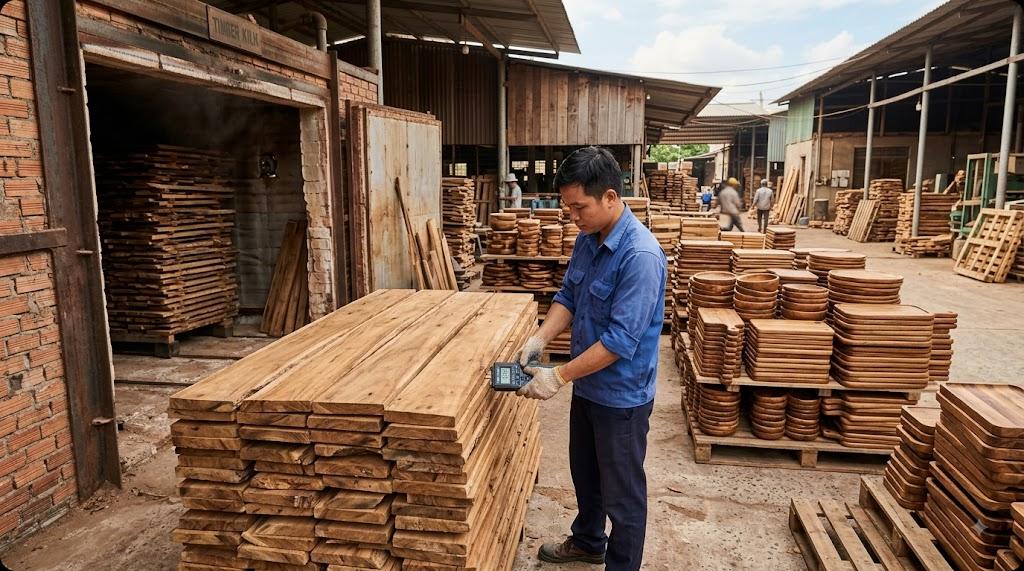
Now place Vietnam on the same scale. Ambient relative humidity across most of the country runs in the seventies and eighties for much of the year. Untreated timber sitting in an open Vietnamese workshop will sit somewhere around 15% to 17% moisture content. That is the starting point, and it is why kiln drying is not optional for any product going to a dry market.
The practical rule is straightforward. Identify the driest condition your product will realistically encounter in service, work out the EMC that corresponds to it, and specify a shipped moisture content close to the middle of the range the product will experience — not the wettest end of it. A board destined for Gulf retail should not ship at the same moisture content as one destined for Jakarta.
What Vietnamese Factories Mean When They Say "Kiln Dried"
"Kiln dried" on a quotation is a process description, not a result. It tells you the timber went through a kiln. It does not tell you the target, the tolerance, the schedule, whether the charge was conditioned at the end, or whether the number was measured on the surface or at the core.
A typical acacia or rubberwood drying cycle in Vietnam runs from a green moisture content well above 40% down to a target in the 8% to 12% band, over roughly one to three weeks depending on species, thickness and kiln type. Several things determine whether the output is genuinely stable:
- Schedule discipline. Drying too fast case-hardens the timber: the outer shell dries and sets while the core is still wet, locking in stress that surfaces later as checking or cupping when the part is machined.
- Conditioning at the end of the charge. A short steam-conditioning phase equalises moisture through the thickness and relieves case-hardening. Skipping it is a common corner-cut because it adds hours to a cycle.
- Post-kiln storage. Timber dried to 9% and then stacked for three weeks in an open shed will climb back towards ambient. Conditioned storage between kiln and machining is what preserves the number you paid for.
- Where in the process the reading is taken. A reading at kiln discharge is not a reading at packing. The one that matters commercially is the one taken on finished goods.
Where the Moisture Number Belongs in Your Specification
A usable moisture clause has five parts, and most buyer specifications contain none of them. Write it into the product specification sheet attached to the purchase order, not into an email.
- The target and tolerance. For example, 9% ± 2% for Gulf and northern European programmes; 11% ± 2% for humid tropical markets. A range without a tolerance invites the supplier to sit at whichever end is cheapest.
- The measurement point. Finished goods, after final sanding and finishing, before packing. Not raw lumber, not kiln discharge.
- The method. Calibrated pin-type resistance meter with the correct species correction, measured at depth rather than on the surface, with oven-dry testing on sample pieces as the reference method where a dispute arises.
- The sampling plan. How many pieces per production lot, drawn at random across the lot rather than from one pallet.
- The record. A moisture log by lot, supplied with the shipping documents. If a claim arises later, this is the document that tells you whether the problem originated in Vietnam or in the supply chain after it.
Specifying a number that is too low is also a mistake. Over-drying acacia below about 7% for a market that lives at 65% relative humidity means the product absorbs moisture, swells and can cup or delaminate at glue lines. The objective is a match to service conditions, not the lowest achievable figure.
Construction Choices That Matter as Much as the Number
Moisture content sets how much dimensional movement will occur. Construction determines whether that movement is absorbed harmlessly or concentrated into a crack.
- Edge-glued panels outperform single-piece slabs. A wide one-piece board carries all its shrinkage across a single span. The same board built from narrow staves with alternating grain orientation distributes the movement across many glue lines and stays flatter. For dry-market programmes this is usually the highest-value change you can make.
- Thickness cuts both ways. Thicker stock is more rigid but harder to dry evenly and slower to equalise. Very thick single-piece boards are the most claim-prone item in most catalogues.
- End grain is the fast lane for moisture. Water vapour moves along the grain far faster than across it, so ends dry first and check first. Sealing end grain on longer items is cheap insurance.
- Radiused edges and corners reduce stress concentration and are far less likely to start a split than sharp arrises.
- Glue selection matters in humid service. For items exposed to washing, a water-resistant adhesive class is the difference between a panel that survives and one that opens along the joints.
- Species behaviour differs. Rubberwood is usually supplied as finger-jointed and laminated panel, which is inherently more stable than solid stock. Acacia offers better appearance and hardness but larger movement in solid sections. Bamboo laminate moves differently again and can be a strong option for very dry markets. This is covered in more depth in our acacia, rubberwood and bamboo material comparison.
Finish Is Moisture Management, Not Decoration
No food-safe finish makes wood waterproof. What a finish does is slow the rate of moisture exchange, which gives the piece time to equalise gradually instead of shocking. That distinction changes how you should specify it.
Mineral oil and beeswax penetrate and slow exchange modestly; they are consumable and depend on the end user re-oiling. Film-forming lacquers and food-contact polyurethanes slow exchange much more, but only where the film is continuous. The most frequent field failure we see is a board finished beautifully on the display face and left bare underneath. Moisture then leaves through one face only, the two faces move at different rates, and the board cups and then splits. Specify finish on all faces and all edges, including the underside. Our guide to food-safe finishes for Vietnam wooden kitchenware covers the compliance side of that choice.
The Container Is Its Own Climate
A dry container on a thirty to forty day ocean leg is not a neutral environment. Internal air temperature under direct sun can climb far above ambient and then fall sharply overnight. Each cycle drives moisture out of everything inside — cartons, pallets, dunnage, product — and when the air cools past its dew point that moisture condenses on the container ceiling and rains back down onto the top layer of cargo. Buyers see the result as water staining on upper cartons and mould spotting, and often conclude the goods were packed wet.
Practical controls, all inexpensive relative to a rejected container:
- Container desiccant — hanging calcium chloride or clay bags sized to the container, not a handful of sachets thrown in at the door.
- Dry pallets. Wet or freshly treated pallets can carry a large water load and release it directly into your cargo. Specify a maximum pallet moisture content alongside the ISPM 15 requirement.
- Avoid stuffing at dawn in the rainy season, when you seal the highest dew point air of the day inside the box.
- Polybag individual items and use a moisture-barrier liner for high-value or lacquer-finished lines.
- Keep cargo clear of the container walls and ceiling so condensate has somewhere to go that is not the product.
Verifying Moisture Content at Pre-Shipment Inspection
Moisture content should be an explicit line item on the inspection checklist, with a pass or fail criterion, sitting alongside the visual and dimensional checks. Treat it the same way you treat any other measurable attribute in your pre-shipment inspection and AQL plan.
- Draw samples at random across the whole lot. Readings from one pallet tell you about one pallet.
- Take multiple readings per piece — centre and near an end — and record them individually rather than as an average.
- Insist the meter is set to the correct species correction and has a current calibration check. An uncorrected reading on a dense tropical hardwood can be several points out.
- Where the result is contested, oven-dry testing on sacrificial samples is the reference method and settles the question definitively.
- Photograph the meter display against the piece and the lot label. A number in a report without evidence is difficult to rely on months later.
One further check costs nothing: ask for readings on the same reference pieces at two points, at packing and again after several days in the packed carton. A drift of more than a point or so suggests the goods were packed before they had equalised.
Care Instructions Are Part of the Product
Even a correctly specified board will fail if the end user puts it through a dishwasher. A dishwasher cycle saturates the surface at high temperature and then drives it bone dry in the heated drying phase — the most aggressive moisture cycle the product will ever face, repeated weekly. Prolonged soaking in a sink is the second most common failure mode.
A printed care card in the retail pack, in the destination market language, materially reduces consumer return rates for a cost measured in cents. It should say plainly: hand wash, dry immediately and standing on edge rather than flat, do not soak, do not put in a dishwasher, re-oil periodically. Buyers who treat the care card as a marketing afterthought rather than a technical component of the product tend to carry higher return rates than the specification alone would predict.
What a Fair Claims Clause Looks Like
Wood is a natural material and no honest manufacturer can guarantee zero movement. What is reasonable is a clause that allocates responsibility according to what each party controls.
- The manufacturer is responsible for shipping within the agreed moisture band, for construction and glue-line integrity, and for finish coverage as specified. Failures traceable to those are supplier defects.
- The buyer is responsible for storage and retail conditions, and for the care information passed to the end user.
- Define the defect. "Cracked" is not measurable. A surface check under a stated length and depth that does not pass through the piece is a characteristic of the material; a through-split or an open glue line is a defect. Put the threshold in the specification.
- Agree the remedy and the window in advance — typically replacement or credit on defects reported within a defined period from arrival, supported by photographs and the lot number.
- The moisture log from the shipment is the evidence that resolves most of these disputes without argument. That is the real reason to insist on it.
Frequently Asked Questions
What moisture content should I specify for the Middle East?
For products that will live in air-conditioned interiors most of the year, a target around 8% to 10% is a sensible working range, with a stated tolerance. Gulf outdoor air can be very humid, but the interiors your product actually occupies are conditioned and considerably drier, and that is the environment that determines EMC. Confirm the assumption against your own market rather than treating it as universal.
Does specifying a lower moisture content increase my price?
Usually only marginally, and mostly through longer kiln residency and slightly higher drying losses. It is a small line in the cost build compared with material grade or finish, and it is far cheaper than a replacement shipment. Our breakdown of how a Vietnamese wooden kitchenware quotation is built puts drying in context against the other cost drivers.
Can a supplier fix moisture content after the parts are machined?
Only partially and only downward, by holding finished parts in a conditioned space until they equalise, which costs time. Stress locked in by a badly run kiln schedule cannot be undone later. This is why the drying question belongs at quotation stage rather than at inspection stage.
Do bamboo and compostable lines have the same issue?
Bamboo laminate is a glued composite and behaves more predictably than solid hardwood, though it is not immune and its glue lines are the point to watch. Moulded compostable and disposable items such as bagasse and areca palm leaf have their own moisture sensitivities in storage — mainly softening and mould risk in humid warehousing — but they are not subject to the shrinkage-cracking mechanism described here.
How do I handle a programme selling into both humid and dry markets?
Two options. Either split the specification by destination, running separate drying targets for each lane, which is straightforward once volumes justify it. Or standardise on a middle target around 10% and compensate with construction — laminated or edge-glued panels, full-coverage finish, moderate thickness — so the product tolerates a wider band. The second is usually the better answer for a mixed programme with modest volume per market.
Where Viet Farm Vision Fits
Viet Farm Vision is a Vietnam-based OEM manufacturer and exporter of wooden kitchenware and houseware, compostable and disposable tableware, agricultural products and handcrafts, supplying wholesale and private-label buyers across the Middle East, Asia and wider international markets.
On moisture specifically, we ask for the destination market and the retail environment before we quote, and we set the drying target to that rather than to a house default. Moisture content is recorded on finished goods by lot, and the log travels with the shipping documents. Where a programme is going into a demanding climate, we will say so at specification stage and recommend the construction and finish changes that go with it, rather than accepting the drawing as issued and dealing with the consequences later.
If you are specifying a wooden kitchenware or houseware programme for a dry or strongly seasonal market, send us the destination and the intended retail channel and we will propose a moisture target, construction and finish package before you commit to a specification.