
Wedding stationery is one of the few paper categories where buyers still pay for visible handwork. A printed invitation competes on price; a quilled invitation, where every petal is a coil of paper set by hand, competes on feeling. That is why stationery studios, wedding planners and event gifting companies are adding quilled pieces to their premium tier, either as the full suite or as a single hero card that lifts the whole order.
This guide explains how wedding and event buyers in the Middle East, Asia and Europe can source quilled wedding invitations from Vietnam at scale: which pieces of a suite are worth quilling, how personalisation works on handmade cards, how to plan lead time against a fixed wedding date, and how to brief a workshop so 300 invitations look as good as the sample.
Why quilling works for weddings and events
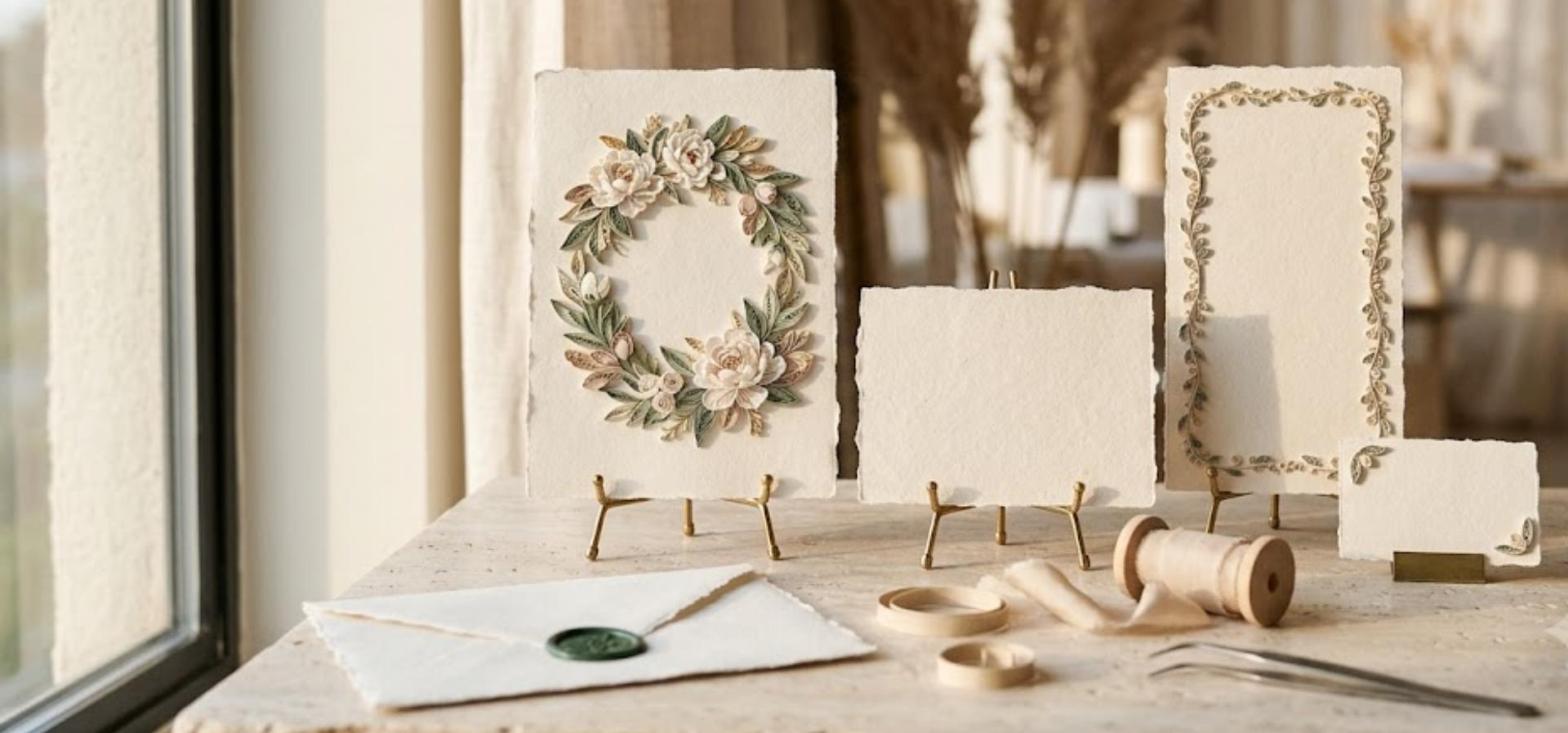
Couples and event hosts want stationery that guests keep. A quilled card has real depth, catches light and photographs well, so it often ends up framed or shared on social media rather than thrown away. For the reseller, that perceived value supports a higher retail price per piece than flat print, and the handmade story is easy to explain in a showroom or online listing.
- Keepsake value: raised paper motifs feel like a small gift, not just a notice.
- Colour matching: paper strips can be chosen to follow the wedding palette, from ivory and gold to deep emerald or burgundy.
- Cultural fit: floral, geometric and arabesque motifs translate well across Gulf, South Asian, East Asian and European ceremonies.
- Premium tier for studios: one quilled range lets a print studio offer a clear step up without new machinery.
Which pieces of the suite to quill
Not every piece needs the same level of handwork. The smartest suites put the most detailed quilling where guests look first and keep secondary pieces lighter. This controls unit cost and lead time while keeping the set visually consistent.
| Suite piece | Typical quilling level | Why |
|---|---|---|
| Main invitation | Full motif (wreath, bouquet, monogram frame) | The hero piece guests keep and photograph |
| Save the date | Small accent motif | Sent early, sets the style, lower cost per piece |
| RSVP and details cards | Corner accent or printed only | Functional, often returned or discarded |
| Menu and table cards | Slim border or single flower | Seen up close at the table, needs to stand flat |
| Place cards and favour tags | Mini coil accent | High quantity, so keep it simple and fast |
| Thank you card | Medium motif matching the invitation | Sent after the event, closes the story |
Personalisation: what can be handmade and what should be printed
The most common question from wedding buyers is how names and dates are added. On handmade cards the practical answer is to separate the artwork from the variable text.
- Quilled artwork: the motif is made in a repeatable design, identical across the order, so artisans can work at a steady rhythm and quality stays even.
- Printed text: names, date, venue and wording are printed on the card stock or on an insert, either at the workshop or by the buyer’s local printer close to the event.
- Quilled initials: a couple’s monogram can be quilled, but it adds time per piece, so it is usually reserved for the main invitation or a small run of VIP cards.
- Language and script: Arabic, Latin and Asian scripts are best handled in print. Proof the text with the client before any card goes to production.
Many studios order the quilled cards blank inside, then print the wording locally. This keeps the handmade part on a predictable timeline and removes the risk of a last minute wording change holding up a whole shipment.
Planning lead time against a fixed wedding date
A wedding date does not move, so the timeline has to be worked backwards. A realistic plan for a handmade order looks like this:
- Design brief and quote: palette, motif references, card sizes, quantities per piece.
- Sample and approval: a physical or photo sample of each piece, signed off before production starts.
- Production: depends on quantity and motif complexity; a dense wreath takes far longer per card than a corner accent.
- Packing and shipping: express air for small studio orders, consolidated air or sea for wholesale volumes.
- Local finishing: printing names, assembling, addressing and mailing by the studio or planner.
For stationery studios, the better model is to stock a seasonal collection of blank quilled designs ahead of peak wedding months, then personalise locally per client. Planners and event companies with one large event should confirm the design early and leave a buffer between arrival and the mailing date.
Matching the suite to regional wedding styles
- Gulf and wider Middle East: large guest lists, gold and ivory, arabesque frames, often boxed or presented in a sleeve. Volume per event can be high, so a simple repeatable motif matters.
- South and Southeast Asia: rich reds, marigold, magenta and gold, floral and peacock motifs, layered cards for multi day ceremonies.
- East Asia: red and gold for traditional ceremonies, soft pastels and minimalist florals for modern ones; double happiness and crane motifs are popular in quilled form.
- Europe: smaller guest lists, muted palettes such as sage, dusty rose and navy, botanical wreaths and generous white space.
Packaging that protects a raised paper surface
Quilled cards are not flat, so standard invitation packing can crush them. Ask for each card in a clear sleeve or individual box, rigid inner cartons that stop movement, and envelopes sized for the extra depth. If cards will be mailed by post, test one complete card in the envelope through your local postal service before ordering, since some services treat thicker letters as parcels.
How to brief a workshop for a wedding order
- Wedding or collection palette with colour references.
- Motif references and which suite pieces get which level of quilling.
- Card sizes, fold type and envelope size for each piece.
- Quantity per piece, plus a spare allowance for mistakes and late guests.
- Whether text is printed at the workshop or locally, and who proofs it.
- Packaging, labelling and private label requirements.
- The date cards must arrive, not just the event date.
Common mistakes on handmade wedding orders
- Approving a design from a screen image only, without seeing real paper colours.
- Putting full quilling on every piece and blowing up both cost and lead time.
- Ordering exact guest numbers with no spares.
- Leaving wording changes until production has started.
- Choosing envelopes before checking the finished card depth.
Sourcing quilled wedding stationery with Viet Farm Vision
Viet Farm Vision works directly with a handmade quilling workshop in Vietnam, where artisans create custom handmade quilling cards in the workshop itself. For wedding and event buyers we can develop custom motifs in your palette, add your studio logo, prepare private label packaging and plan production around your season or event date. If you are comparing card formats, our guide on quilling, pop-up and laser-cut cards is a useful next read, and event companies ordering branded pieces can also see how hotels and event planners specify logo-quilled cards. For background on the craft itself, see the history and techniques of quilling. Share your palette, suite pieces and quantities, and we will propose a sample set and quote. Contact our team to start.