
A kitchenware importer in Riyadh launched a first wooden range with twenty eight SKUs, every one of them in acacia, every one of them at a similar price point. Six months later, five items had sold through and the rest sat in the warehouse. The products were well made. The range was not. There was no clear entry item to pull shoppers in, no premium item to lift the basket, and too many near duplicates competing for the same shelf space and the same minimum order quantities.
Range planning is where most of the margin in a wooden kitchenware program is won or lost, long before a factory quotes a price. This guide explains how experienced buyers structure a wooden kitchenware assortment sourced from Vietnam: how to choose hero SKUs, how to build good, better and best tiers that make sense to both the shopper and the factory, and a practical twelve SKU starter range that fits a first order without spreading volume too thin.
Why range structure matters more than item count
Every SKU added to a wooden kitchenware order carries its own fixed costs: a golden sample, a branding setup, a retail pack design, a barcode, a carton specification and its own minimum order per item. In Vietnam, factories typically quote utensil MOQs per design rather than per order, so a buyer who spreads a fixed budget across thirty items ends up at the minimum on all of them, with weaker unit pricing and a container that is harder to load efficiently.
A tight range does the opposite. Fewer SKUs mean deeper quantities per item, better FOB pricing, simpler quality control and cleaner sell through data after launch. The goal of range planning is not to offer everything, it is to offer the right number of items, each with a clear job on the shelf.
Step one: pick your hero SKUs before anything else
A hero SKU is the item that carries the range. It is the product shoppers recognise, the one that appears in the advertising, and usually the one that reorders first. In wooden kitchenware the strongest heroes tend to share three traits: daily use, an obvious material advantage over plastic or silicone, and a price that feels like good value for natural wood.
- Cooking spoon and spatula sets. High frequency use, simple forms that suit CNC or lathe routes, and easy to bundle in threes or fives.
- Cutting and serving boards. The highest perceived value in the category and the easiest item to brand with laser engraving.
- Salad servers and serving bowls. Strong gifting appeal and a natural fit for seasonal promotions such as Ramadan, Eid, Christmas and Lunar New Year.
Choose one or two heroes and specify them carefully: species, grain direction, finish, tolerance in millimetres and packaging. The rest of the range is then built around them, not beside them.
Step two: build good, better and best tiers that the factory can actually make
Tiering gives shoppers a reason to trade up and gives retailers a way to cover more than one price point without confusing the shelf. The mistake is to create tiers by changing too many variables at once. In Vietnam, the cleanest tiers are built by changing one or two levers per step, so the factory can run the same base processes and keep costs predictable.
Good: the entry tier
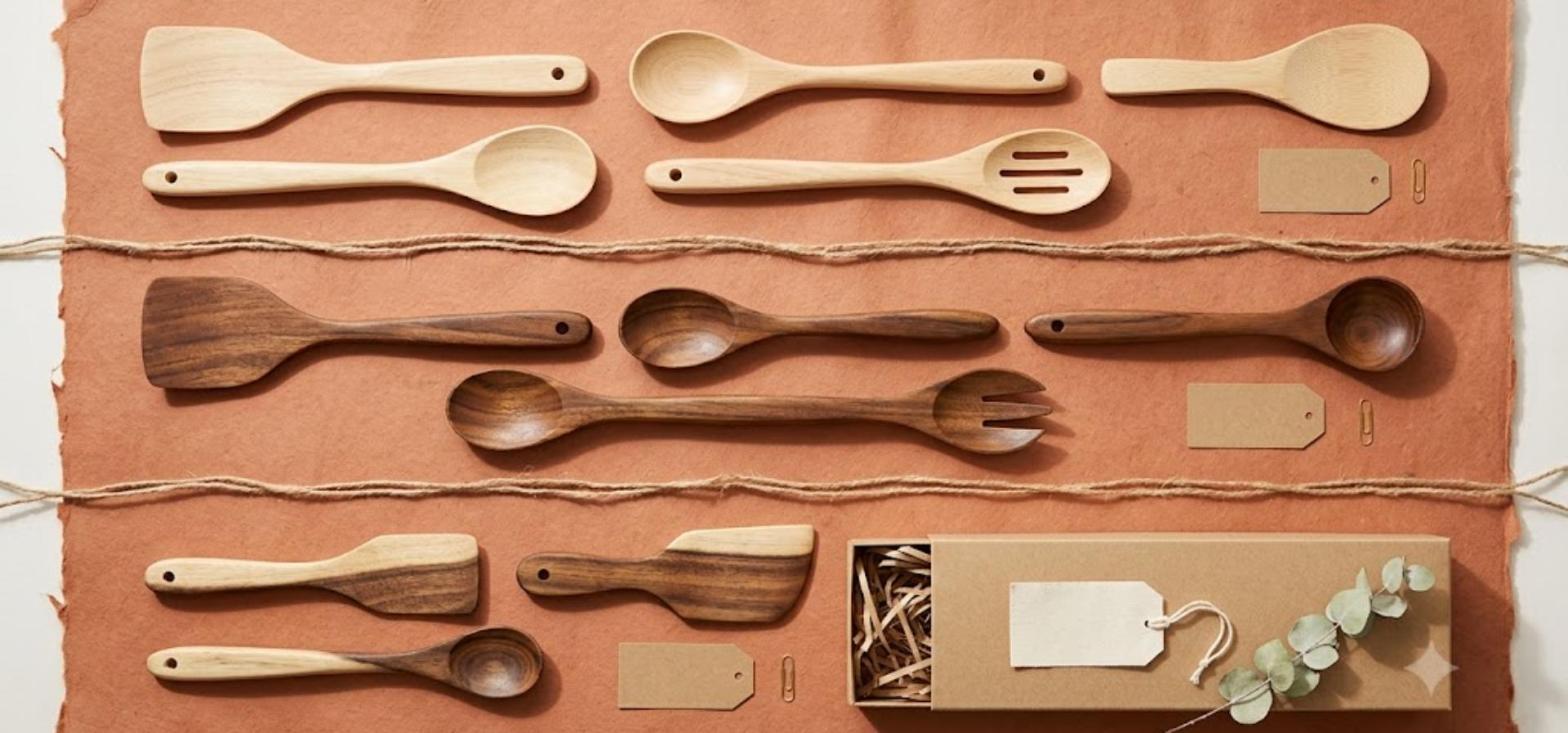
Rubberwood or plain acacia, CNC or lathe formed, a food safe mineral oil finish, minimal branding and a simple belly band or hang tag. This tier exists to bring shoppers into the category at an accessible price and to drive volume, so it should be the deepest order in the range.
Better: the core tier
Selected acacia with visible grain, refined edges and handles, a mineral oil and beeswax finish, laser engraved branding and a printed kraft sleeve. This is where most of the margin sits for the retailer, and where shoppers who care about natural materials will settle.
Best: the signature tier
Hand finished or hand faceted details, two tone or end grain construction on boards, premium packaging such as a rigid kraft gift box with a care card, and sets that work as gifts. This tier is smaller in volume but lifts the perceived quality of the whole brand.
A useful rule is that each tier should look clearly different from a distance of two metres. If a shopper cannot tell good from better without reading the label, the tiers are too close and will cannibalise each other. For how construction choices change the price of boards, see our guide to solid, edge grain, end grain and finger jointed boards.
A twelve SKU starter range for a first Vietnam order
The structure below is a practical starting point for a retailer, distributor or private label brand placing a first order. It concentrates volume on a small number of forms, shares species and finishes across items, and still covers three price tiers.
- Good tier, five SKUs: cooking spoon, slotted spoon, flat spatula, stirring spoon in rubberwood or plain acacia, plus a three piece utensil set made from the same four forms.
- Better tier, four SKUs: acacia salad servers, a paddle serving board with handle, a medium round serving bowl and a five piece utensil set with a holder.
- Best tier, three SKUs: an end grain or two tone chopping block, a large serving bowl with matching servers as a gift set, and a boxed premium utensil set with a care card.
Notice that the utensil forms repeat across tiers. The same spoon shape can appear in rubberwood in the good tier and in selected acacia with a refined finish in the better tier. The factory keeps one program and one set of templates, the buyer gets deeper effective volume, and the shopper still sees a clear step up.
How assortment choices change your FOB price and container fill
Range decisions feed directly into landed cost. Three effects matter most:
- Shared species and finishes lower cost. Running two species with one finish is simpler for the factory than four species with three finishes, and it reduces both material waste and setup time.
- Mixed cube improves loading. Long, flat utensils and boards pack densely, while bowls carry a lot of air. Balancing them across the range helps fill a container by volume instead of shipping air. Our guide to container loading and cube efficiency explains the math.
- Branding setups are per artwork, not per piece. Using one engraving file across several SKUs spreads the setup cost. See our overview of private label branding options.
For a full breakdown of where each cost sits in a Vietnamese quotation, read the anatomy of a wooden kitchenware FOB price.
Adapting the range to your market
- Gulf and Middle East retail: larger serving boards, serving bowls and gift sets perform well around Ramadan and Eid, and hosting pieces often justify a stronger best tier.
- East and Southeast Asia: compact utensils, smaller boards and neat retail packs suit smaller kitchens and convenience led shopping, so the good and better tiers usually carry the range.
- Europe: buyers often ask for documented timber origin and food contact compliance, so choosing a single, well documented species across the range simplifies paperwork.
- HoReCa and hospitality: fewer SKUs in larger quantities, durable finishes and replacement continuity matter more than retail packaging.
Range planning checklist before you request quotations
- One or two hero SKUs specified in full, including dimensions, species, finish and tolerance.
- Three tiers, each visibly different, built by changing one or two levers per step.
- No more than two timber species and two finishes across the first order.
- Forms that repeat across tiers wherever possible.
- A target retail price for each tier, so the factory can engineer back to it. Our guide to cost engineering for retail price points shows how.
- A plan for which SKUs will be reordered first and which are allowed to sell out.
How Viet Farm Vision helps buyers plan a wooden kitchenware range
Viet Farm Vision works as a manufacturing network and export partner for wooden kitchenware made in Vietnam. When a buyer sends a wish list, we do not simply quote every line. We look at which items can share species, forms and finishes, suggest where a tier is too close to the next one, and flag SKUs whose MOQ would tie up budget without supporting the range.
The result is usually a shorter, stronger assortment with deeper quantities per item, a cleaner golden sample process and a container that loads efficiently. Where a buyer wants a broader range, we phase it, launching the core first and adding SKUs once sell through data is in.
Importers, retailers and private label brands planning a wooden kitchenware launch for 2027 are welcome to send a current range list, target price points or a few reference photographs to info@vietfarmvision.com. We will reply with a suggested tier structure, the items we would combine or cut, and indicative FOB ranges for each tier.