
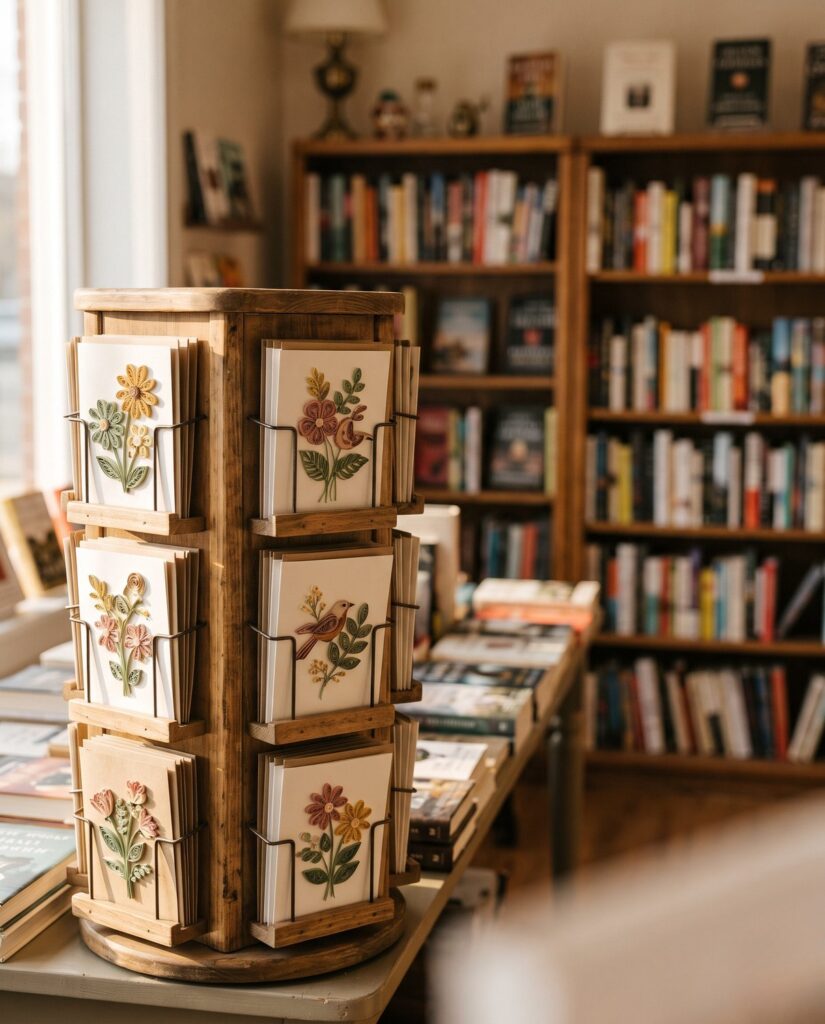
If you buy for an independent bookstore, wholesale greeting cards for bookstores work best when they behave like a curated book table: a tight edit, a clear story and steady replenishment. Handmade quilling cards from Vietnam fit that brief because they look and feel different from the mass-printed cards in supermarkets, and they can be produced under your own label with designs that match your store’s identity. This guide walks through how bookstore and stationery buyers can import them without overstocking or overcomplicating the first order.
Why do greeting cards matter so much to bookstores?
Cards are one of the most dependable “sidelines” in bookselling, the non-book products that lift basket size and give regulars a reason to come back between book releases. The American Booksellers Association runs dedicated education sessions on merchandising non-book gifts and sidelines, a sign of how central these categories have become to store economics.
Physical retail still dominates the category. In the UK, the Greeting Card Association’s market report found that single card sales reached £1.51 billion in 2023, and that more than 80% of single cards were bought in bricks-and-mortar stores (PG Buzz, reporting the GCA Market Report). For a bookstore, that means the card spinner by the till is competing for a real, in-person purchase, and distinctive product wins that competition.
What makes quilling cards a good fit for a bookstore card range?
Bookstore customers tend to browse slowly, pick things up and read the back. Quilled cards reward that behaviour. Each design is built from narrow paper strips rolled, shaped and glued by hand, so the surface has real depth and texture that a printed card cannot copy. A few practical reasons buyers choose them:
- They are a natural “gift with a book” add-on at the till, especially for birthdays, thank-you notes and sympathy.
- They support the handmade, independent positioning that separates indie bookshops from chain stores and online giants.
- Designs can be themed to your store: botanical prints for a garden and nature section, birds and butterflies for a children’s corner, minimal line motifs for a design-led shop.
- Every card carries a story you can tell on a shelf talker: made by hand by skilled artisans, mostly local women working at our partner workshop in Vietnam.
How should a bookstore plan its first wholesale greeting card order?
The most common mistake on a first order is buying too many designs in too few occasions. Bookstores usually have limited fixture space, often one spinner or a slim wall rack, so the range needs to earn every pocket. Start by mapping your occasions to your fixture, then choose designs.
| Step | What to decide | Bookstore-specific tip |
|---|---|---|
| Define fixture space | Count pockets on your spinner or rack | Plan the range to fill the fixture, not the other way round |
| Choose occasions | Birthday, thank you, blank/any occasion, sympathy, seasonal | Blank “any occasion” designs sell steadily next to gift books |
| Pick a design story | Botanical, birds, literary-inspired motifs, minimal | Echo the themes of your strongest book sections |
| Decide branding | Your logo on the back, private label sleeves, header cards | A store logo turns cards into a quiet brand ambassador |
| Approve samples | Pre-production sample of every design | Check colour against your store lighting, not just a photo |
| Plan replenishment | Reorder rhythm before peak seasons | Order holiday ranges months ahead, not in the autumn rush |
Keep the edit tight
A focused range of strong designs usually outperforms a wide range of weak ones. Many bookstore buyers begin with a core of evergreen “any occasion” and birthday designs, then add a small seasonal capsule. Your sell-through data from the first season tells you which designs deserve a reorder and which pockets should be rotated.
Think in occasions, not just designs
Group your spinner by occasion so customers find what they need quickly: birthday at eye level, thank you and blank cards nearby, sympathy placed discreetly. For more layout ideas, see our guide to greeting card display ideas.
Can a bookstore get private label greeting cards with its own logo?
Yes. Private label is often the most valuable part of sourcing directly. With our handmade greeting cards, you can request your logo printed on the back of each card, custom cello sleeves or kraft packaging carrying your brand, and header cards for the display. Some bookstores also commission a design exclusive to their shop, for example a local landmark, a literary motif or a seasonal piece tied to a town festival.
Because the cards are made to order, you send your artwork or brief, we prepare a sample for approval, and production starts only after you sign off. That approval step protects you from surprises in colour, size or finishing.
How do imported handmade cards hold up between the workshop and your shop floor?
Quilled cards have raised elements, so packing matters more than with flat printed cards. Each card should travel in an individual sleeve with a backing board where needed, packed in inner boxes that stop movement, then in export cartons. Our quality process has four steps: sample approval before production, an in-process check at the partner workshop, a card-by-card inspection before packing, and a carton count with photos and video sent to you before shipment. You can read more about this stage in our article on greeting card packaging.
For paperwork, each shipment comes with a commercial invoice, a packing list and a certificate of origin. Import duties and taxes depend on your country and the customs classification of the product, so always confirm the current treatment with your customs broker before you place the order.
What affects the wholesale price of handmade greeting cards?
Rather than quoting a single number, it helps to understand what drives the cost so you can make sensible trade-offs:
- Design complexity: more coiled elements and finer detail mean more hand-work per card.
- Card format: larger cards and special sizes use more material and need bigger sleeves and cartons.
- Branding: a printed logo, custom sleeves or header cards add set-up and material cost.
- Assortment: many designs in small runs cost more to manage than fewer designs in larger runs.
- Shipping mode and destination: air is faster, sea is usually more economical for larger orders.
Once you have a landed cost per card, the retail price follows your store’s margin policy. Our guide to greeting card retail markup explains common approaches with clearly labelled examples.
How should bookstores time wholesale greeting card orders through the year?
Handmade products need lead time, and bookstores have sharp seasonal peaks. Work backwards from the dates that matter in your shop, such as Valentine’s Day, Mother’s Day, graduation season, back-to-school and the winter holidays. Place seasonal orders well before your own buying deadline, and keep a small buffer of evergreen designs so the spinner never looks empty while you wait for a reorder. If you plan your year in one sitting, you can also bundle several seasonal capsules into fewer shipments.
How can a bookstore sell more handmade cards once they arrive?
A few low-effort habits tend to make a visible difference:
- Place a card spinner next to the gift book table or the till, where customers are already in a gifting mindset.
- Use a small shelf talker that explains the cards are hand-quilled, with a short line about the artisans who make them.
- Pair cards with books in staff picks: a botanical card next to a gardening title, a bird card next to a nature memoir.
- Refresh a few pockets every month so regulars notice something new.
Good product copy helps online too. If your store sells through its own website, see our tips on writing handmade card product descriptions.
Frequently Asked Questions
Are quilling cards a good choice for a small independent bookstore?
Yes. They offer a distinctive, handmade look that suits indie bookshops and gives customers a reason to choose your shop over a supermarket card aisle. Because orders are made to your brief, you can start with a focused range that fits a single spinner.
Can I mix designs and occasions in one wholesale order?
Yes, mixed assortments are common for bookstores. Fewer designs in larger runs are usually more cost-efficient, so many buyers start with a core of best-selling occasions and add a small seasonal capsule. Share your fixture size and we will suggest a balanced split.
Can my bookstore’s logo appear on the cards?
Yes. We can add your logo to the back of each card and supply private label sleeves or header cards. Every branded element is shown on a pre-production sample for your approval before production begins.
What documents come with an export shipment?
Each shipment includes a commercial invoice, packing list and certificate of origin. Duties and import taxes vary by country and product classification, so please confirm the current position with your customs broker before ordering.
How quickly will I get a quotation?
We reply to quote requests within one business day. Tell us your designs or themes, quantities per design, branding needs and destination, and we will come back with a clear quotation.
Ready to build your bookstore card range?
If you are planning a new card spinner or refreshing a tired one, we can help you shape a range that fits your shelves and your customers. Send your brief through our Request a Quote page and we will reply within one business day.