
A first order is where a supplier relationship either becomes durable or quietly fails, and price is almost never the reason. It fails because the two sides never established, in physical form, what “the product” is. The buyer approved a photograph. The factory quoted a description. Ninety days later a container arrives in which every carton is defensible against the purchase order and none of it is what the buyer had in their head. Nobody lied. There was simply no object in the room that both parties had signed.
Two mechanisms exist to prevent this, and both are routinely mishandled. The first is the minimum order quantity, which buyers read as a sales tactic and suppliers rarely explain as what it actually is: a cost-recovery threshold determined by kilns, moulds, dies and changeover time. The second is the sample sequence, which most first-time buyers compress into a single vague step called “send me a sample” and then discover, at inspection, that the sample they approved was never the sample the production line was built against.
This guide sets out how a first order with a Vietnamese wooden kitchenware and compostable tableware factory actually runs in 2026: where MOQ comes from on each product family, which samples matter and which are theatre, what a golden sample has to physically carry, what samples and tooling cost and who pays, how to write a specification a factory can quote against, how to size a trial order that proves the relationship without exposing your working capital, and a timeline you can hold a supplier to.
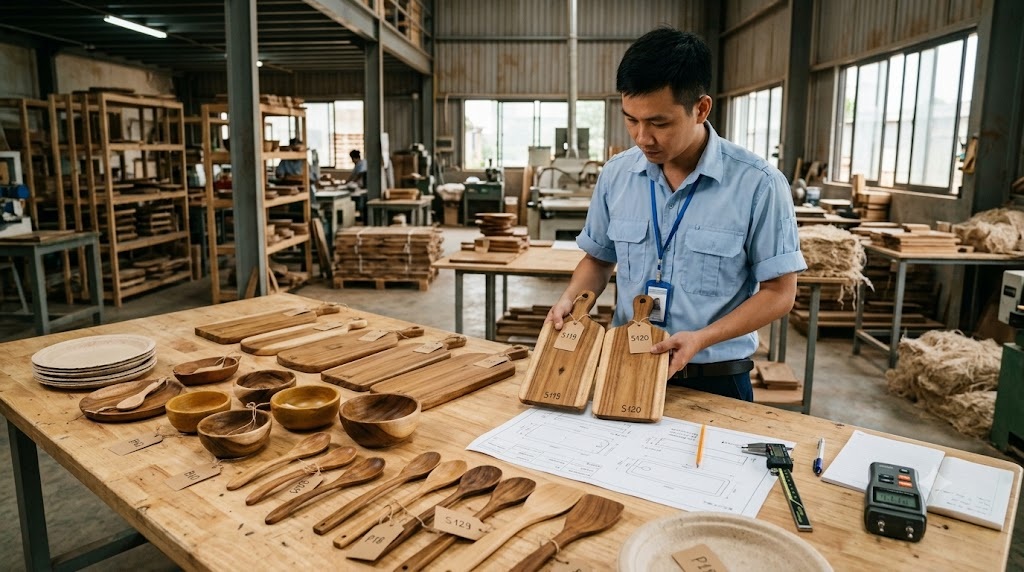
What an MOQ Is Actually Protecting
An MOQ is not a measure of how much the factory wants to sell you. It is the point at which the fixed cost of making your item at all is spread thinly enough that the unit price you were quoted is still true. Every order carries costs that do not shrink when the quantity shrinks: setting up and profiling a moulding line, cutting or adjusting a die, mixing and matching a stain, changing over a printing plate, running the first pieces to waste until the finish stabilises, and occupying a kiln charge or a press for a block of time that cannot be shared with another customer.
The practical consequence is that MOQ is not one number. It is a different number for each cost driver, and the binding one is whichever is largest. A wooden salad bowl in a standard shape with no branding may have an MOQ driven only by lumber batching. The same bowl with a custom laser mark has a second threshold set by fixture time. The same bowl in a colour stain that the factory does not otherwise run has a third threshold set by finishing-line changeover and the minimum drum of stain that has to be bought. Buyers who ask “what is your MOQ” and receive a single figure are usually being quoted the largest of these without being told which one is binding, which is why the number so often moves when the specification changes.
The productive question is therefore not “can you lower the MOQ” but “which part of my specification is setting it”. In our experience most MOQ objections dissolve once a buyer learns that dropping a custom stain colour, accepting the factory’s standard carton, or moving a logo from laser engraving to a printed hangtag removes the threshold that was binding. What remains after that is the genuine floor, and no supplier can go below it without either losing money or quietly changing something you did not agree to.
Where MOQ Comes From on Wooden Kitchenware
Wood has the gentlest MOQ structure of any product family we make, because almost nothing in it requires dedicated steel. The constraints are lumber, kiln time, jigs and finishing.
Lumber batching. Acacia and rubberwood arrive as sawn boards that have to be dried to an export-stable moisture content before they can be machined. A kiln charge is a block of volume, not a block of pieces, and it runs for a fixed number of days regardless of how full it is. Running a half-empty charge for one customer means the drying cost per cubic metre roughly doubles. This is the single most common invisible driver behind a wooden kitchenware MOQ, and it is why the threshold is often expressed in pieces but is really about cubic metres of timber.
Jigs and fixtures. A new board profile, a handle cut-out, a juice groove or a non-standard bowl diameter needs a router template or a lathe fixture. These are made in-house from plywood or aluminium, usually within two to five days, and cost far less than steel tooling. They still represent hours that have to be recovered somewhere.
Finishing changeover. A food-safe mineral oil and beeswax finish is the default and carries no changeover cost. A pigmented stain, a two-tone finish or a lacquer in a specific sheen does: the line has to be flushed, the first pieces run to waste, and a minimum quantity of material purchased. If your specification includes a colour nobody else orders, expect a distinct minimum attached to that colour alone.
Branding. Laser engraving is fixture time plus a file, and is usually the cheapest way to personalise wood at low volume. Printed sleeves, belly bands, hangtags and custom cartons carry printing minimums set by the print house rather than by us, and these are frequently the real reason a “wooden bowl MOQ” turns out to be higher than the wood itself requires.
Taken together, a realistic first-order floor for a standard wooden kitchenware item with the factory’s own finish is in the low hundreds of pieces per SKU, rising as customisation is layered on. A buyer who wants five SKUs can usually reach a workable total by combining them into one production window rather than negotiating each line downwards, because the kiln and the finishing line do not care which shape the wood ends up as. The material choice itself also moves the number, which is covered in more detail in our comparison of acacia, rubberwood and bamboo.
Where MOQ Comes From on Compostable and Disposable Tableware
Compostable lines behave completely differently, and buyers who move from wood to disposables carrying wooden expectations are usually shocked by the numbers. The reason is steel.
Moulded fibre, including bagasse. Every shape requires a machined mould set. The mould is a real capital item, it takes weeks to cut and prove out, and it is specific to one plate, one bowl, one lid. Until that mould exists, the item cannot be made at any quantity. Once it exists, the machine runs fast, so the marginal cost per piece is low and the sensible order size is large. This is why bagasse MOQs are quoted in tens of thousands of pieces per item while wooden bowls are quoted in hundreds. If you can accept an existing mould from the factory’s standard range, the tooling question disappears entirely and the MOQ falls to whatever the packing and pulp batching require.
Areca palm leaf. Areca sits between the two worlds. The raw material is a naturally fallen leaf sheath, so there is no pulp line, but each plate shape needs a heated press die. Dies are cheaper and faster to make than fibre moulds, and standard rounds and squares are already in production, so a first order on a stock shape is far more accessible than a first order on a custom one.
Wooden disposables. Disposable birchwood or bamboo cutlery, stirrers and picks are die-cut and press-formed at very high speed. Volumes are large, unit values are small, and the meaningful minimum is usually driven by the printed retail bag or the individually wrapped sleeve rather than by the cutlery itself.
There is also a compliance floor that has nothing to do with production. If you need documentary proof of compostability or food contact for your market, that proof is issued against a specific material formulation and often a specific item, and it is not free. A buyer ordering a token quantity cannot reasonably expect a supplier to open a certification file for it. Our guide to compostable tableware certifications, EN 13432, OK compost, BPI and the 2026 PFAS rules sets out which documents exist and what they cover.
The Sample Sequence: Five Names, Three That Matter
“Send me a sample” is not one request. In a properly run programme there are up to five distinct objects, and confusing them is the source of most first-order disputes.
- Stock sample. An existing item pulled from the factory’s own range. It proves material, workmanship and finish quality. It proves nothing about your dimensions or your branding. It is fast and cheap, and it is the right first step for almost every buyer.
- Counter sample. The factory’s reproduction of a reference you supplied, whether a physical item, a drawing or a competitor product. Its purpose is to test whether the factory understood you. Judge it on interpretation, not on polish.
- Pre-production sample. Made after the specification is frozen, using the actual material, tooling and finish that production will use, but before the line runs. This is the object that catches the expensive mistakes, because everything about it is real.
- Golden sample. The approved pre-production sample, signed, dated, sealed and duplicated. It is the contractual reference for the entire order and for every reorder afterwards.
- Shipment sample. A unit taken from the finished production run and sent to the buyer, usually alongside the inspection report. It is evidence, not an approval gate.
Of these, three carry real weight: the stock sample, because it screens out unsuitable suppliers in a week rather than a quarter; the pre-production sample, because it is the last cheap moment to change anything; and the golden sample, because it is what an inspector will physically hold against the goods. The counter sample is useful when your item does not yet exist. The shipment sample is a courtesy that proves nothing you did not already learn from inspection.
The most common and most costly compression is skipping the pre-production sample because the counter sample looked good. A counter sample is frequently hand-made by the factory’s best craftsman, using whatever board was to hand, finished with unusual care. It tells you what the factory can do, not what the line will do. A pre-production sample made on the production fixture, from the production timber lot, with the production finish, is a different object, and the gap between the two is where quality complaints are born.
What a Golden Sample Must Physically Carry
A golden sample is only useful if a third party who was never in your conversations can pick it up and adjudicate. That means the object itself has to carry the agreement, not the email thread. At minimum it should be tagged and sealed with the following on or attached to it.
- Item code, buyer name, purchase order or programme reference and the date of approval.
- Signatures from both the buyer’s approver and the factory’s quality lead, on the tag, not on a separate page.
- Species and material, finish system and the measured moisture content at the moment of approval.
- Nominal dimensions with the agreed tolerance written next to each one, because “as sample” without a tolerance is unenforceable.
- Colour and grain acceptance range, ideally as a second and third tagged unit showing the lightest and darkest acceptable pieces. Wood is a natural material and a single sample implies a uniformity no factory can deliver.
- Branding position and size, with the actual engraving or print applied, not described.
- A note of what is explicitly excluded from the approval, such as packaging still under development.
Three identical copies should exist: one retained by the buyer, one sealed in the factory’s sample room, one held for the inspection body. A golden sample that lives only in the factory is a golden sample the buyer cannot argue with, and one that lives only with the buyer is one the production line cannot consult. The colour-range trio is the single most valuable addition for wooden goods, and the one buyers most often omit. Our note on moisture content and cracking explains why the recorded moisture figure on the tag matters as much as the dimensions.
Sample Costs, Tooling and Who Pays for What
The convention that has settled across the Vietnamese export sector is straightforward once it is stated plainly, and it is worth agreeing in writing before the first sample moves.
Stock samples are usually supplied free or at nominal cost, with the buyer paying international courier. Courier to the Gulf or Europe on a small parcel of wooden goods is not trivial, and a buyer who insists the supplier absorbs it is signalling something about how the rest of the relationship will go.
Custom and pre-production samples are charged, because they consume machine time, material and a craftsman’s day for a single unit. The normal and fair arrangement is that the sample charge is credited against the first production order. A supplier who refuses to credit it is treating samples as a revenue line; a buyer who refuses to pay it at all is asking the supplier to subsidise a relationship that may not happen.
Tooling is the item that needs the most explicit agreement, and it applies almost entirely to moulded fibre and pressed items. Three questions decide it. Who pays for the mould, in full or shared. Who owns it once paid, and whether ownership includes the right to have it physically released to another factory. Whether it is exclusive, meaning the shape cannot be sold to another buyer, and for how long. Buyers frequently pay for tooling and assume all three follow automatically. They do not. Exclusivity in particular is a commercial concession with a real cost to the supplier and should be negotiated as such, with a defined term and a defined volume commitment attached.
A reasonable structure for a first custom moulded programme is a shared tooling cost with the buyer’s share credited back progressively against volume, ownership transferring once the buyer’s share is fully recovered, and exclusivity granted for a fixed period contingent on an agreed annual quantity. That aligns both sides: the factory is protected against a mould that is cut and never used, and the buyer is protected against paying for a shape that shows up in a competitor’s catalogue.
Branding assets sit alongside tooling and are often forgotten. Laser files, print separations, die lines for cartons and barcode allocations are all created during the first order. Agree that these are the buyer’s property and will be released on request. The cost of recreating them at a second supplier is small, but the delay is not.
Writing a Specification a Factory Can Quote Against
Most enquiries that go unanswered or receive a vague reply are not being ignored. They cannot be quoted. A photograph and a target price do not contain enough information to cost a job, and a factory that quotes anyway is guessing, which means the price will move later. A specification that can be quoted in one pass fits on a single page and contains the following.
- Item and material. Species or fibre, and whether alternatives are acceptable. Acacia and rubberwood are not interchangeable in appearance, weight or price, and saying so up front avoids a quote you cannot use.
- Dimensions with tolerances. Length, width, thickness and, for turned goods, diameter and depth, each with a plus or minus figure. Wood moves; a specification without tolerance is a specification with an implied tolerance of zero, which nobody can meet.
- Finish system. Food-safe oil, oil and wax, or lacquer, and the expected sheen. This is a price driver and a compliance driver at once; see our guide to food-safe finishes for Vietnamese wooden kitchenware.
- Branding. Method, position, size, and whether it appears on the product, the packaging or both. Attach vector artwork rather than a screenshot.
- Packaging. Polybag, sleeve, gift box or bulk; retail-ready or not; barcode responsibility. Packaging routinely accounts for a larger share of unit cost than buyers expect, which our export packaging and retail-ready presentation guide covers in detail.
- Quantity and Incoterm. Quantity per SKU, destination port and whether you want FOB, CFR or a delivered price. A quote without a stated Incoterm is not comparable to any other quote.
- Compliance requirements. The market you are entering and any certificate you need at destination. Late compliance requirements are the most expensive kind of late change.
Buyers sometimes withhold quantity in the belief that it strengthens their negotiating position. It does the opposite: with no quantity, a supplier prices for the smallest plausible run, and the number that comes back is worse than the one an honest volume would have produced. If your volume is genuinely uncertain, give a range and say so. The structure of the resulting quotation is explained in our breakdown of how a Vietnam wooden kitchenware FOB price and landed cost are built.
Sizing a First Order Without Overcommitting
A trial order has one job: to test the supplier, the product and your own channel at the smallest cost that still produces reliable information. Three sizing errors are common.
The first is ordering too little. A quantity below the real MOQ is either declined, or accepted at a unit price so distorted that it tells you nothing about the economics of a repeat order. A trial that produces an unusable price has not tested anything.
The second is ordering too many SKUs. Buyers who want to trial a whole range spread a small budget across ten items, hit the MOQ floor on every one, and end up with a large order that is still statistically thin per line. Three to five SKUs at a meaningful depth per line teaches you far more, and leaves room to add the rest once the supplier is proven.
The third is ordering an awkward volume. Freight cost per unit falls in steps, not smoothly. A shipment that half-fills a twenty-foot container carries almost the same freight bill as one that fills it, and a shipment that overflows a container by a small margin is disproportionately expensive. The most efficient trial is usually one that fills a single twenty-foot container, and it is worth adjusting quantities of your less critical lines to reach that point rather than shipping air.
A sensible default for a first programme is therefore a single full twenty-foot container, three to five SKUs, one binding golden sample per SKU, a third-party inspection booked before shipment, and payment terms that put a deposit at risk but not the full value. From the supplier’s side the mirror-image test applies: a buyer willing to pay a deposit, approve a pre-production sample and book an inspection is a buyer worth allocating capacity to.
The Mixed First Container
Buyers who want both wooden kitchenware and compostable tableware often assume they must run two separate first orders. They usually do not, provided the mix is planned rather than improvised.
The two families have opposite loading characteristics, which is exactly why they combine well. Wooden goods are dense and heavy for their volume; a container filled only with solid acacia boards reaches its weight limit long before it fills. Compostable plates and cutlery are the reverse: extremely light and extremely bulky, so a container of bagasse alone fills its volume with the payload barely used. Loaded together, wood at the bottom and fibre above, the container reaches both limits at once and the freight cost per unit falls for both product families simultaneously.
Three cautions apply. Moisture is one: compostable fibre goods are hygroscopic and wooden goods release moisture, so both need to be properly wrapped and desiccant used, particularly on a route crossing the tropics into a dry destination climate. Documentation is another: the two families can sit under different tariff headings and may need different certificates, so a mixed container does not mean a single simplified document set, as our guide to export documentation, certificates of origin and ISPM-15 explains. The third is scheduling: the two lines have very different lead times, and the container ships at the pace of the slowest.
A Realistic Timeline From Enquiry to First Shipment
The following is a working timeline for a first order on wooden kitchenware with light customisation and no new steel tooling. Treat it as a structure to hold a supplier to rather than a promise, and add materially to it if moulded fibre with new tooling is involved.
- Week 1. Specification issued, quotation returned, stock samples couriered.
- Weeks 2 to 3. Stock samples assessed, specification refined, commercial terms and Incoterm agreed, custom sample charged and started.
- Weeks 4 to 6. Counter or pre-production sample made and shipped. Artwork finalised in parallel rather than afterwards, since branding is the most frequent cause of a second sample round.
- Week 7. Pre-production sample approved, golden samples sealed and distributed, purchase order issued, deposit paid, materials and packaging released for purchase.
- Weeks 8 to 14. Production. Kiln drying and finishing are the long poles on wood; printed packaging frequently arrives later than the goods it is meant to hold, which is why it should be ordered at week 7 and not at week 11.
- Week 15. Third-party inspection against the golden sample, defects rectified, loading photographed.
- Week 16. Balance settled, container loaded and sailed, documents released.
Two dates will distort this timeline no matter how well it is managed. The first is Tet, when Vietnamese factories close for one to two weeks and take a further two to three weeks to return to full output as workers travel back. The second is the northern-hemisphere Q4 buying peak, when both factory capacity and container space are contested. Our note on lead times and peak-season capacity sets out how far ahead each needs to be planned.
Where First Orders Go Wrong
Approving a sample by photograph. Colour, weight, surface texture and the feel of an edge do not survive a camera. Photographs are for progress updates. Approval requires the object in your hand.
Writing “as per sample” with no tolerance. This looks rigorous and is legally close to meaningless. Every dimension that matters needs a number and a tolerance; everything else is a conversation you will have later at your own cost.
Expecting uniform grain. A buyer who approves one board and then rejects production for colour variation has approved the wrong thing. Approve a range, in three tagged units, at the start.
Leaving packaging to the end. Printed cartons, sleeves and hangtags have their own lead times and their own minimums, and they are made by a third party. Packaging that is specified in week eleven will delay a shipment that the goods were ready for in week fourteen.
Introducing compliance requirements after the deposit. A certificate that was never mentioned at specification stage may require a different material, a different supplier of that material, or a test cycle measured in weeks. This is the single most common cause of a first order shipping a month late.
Skipping inspection on a trial order. The trial is precisely when inspection has the highest value, because neither side has a track record with the other. Booking a third-party inspection against the golden sample is not a signal of distrust; it is the mechanism that lets a supplier prove itself. Our guide to quality control, AQL levels and pre-shipment inspection covers how to set the standard.
Negotiating the MOQ instead of the specification. As above: the quantity is usually a symptom. Change what is driving it and the number moves on its own.
A First-Order Checklist
- One-page specification issued, including tolerances, finish, branding, packaging, Incoterm, destination port and target quantity range.
- Stock samples received and assessed before any custom work is commissioned.
- Written confirmation of which element of the specification is setting the MOQ.
- Sample charge agreed, with credit against the first production order stated in writing.
- Tooling cost, ownership and exclusivity agreed separately and explicitly, where tooling applies.
- Branding artwork supplied as vector files; ownership of laser files, print separations and die lines confirmed as the buyer’s.
- Pre-production sample made from production material, tooling and finish, and physically approved.
- Three golden samples sealed and tagged, including a colour and grain acceptance range, distributed to buyer, factory and inspector.
- Packaging and printed components ordered at the same time as the goods, not later.
- Compliance and documentation requirements for the destination market confirmed before the deposit is paid.
- Order volume adjusted to fill a container cleanly rather than to ship air.
- Third-party inspection booked, with the AQL standard and the golden sample named in the booking.
- Production timeline agreed in writing against Tet and Q4 peak dates.
Frequently Asked Questions
Can a Vietnamese factory really not go below its stated MOQ?
It can, but something has to give, and it is better to decide what. A lower quantity at the same price means the supplier is absorbing setup cost, which is unsustainable and usually recovered elsewhere. A lower quantity at a higher unit price is honest and often perfectly workable for a trial. A lower quantity on a standard specification, with the factory’s own finish and packaging, is frequently possible at close to the original price because the thresholds that were binding have been removed. Ask which of the three is on offer.
Should I pay for samples?
For stock samples, normally only the courier. For custom and pre-production samples, yes, with the charge credited against your first production order. Paying for a custom sample is also a useful filter in the other direction: it tends to move a supplier from speculative enquiry handling to actual engineering attention.
Who owns the mould if I paid for it?
Only what your agreement says. Paying for tooling does not automatically grant ownership, physical release, or exclusivity, and these are three separate rights. Set out in writing who pays, who owns, whether the mould can be physically collected, and whether the shape is exclusive to you, for how long and against what volume. Agreeing this before the mould is cut costs one paragraph; agreeing it afterwards costs a negotiation you have already lost.
How different can production legitimately be from the golden sample?
As different as the tolerances and the colour range on the tag allow, and no more. This is exactly why those two things belong on the sample rather than in an email. On wooden goods, natural variation in grain, colour and small character marks is inherent to the material and cannot be engineered away; dimensional drift, finish inconsistency and workmanship defects are a different matter and are what an AQL inspection is designed to catch.
Can I combine wooden kitchenware and compostable tableware in one first order?
Usually yes, and the freight economics reward it, because dense wooden goods and bulky fibre goods together let a container reach its weight and volume limits at the same time. Plan for different lead times between the two lines, moisture protection for both, and the possibility of different tariff headings and certificates at destination.
What is the fastest a first order can realistically ship?
On a stock item, with the factory’s standard finish and packaging and no branding, a first container can move in around six to eight weeks from purchase order. Every layer of customisation adds a sample round, and every sample round adds courier time in both directions. Buyers with a hard seasonal deadline should start from the ship date and work backwards, rather than from the enquiry date and work forwards.
Is a factory audit worth it on a trial order?
A full social or technical audit is usually disproportionate at trial stage unless your buyer or retailer requires it. A pre-shipment inspection against the golden sample delivers most of the practical protection at a fraction of the cost. Reserve the full audit for the point at which you are committing to a programme rather than testing one.
Related Reading
- How a Vietnam wooden kitchenware FOB quotation is built
- Private label and custom branding: laser engraving, packaging and MOQ
- Quality control and pre-shipment inspection: AQL levels and container loading
- Lead times and peak-season capacity: planning around Tet and Q4
- Compostable tableware certifications: EN 13432, OK compost, BPI and PFAS
- Export documentation: certificates of origin and ISPM-15
For official market and trade-promotion information on Vietnamese exports, buyers can also consult the Vietnam Trade Promotion Agency and the Ministry of Industry and Trade.
Where Viet Farm Vision Fits
Viet Farm Vision is a Vietnam-based OEM manufacturer and exporter of wooden kitchenware and houseware, compostable and disposable tableware, agricultural products and handcrafts, supplying wholesale and private-label buyers across the Middle East, Asia and wider international markets.
On first orders we state which element of a specification is setting the MOQ rather than quoting a single unexplained figure, charge custom samples and credit them against the production order, make pre-production samples from the actual production material and finish, and seal three golden samples with tolerances and a colour acceptance range on the tag before a line is released. Where a buyer is trialling both wooden and compostable lines we will plan the mix so the first container loads efficiently instead of shipping air, and we will raise destination compliance questions at specification stage rather than at the port.