
A five-star property in Doha replaces its breakfast buffet boards every nine months. The purchasing manager assumes this is normal wear and budgets for it. It is not normal wear. The boards were specified from a retail catalogue — 15 mm acacia, mineral-oil finish, the same article the supplier sells to homeware chains in Europe — and they are being run through a high-temperature warewasher with an 82 °C final rinse two or three times a day, then stacked wet. A retail board is engineered for a domestic sink and a tea towel. A hospitality board is engineered for a duty cycle. The two products can look identical on a sample table and behave completely differently ninety days into service.
The HORECA channel — hotels, restaurants, catering and cafés — is the fastest-growing destination for Vietnamese wooden houseware and kitchenware, and it is also the channel where the most sourcing money is quietly wasted. Buyers who are excellent at retail sourcing routinely underperform in hospitality because they carry over retail assumptions: one-off purchase orders, seasonal ranges, consumer-facing packaging, and a specification that stops at dimensions and finish. Hospitality buys differently. It buys against a service standard, replenishes against attrition, and expects the same article, in the same colour, to be available in eighteen months when the general manager reorders.
This guide sets out how to specify, contract and replenish Vietnamese wooden houseware and kitchenware for the HORECA channel in 2026: the duty-cycle bands that should drive specification, what commercial warewashing actually does to wood, how to build par levels and attrition allowances, how open orders and call-offs work with a Vietnamese factory, and what changes when the order is a pre-opening project rather than a replenishment programme.
Retail Buys a Product. Hospitality Buys a Duty Cycle.
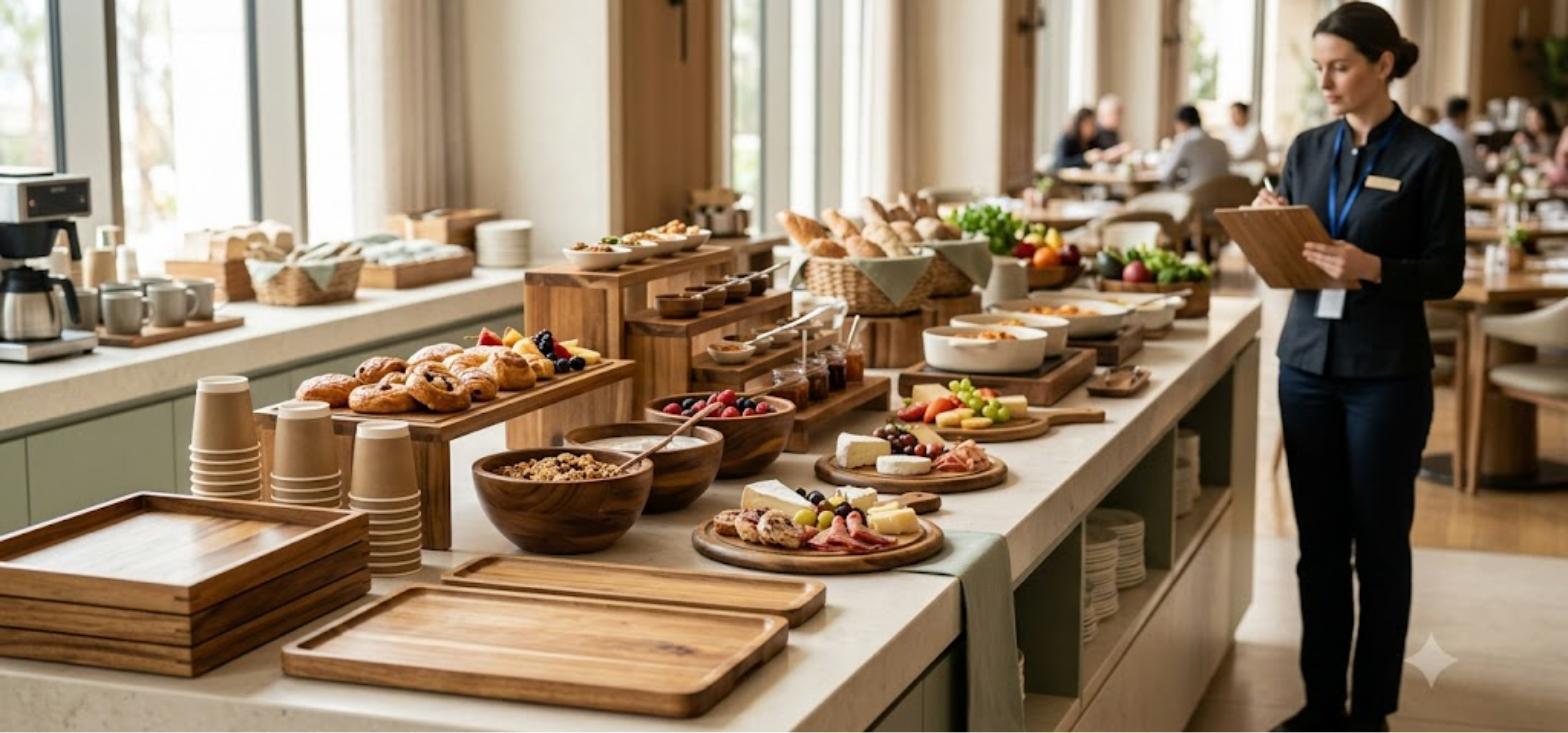
The single most useful discipline a HORECA buyer can impose on a wooden houseware programme is to stop specifying by article and start specifying by duty cycle. A duty cycle is the honest answer to four questions: how many times per day is this item handled, how is it cleaned, how is it stored between services, and what does failure look like to a guest?
A guest-room amenity tray is handled twice a day, wiped with a damp cloth, stored dry on a console, and fails when the finish dulls or a corner chips. A buffet riser is handled six to ten times a day, wiped between services, washed weekly, stored stacked, and fails when the grain lifts. A kitchen prep board in a hot line is used continuously, washed at high temperature two or three times a shift, stored on edge in a rack, and fails when it cups, splits or scores deeply enough to hold soil. Those three items may all be acacia, all 20 mm, all oiled. They should not be the same product.
When you brief a Vietnamese factory, the duty cycle is more informative than any drawing. It tells the factory which wood species and cut to use, what moisture target to hold, how thick to run the blank, whether to specify an end-grain or long-grain construction, whether the finish should be a penetrating oil that can be renewed in service or a cured film that cannot, and how to design the edge profile so water drains rather than pools. A factory that receives a duty cycle can engineer to it. A factory that receives only a photograph and a size will quote the retail article, because that is the article it makes every day.
Who Actually Signs: Owner, Operator, Management Company or Purchasing Agent
Hospitality procurement has more parties in the room than retail, and mapping them early prevents a specification from being approved twice and paid for by nobody. In a typical branded hotel there are at least four interests. The owner holds the asset and the capital budget. The operator or management company sets the brand standard that the article must satisfy, and often maintains an approved-supplier list. The property — the executive chef, the F&B director, the executive housekeeper — has the operational view and will be the one complaining in six months. And on new-build or renovation projects, a third-party OS&E purchasing agent consolidates the buy, issues the purchase orders and manages the freight.
Two distinctions matter commercially. First, wooden serviceware, boards, bowls, risers and trays almost always sit in OS&E (operating supplies and equipment), not FF&E (furniture, fixtures and equipment). OS&E is bought in higher quantities, at lower unit values, with a replenishment expectation. FF&E is a capital line, bought once, with heavy documentation. If a buyer treats a wooden tray programme as FF&E, the process cost will exceed the goods cost. Second, a brand standard is not the same as a specification. Brand standards usually describe outcomes — “natural material serviceware, consistent tone across outlets, no visible wear at guest-facing positions” — and leave the technical specification to whoever is buying. That gap is where a good supplier adds value, and where a weak one hides.
For restaurant groups and café chains the map is simpler but the discipline is the same: identify who owns the standard, who owns the budget, and who will report the failure. Write all three into the distribution list on the specification sheet.
Specifying for Commercial Service, Not Domestic Use
Six variables separate a hospitality-grade wooden article from its retail twin. Each one is a line on the specification sheet and each one has a cost.
- Thickness and mass. Retail serving boards commonly run 12–18 mm. Hospitality boards in daily service should sit at 20–30 mm for long-grain construction, and 35–50 mm where an end-grain butcher block is genuinely required. Mass resists cupping; thin stock does not.
- Lamination pattern. Narrow staves — 25–40 mm — with alternating grain orientation move far less than wide boards. Finger-jointed stock is acceptable in concealed positions but should be excluded from guest-facing faces if the brand standard mentions visual consistency.
- Moisture content at despatch. Specify a target and a tolerance, not a phrase. For Gulf and dry indoor climates, 8–10 % is the practical band; for humid tropical service, 10–12 %. Ask for the meter readings by lot, and read our detailed guide on moisture content, kiln drying and cracking before you fix the number.
- Edge and corner geometry. A 3–5 mm radius survives trolley knocks; a sharp arris does not. Juice grooves should have a drain channel or be omitted, because a blind groove holds water and is the first place a board fails.
- Finish system. Penetrating food-grade oil and wax can be renewed by the property; a cured film finish cannot, and when it fails it fails visibly. Our guide to food-safe finishes: mineral oil, beeswax and lacquer sets out the trade-off in full.
- Feet, rails and non-slip. Silicone feet lift a board off a wet counter and add years of life. They also add a cleaning point and a detachment risk. Specify bonded, recessed feet or none at all — never surface-glued pads on a washed item.
Species choice follows the duty cycle rather than fashion. Vietnamese plantation acacia is dense, dimensionally reliable and takes an oil finish well, which makes it the default for boards, bowls and risers. Rubberwood is lighter in colour and cost, and performs adequately in dry-service items such as amenity trays and display stands. Bamboo is stiff and stable but is a laminated grass with an adhesive line that dislikes prolonged wet heat, so it belongs in ambient and dry positions rather than the warewasher. Our acacia versus rubberwood versus bamboo material guide compares them on the metrics that matter here.
The Dishwasher Question: What Commercial Warewashing Actually Does to Wood
This is the single most common source of dispute between hospitality buyers and wooden houseware suppliers, and almost all of it is avoidable by settling one sentence before the first order: is this article machine-washable in a commercial warewasher, yes or no?
Commercial warewashing is not domestic dishwashing. High-temperature machines typically run a wash around 60–70 °C with a sanitising final rinse near 82 °C, and the cycle is short and violent. Low-temperature machines run cooler, around 50–60 °C, but sanitise chemically, usually with a chlorine-based agent. Both are hostile to wood, for different reasons. Heat and saturation drive rapid moisture gain and then rapid drying, which is exactly the cycle that raises grain, opens glue lines and induces cupping. Chlorine chemistry bleaches tone unevenly and degrades some finishes.
The honest engineering answer is that solid hardwood serviceware should be specified as hand-wash. Where a property insists on machine washing — and many will, because labour is the constraint — the specification has to change: thicker stock, tighter stave widths, a waterproof adhesive rated for the exposure, a cured finish rather than a penetrating oil, and an accepted service life measured in months rather than years. That is a legitimate commercial choice, but it must be priced and written down, not discovered.
| Cleaning regime | Typical parameters | Suitable wooden items | Realistic service life |
|---|---|---|---|
| Wipe-down only | Damp cloth, neutral detergent, dry immediately | Amenity trays, guest-room trays, display risers, menu boards, bread baskets | 3–5 years with annual re-oiling |
| Hand wash, controlled | Warm water, neutral detergent, no soaking, towel-dried and air-finished on edge | Serving and charcuterie boards, bowls, platters, buffet risers | 18–36 months with quarterly re-oiling |
| Low-temperature warewasher | 50–60 °C, chemical sanitiser | Only items specified for it: cured film finish, waterproof adhesive, 25 mm+ | 9–18 months |
| High-temperature warewasher | 60–70 °C wash, ~82 °C rinse | Not recommended for solid wood; substitute an alternative material at this service point | 6–12 months, with visible degradation earlier |
Two practical measures close the gap. First, supply a laminated care card with every carton, in the languages the stewarding team actually reads, and require the operator to post it in the wash area. Second, agree the cleaning regime as a condition of any defect claim. If an article specified as hand-wash is put through a warewasher, that is a use deviation and not a manufacturing defect — a distinction our guide to claims, defects and replacement terms explores in detail.
Duty-Cycle Bands: Matching Product to Service Point
Rather than negotiating each article separately, group the estate into three or four duty-cycle bands and write one specification per band. This collapses a fifty-line item list into a manageable technical document, and it lets the factory batch production efficiently, which shows up in price.
| Band | Service points | Handling frequency | Specification anchor |
|---|---|---|---|
| A — Guest-facing, low contact | Guest rooms, amenity and minibar trays, welcome trays, spa and turndown items, reception display | 1–3 touches/day, wipe-clean | 15–20 mm, rubberwood or acacia, oil-wax finish, tightest tone matching, no juice groove |
| B — Guest-facing, high contact | Buffet risers, bread and cheese boards, table serving platters, charcuterie boards, tapas boards | 4–10 touches/day, hand-wash | 20–25 mm acacia, narrow staves, radiused edges, renewable oil finish, feet optional |
| C — Back of house, heavy | Prep boards, carving boards, butcher blocks, kitchen trolleys and inserts | Continuous, washed 2–3× per shift | 30–50 mm, end-grain where specified, waterproof adhesive, sacrificial and scheduled for replacement |
| D — Ambient display | Menu holders, buffet signage frames, bottle presenters, retail display in the lobby shop | Occasional, dusted | Cost-led; rubberwood or bamboo acceptable, finish chosen for appearance |
Banding also fixes the most expensive habit in hospitality sourcing: buying a single article and deploying it everywhere. The board that looks correct on the chef’s table is the wrong board for the prep line, and buying one specification for both means overpaying at one end and failing at the other.
Attrition, Par Levels and the Replenishment Model
Hospitality does not reorder when stock is low. It reorders when par is broken. Par is the quantity that must be on the property for the operation to run at peak, plus a working buffer for items in the wash cycle, in repair, or held in reserve. For wooden serviceware a defensible starting point is a par of 1.5 to 2.5 times peak simultaneous requirement, weighted upward for items that cannot be washed and returned within a single service.
Annual attrition — breakage, staining, warping, theft and simple aesthetic retirement — is the number that drives the annual purchase order, and it is almost never measured. Ask the property for it and you will usually get a guess. Build it instead from the duty-cycle band and refine it after the first year of real data.
- Band A (guest room, wipe-clean): 10–20 % annual attrition, dominated by chipping in housekeeping trolleys and guest removal.
- Band B (buffet and table service): 25–40 % annual attrition, dominated by staining, edge damage and tone drift against new stock.
- Band C (back of house): 50–100 % annual attrition; these are consumables with a scheduled replacement date, not assets.
- Band D (ambient display): 5–10 % annual attrition, mostly refurbishment-driven rather than wear-driven.
Multiply par by attrition and you have the annual volume that should sit in a supply agreement rather than a spot order. That is the number that unlocks price: a Vietnamese factory quoting a committed annual volume with scheduled call-offs will price differently from one quoting a single container, because it can plan timber purchasing, kiln loading and artisan allocation around it. Our guide to lead times, peak season and capacity planning explains why that visibility is worth more to the factory than a marginal price concession.
Colour and Grain Consistency Across Reorders
In retail, tone variation is a selling point — “every piece unique”. In hospitality it is a defect, because the guest sees eight boards on one buffet and the eye reads the odd one out immediately. Consistency across a reorder placed fourteen months after the first is the hardest thing a wooden houseware supplier is asked to deliver, and it is worth understanding why so you can specify realistically.
Plantation acacia varies in heartwood tone by growing region, age at harvest and position in the log. Sapwood is pale, heartwood ranges from honey to a deep reddish brown, and the ratio in any given batch depends on the timber lot the factory bought that month. Oil finishes deepen tone over the first weeks in service, so a new board placed next to a two-year-old board will never match exactly even if the raw stock was identical.
Four controls make this manageable. First, agree a tone range rather than a single reference: three retained physical samples marking the lightest and darkest acceptable pieces and the target centre. Second, require sorting to band at the factory, so each carton is internally consistent and a property can deploy a carton to a single outlet. Third, reserve timber: on a committed annual programme, ask the factory to buy the year’s stock in one or two lots and hold it, which is only possible if the volume is committed. Fourth, plan cohort replacement — replace a whole buffet’s worth of boards at once rather than trickling in singles — and budget for it, since it is cheaper than the guest-experience cost of a mismatched line. The retained-sample discipline behind all of this is set out in our guide to MOQs, sampling and the golden sample.
Refinishing in Service: The Maintenance Kit Nobody Specifies
A penetrating oil finish is a maintainable finish, and that is its main advantage over a cured film in a hospitality setting. Yet most wooden houseware programmes ship without any means of maintaining it, and the property discovers eight months later that the boards look tired and there is no procedure and no product.
Specify the maintenance package as a line item on the same purchase order as the goods. At minimum it should include food-grade oil or oil-wax in a quantity matched to the surface area shipped, abrasive pads or fine paper at the grit the factory used for final sanding, lint-free cloths, and a one-page procedure with a recommended interval by duty-cycle band — typically quarterly for Band B, annually for Band A. Ask the factory to state the exact finish product used, because refinishing with an incompatible product is a common cause of blotching, and a supplier that will not name its finish system is telling you something.
For large estates, a refinishing cycle written into the stewarding schedule extends Band B service life materially and is far cheaper than replacement. Where a management company runs several properties in one city, a shared refinishing rotation is worth proposing.
Food-Contact and Hygiene Compliance in Hospitality Settings
Hospitality food-safety regimes are usually stricter in practice than retail ones, because the property is inspected. Wood occupies a specific and sometimes misunderstood position in food-contact regulation, and buyers should know where their destination market sits before specifying wooden prep surfaces.
- United States and markets following the FDA Food Code. The Food Code permits hardwood cutting surfaces and utensils, subject to conditions on species, surface condition and cleanability. Properties following HACCP plans will often still restrict wood to ready-to-eat and dry applications by internal policy.
- European Union. Framework Regulation (EC) No 1935/2004 applies to all food-contact materials, but there is no harmonised EU-specific measure for wood, so national rules and national institute recommendations govern. Ask which member state’s regime your customer is inspected under.
- Gulf and wider Middle East. GSO and municipal food-safety regimes govern, and many hotel groups apply their own global standard on top. Halal assurance on any animal-derived finish component is frequently requested — see our Halal certification guide for GCC export.
- Finish and migration testing. Whatever the jurisdiction, the finish is the food-contact layer. Request the declaration of compliance and the migration test report for the specific finish system, not a generic statement that the product is “food safe”. Our guide to food-contact compliance and PFAS testing covers the documents to ask for.
A separate and frequently overlooked point: many hotel operators require suppliers to be socially audited before they can be added to an approved list, regardless of order value. If your customer is a branded group, expect a SMETA or amfori BSCI question early. Our guide to supplier audits and social compliance sets out what an audit-ready Vietnamese factory looks like.
Room-Service, Amenity and Guest-Room Wooden Houseware
Band A is where wooden houseware earns its brand value, and it is the fastest-growing part of the category because it sits at the point where a property signals its sustainability position to the guest without saying anything. The typical guest-room set includes a welcome or amenity tray, a minibar or coffee tray, a tissue-box surround, a hanger or valet tray, a bathroom amenity tray or riser, and increasingly a small wooden caddy replacing plastic in-room collateral.
Three specification notes matter disproportionately here. Guest-room items are seen at close range under warm low light, so surface finish quality and edge crispness are judged far more harshly than on a buffet board — budget for a higher sanding grit and a tighter cosmetic AQL. They are also handled by housekeeping trolleys, which means corner protection in packaging and a radius on every exposed corner. And they are the items most likely to leave with a guest, so attrition is genuinely a supply figure and not a quality figure; specify the reorder quantity accordingly. Our sourcing guide to wooden trays and home-organisation houseware covers the constructions available.
Café and Grab-and-Go: Where Wood Meets Compostable
Café and quick-service operators sit at the intersection of two Vietnamese product families: durable wooden serviceware for the dine-in experience and compostable or disposable tableware for takeaway. Sourcing both from the same origin — and often the same supplier relationship — simplifies freight, consolidates documentation and gives the operator a single sustainability story.
The practical planning point is that the two families have opposite ordering rhythms. Wooden serviceware is a low-frequency, high-value replenishment; compostable tableware is a high-frequency, low-value consumable with a shelf-life constraint and a moisture-sensitive storage requirement. Consolidating them into one container works well for a first fill and poorly as a standing arrangement, because the consumable will need three or four shipments a year to the wooden line’s one. Plan the wooden programme around a scheduled call-off and the compostable programme around a rolling forecast. If you are also making sustainability claims on the takeaway line, the certification evidence required is specific and worth reading up on in our guide to compostable tableware certifications: EN 13432, BPI and PFAS.
Sampling for Hospitality: The Mock-Up Table and the Service Trial
Retail sampling asks whether the product is right. Hospitality sampling asks whether the product survives. Those need different gates, and a programme that skips the second one will approve a beautiful board that fails in ninety days.
- Gate 1 — Material and finish samples. Small panels in each candidate species and finish, sent early. Cheap, fast, and they settle tone and feel before any tooling.
- Gate 2 — Pre-production sample per article. Full-size, correct construction, correct finish. This is what gets counter-signed and retained as the golden sample by both parties.
- Gate 3 — The mock-up table. The full set laid out together as the guest will see it: boards, bowls, risers, trays, in the intended lighting. This is where tone mismatch, scale errors and proportion problems surface, and it cannot be done from photographs.
- Gate 4 — The service trial. A small quantity placed into real service at one outlet for 30 to 60 days, with the stewarding team briefed to follow the specified cleaning regime and to record what happens. This is the gate almost everyone skips and the one that pays for itself.
- Gate 5 — Pre-shipment inspection. On the production run, inspected against the retained golden sample with an agreed AQL and a written cosmetic boundary standard. Our guide to quality control and pre-shipment inspection covers how to set the levels.
Build the service trial into the timeline from the beginning. Adding sixty days at the end of a pre-opening schedule is impossible; adding it in parallel with the FF&E long-lead items is straightforward.
Contract Structures: Open Orders, Call-Offs and Price Validity
The right commercial structure for a HORECA wooden houseware programme is rarely a series of spot purchase orders. Four structures cover most situations, and choosing the correct one is worth more than a price negotiation.
| Structure | How it works | Best for | What the buyer gives up |
|---|---|---|---|
| Spot purchase order | One quantity, one price, one shipment | Trials, single-outlet restaurants, one-off refits | Price, priority and tone continuity |
| Blanket order with call-offs | Committed annual quantity, price fixed for the term, released in scheduled drops | Multi-property groups, chains with predictable attrition | Volume commitment and a cancellation position |
| Consignment or buffer stock | Factory holds an agreed buffer against a rolling forecast; buyer draws down | Operators needing fast replenishment into a regional hub | Carrying cost, usually shared, and forecast accuracy obligations |
| Project order | Defined scope for one opening, milestone payments, hard delivery date | Pre-opening and full renovations | Flexibility on scope change after freeze |
Three clauses deserve attention regardless of structure. Price validity should be stated with its assumptions: timber index, exchange rate band and ocean freight basis, with a defined mechanism if any moves beyond an agreed threshold. A twelve-month fixed price with no mechanism is not a favour to either side, because it is either padded or it will be reopened. Article continuity should oblige the supplier to give notice — six months is reasonable — before discontinuing or materially changing a specified article, and to offer a last-time-buy. Tooling and artwork ownership should be settled where branding is involved. On payment mechanics and delivery terms, our guide to payment terms and Incoterms sets out the practical positions.
Pre-Opening Projects vs Replenishment Programmes
A pre-opening OS&E order and an annual replenishment order are different products commercially, even when the articles are identical. Pre-opening has a hard, publicly announced date, a full-estate quantity in one drop, and a specification that is still moving while the interior designer finishes. Replenishment has a soft date, a modest quantity, and a frozen specification.
For a pre-opening project sourced from Vietnam, work backwards from the soft-opening date rather than forwards from the design freeze. A defensible outline for a full wooden houseware and serviceware package:
| Months before soft opening | Milestone |
|---|---|
| 10–12 | Duty-cycle banding agreed; supplier shortlist and audit status confirmed; material and finish samples in hand |
| 8–10 | Pre-production samples approved; mock-up table reviewed with the operator; golden samples counter-signed |
| 7–8 | Service trial running at a sister property or the operator’s test kitchen; specification frozen; project order placed |
| 4–6 | Production; mid-production inspection; packaging and labelling artwork approved against the receiving hotel’s format |
| 3–4 | Pre-shipment inspection; export documentation issued; vessel booked with buffer for the destination lane |
| 1–2 | Arrival, customs clearance, delivery into the property’s OS&E store; snagging list raised within the agreed inspection window |
Two Vietnam-specific factors sit inside that calendar. Lunar New Year reduces effective factory and workshop capacity for roughly four to six weeks around the holiday — Tet falls on 6 February 2027 and 26 January 2028 — so any milestone that lands in that window should be pulled forward rather than compressed afterwards. And transit varies materially by lane: Vietnam to the Gulf runs roughly sixteen to twenty-four days, while Vietnam to North Europe currently ranges from thirty to fifty days depending on routing. Planning to a historical average consumes the safety margin before the container is stuffed. Our guide to container loading and ocean freight covers the lane and cube planning in detail.
Packaging and Delivery into Hotel Loading Docks
Hospitality packaging is the mirror image of retail packaging, and getting it wrong creates real cost at the receiving end. Retail packaging protects and sells; hospitality packaging protects and disappears. A hotel receiving dock has limited space, a small team, and no appetite for two hundred individual printed boxes that have to be unwrapped, flattened and disposed of before the goods reach the store.
- Bulk-pack rather than unit-pack. Interleaved with recycled board or non-marking foam, in cartons sized to a two-person lift, typically under 15 kg.
- Label for the property, not the shelf. Article code, description, quantity per carton, outlet or department destination, project or purchase-order reference, carton n of N. Add the operator’s own OS&E code if they have one — it saves hours in receiving.
- Segregate by outlet. On a pre-opening project, pack so that a carton belongs to one outlet. Mixed cartons force a sort on a dock that has no room to sort.
- Desiccant and moisture control. Wooden goods crossing from a humid origin to a dry, air-conditioned destination need controlled packing, and cartons should be allowed to acclimatise before opening.
- Wood packaging compliance. Any solid-wood pallet or crate must carry an ISPM 15 mark. Our guide to export documentation, certificates of origin and ISPM 15 covers the paperwork.
Sustainability Evidence Your Client Will Ask For
Hotel groups and restaurant chains now publish sustainability commitments, and the procurement team is the one asked to evidence them. A wooden houseware programme is an easy win in a sustainability report — and an easy embarrassment if the claim is not supported.
Ask for, and keep on file: the species and its source, with plantation origin stated; chain-of-custody certification where the claim requires it; the finish system’s composition and compliance declarations; the factory’s social audit status and date; and, where the buyer sells into the European Union, the due-diligence position on deforestation regulation. Our guide to EUDR and FSC compliance for Vietnamese wooden kitchenware explains what a Vietnamese supplier should be able to produce.
Two claim-discipline points. First, “sustainable” and “eco-friendly” are not evidence; a species, an origin, a certificate number and a date are. Second, a durable wooden article’s environmental case rests on service life, so a specification that fails in nine months undermines the very claim it was bought to support. Specifying properly is the sustainability strategy.
Welcome Cards, Turn-Down Notes and Handcrafted Guest Touches
One adjacent category is worth a line in the same OS&E conversation, because it is sourced from the same country, often through the same supplier relationship, and it addresses the part of the guest experience that wooden houseware cannot reach. Handcrafted paper quilling and pop-up cards are used by hospitality operators for welcome notes, turn-down messages, anniversary and honeymoon recognition, loyalty-tier acknowledgements and VIP amenity cards.
The planning logic is different from wooden goods because the constraint is artisan hours rather than machine capacity: a quilled card is assembled coil by coil, so a large annual requirement is a capacity reservation rather than an order. Properties running recognition programmes should treat cards as an evergreen line with a committed monthly draw, and place seasonal or event-specific designs separately with a longer runway. If the design carries the property’s own artwork, settle ownership and exclusivity before the first order — the position is set out in our guide to custom artwork, IP ownership and design exclusivity for Vietnam quilling cards, and the calendar logic in our guide to seasonal range planning and order calendars.
A HORECA Specification Checklist Before the First Order
Run this before the purchase order, not after the first complaint. Every line is a sentence that costs nothing now and a container later.
- Duty-cycle band assigned to every article, with the service point named.
- Cleaning regime stated per article, and machine-washability answered explicitly yes or no.
- Species, cut, stave width, thickness and adhesive type specified — not “hardwood”.
- Moisture content target and tolerance at despatch, with per-lot readings required.
- Finish system named, with declaration of compliance and migration report on file.
- Tone range fixed by three retained physical samples: lightest, target, darkest.
- Cosmetic boundary standard photographed and counter-signed; AQL levels agreed.
- Par level and annual attrition estimated per band, converted into a committed annual volume.
- Contract structure chosen — spot, blanket with call-offs, buffer stock or project order.
- Price validity period stated with its assumptions and an adjustment mechanism.
- Article continuity notice period and last-time-buy right written in.
- Maintenance kit and refinishing procedure quoted as a line item, with intervals by band.
- Service trial scheduled in parallel with long-lead items, not after them.
- Packaging specified for a hotel dock: bulk-packed, outlet-segregated, under 15 kg, ISPM 15 compliant.
- Sustainability evidence pack requested: species origin, chain of custody, audit status, finish compliance.
- Tet and destination-lane transit built into the delivery calendar with a named buffer.
Further Reading
- U.S. Food and Drug Administration — FDA Food Code
- Regulation (EC) No 1935/2004 on materials and articles intended to come into contact with food
- NSF — food equipment standards
- ISO 2859-1 — Sampling procedures for inspection by attributes
- IPPC — International Standards for Phytosanitary Measures (ISPM 15)
- FSC — Chain of Custody certification
- International Chamber of Commerce — Incoterms rules
Where Viet Farm Vision Fits
Viet Farm Vision is a Vietnam-based OEM manufacturer and exporter of wooden kitchenware and houseware, compostable and disposable tableware, handcrafted paper quilling cards, agricultural products and handicrafts, supplying wholesale, private-label and hospitality buyers across the Middle East, Asia and wider international markets.
On HORECA programmes we work to the duty cycle rather than the catalogue: the cleaning regime is agreed article by article before the specification is frozen, moisture readings are recorded per lot, tone bands are fixed by counter-signed physical samples and sorted at carton level so a property can deploy a carton to a single outlet, and a maintenance kit with a written refinishing procedure ships with the goods. For committed annual programmes we reserve timber and artisan capacity against the call-off schedule, and we plan around Tet rather than apologising for it. Buyers are welcome to run a service trial before committing, and to nominate their own third-party inspection agency and make its determination binding on us.
If you are specifying or re-tendering a wooden houseware, wooden kitchenware, compostable tableware or guest-recognition card programme for a hotel, restaurant, café or catering operation, contact our export team at info@vietfarmvision.com or visit vietfarmvision.com to discuss your duty cycles, par levels and delivery calendar.